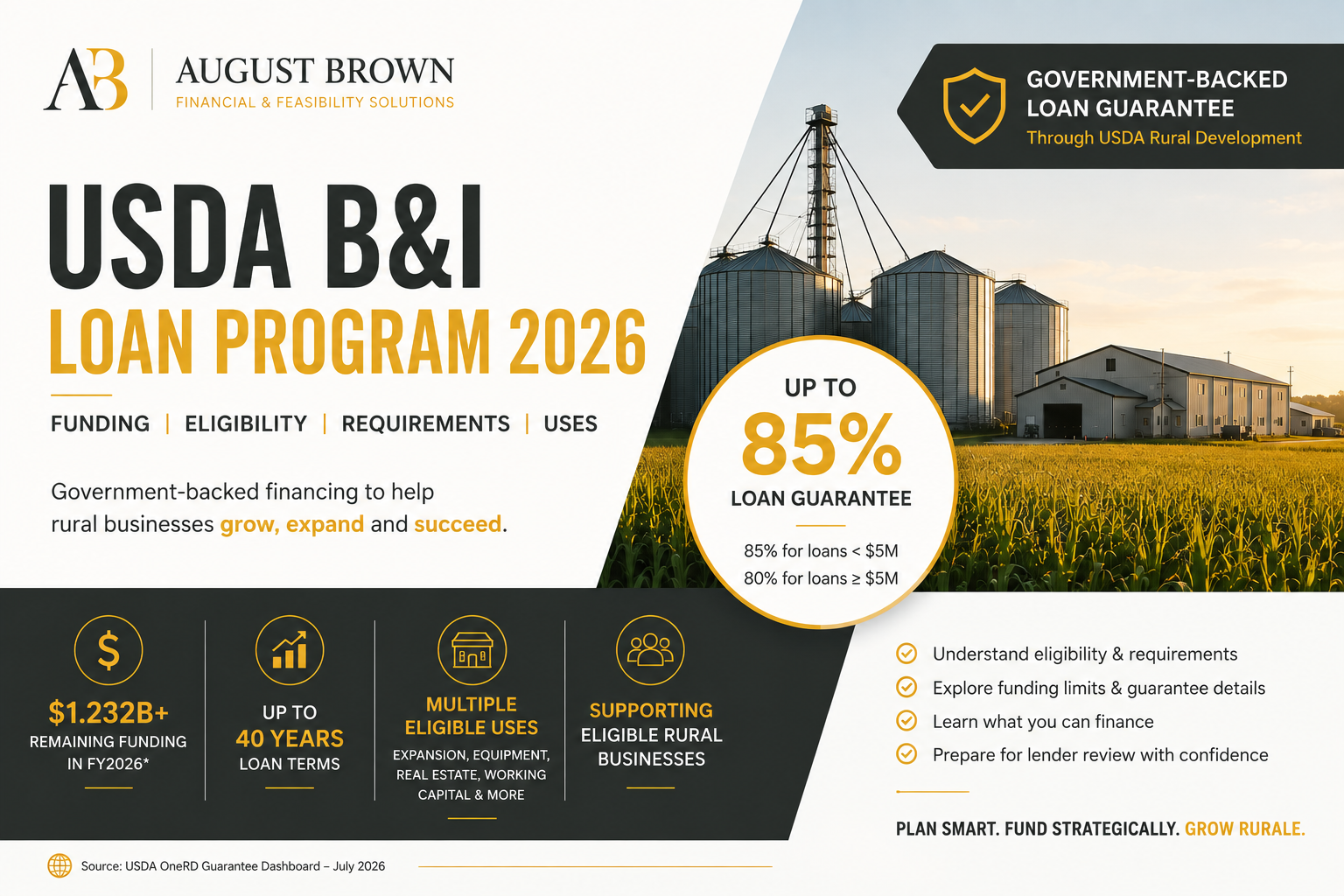
USDA B&I financing: funding, eligibility, loan requirements, and more.

USDA B&I Loan Program 2026: Funding & Eligibility

Quick Answer: The USDA Business & Industry Guaranteed Loan Program provides a loan guarantee that helps eligible rural businesses access financing through a commercial lender. In FY2026, USDA provides an 85% guarantee for applications requesting less than $5 million and an 80% guarantee for applications requesting $5 million or more. The program can support business expansion, working capital, equipment financing, real estate acquisition, and other eligible capital investments. Businesses seeking USDA B&I financing should be prepared to demonstrate eligibility, repayment capacity, and overall project viability through appropriate financial and market analysis.

Introduction

Access to capital can determine whether a rural business can expand, modernize, acquire equipment, or bring a new project to market. The USDA Rural Development offers several programs designed to improve access to capital and support economic development in rural communities.

Among them, the Business & Industry Guaranteed Loan Program is particularly relevant for businesses seeking larger-scale financing. Rather than lending directly in most cases, USDA provides a B&I loan guarantee to support financing arranged through participating lenders.

For businesses considering expansion or a major capital investment, the opportunity is significant. However, eligibility alone does not guarantee financing. A lender will also evaluate the project’s financial strength, market opportunity, repayment capacity, and overall viability.

This is where proper preparation, including financial feasibility and market feasibility, becomes critical.

What Is the USDA Business & Industry Guaranteed Loan Program?

The Business & Industry Guaranteed Loan Program is a USDA Rural Development program designed to increase access to business capital in eligible rural areas. USDA describes B&I as its flagship business program for improving rural economic health through loan guarantees that enable commercial lenders to provide financing to rural businesses. [USDA B&I Official Program Page]

The program can support eligible businesses seeking financing for expansion, modernization, acquisition, equipment, real estate, working capital, and other approved purposes.

The key point is that the USDA guarantee supports the lender. The borrower still receives financing from a participating financial institution and remains responsible for repaying the loan.

How Does USDA B&I Financing Work?

USDA B&I financing generally involves three parties: the business, the commercial lender, and USDA Rural Development.

The business approaches a lender with its proposed project and financing requirements. The lender evaluates the application and determines whether it is willing to provide financing under the USDA guarantee structure. USDA then provides the applicable loan guarantee to the lender, subject to program requirements.

This structure can make rural business financing more accessible for qualifying projects while maintaining traditional lender underwriting and repayment requirements.

For businesses unsure about the right financing structure, professional government funding solutions can help evaluate the project before significant resources are committed.

How Much Can You Borrow Through USDA B&I Financing in 2026?

USDA’s FY2026 B&I program has significant funding capacity. The USDA OneRD Guarantee page currently reports approximately $2.093 billion in total B&I funding, with about $861.1 million obligated and $1.232 billion remaining.

For FY2026, applications requesting less than $5 million receive an 85% guarantee, while applications requesting $5 million or more receive an 80% guarantee. USDA also states that guaranteed loan terms cannot exceed 40 years, with the specific term determined according to the project, assets being financed, collateral, and repayment ability. [USDA B&I Official Program Page]

These figures make USDA B&I financing an important option for businesses evaluating substantial capital requirements in eligible rural areas.

What Can USDA B&I Loans Be Used For?

One of the program’s major advantages is the range of eligible project uses. Depending on program requirements, USDA B&I financing can support projects involving:

  • Business expansion and modernization
  • Equipment financing and machinery
  • Working capital
  • Real estate acquisition
  • Construction and improvements
  • Acquisition of businesses
  • Certain refinancing and other eligible purposes

The exact eligibility of a project depends on USDA requirements and lender review, so businesses should verify their proposed use before proceeding. [USDA B&I Official Program Page]

For projects involving substantial capital investment, understanding the funding requirements before approaching a lender can prevent costly delays.

Who Is Eligible for a USDA B&I Loan?

Eligibility depends on both the borrower and the proposed project. In general, the program is designed to support an eligible rural business and projects that contribute to economic development in rural communities.

USDA Rural Development Business Programs provide financial assistance to businesses, cooperatives, nonprofits, public bodies, and other eligible entities through various programs.

For B&I specifically, businesses must also satisfy program-specific requirements concerning location, ownership, project purpose, creditworthiness, collateral, and repayment ability.

A business should therefore evaluate both its own eligibility and the eligibility of the proposed project before investing significant time in an application.

What Are the USDA B&I Loan Requirements?

Meeting basic eligibility requirements is only one part of the process. A lender will typically examine the strength of the business, the proposed project, financial projections, available equity, collateral, and repayment capacity.

This is where lender underwriting becomes important. The lender needs sufficient evidence that the proposed project can generate the cash flow required to service the debt.

Documentation and analysis may include financial statements, projections, market research, project costs, management information, and feasibility analysis.

For complex projects, a professional feasibility analysis can help identify financial risks, market assumptions, operational challenges, and other factors that may influence the lender’s decision.

Why Financial Feasibility Matters for USDA B&I Financing

A strong USDA application needs more than an attractive business concept. It needs evidence that the project is financially sustainable.

Financial feasibility examines factors such as projected revenue, operating costs, cash flow, investment requirements, debt obligations, and expected returns. It helps determine whether the business can realistically support the proposed financing and maintain sufficient repayment capacity.

For a lender, this analysis helps answer a fundamental question: can the project generate enough sustainable cash flow to repay the loan?

A well-developed financial feasibility analysis can therefore strengthen the overall assessment of project viability.

How Market Feasibility Supports a USDA B&I Loan Application

Financial projections are only as reliable as the market assumptions behind them. Market feasibility evaluates whether sufficient demand exists for the product or service and whether the proposed business can compete effectively.

This can involve analyzing market size, customer segments, competitors, industry conditions, pricing, demand trends, and geographic factors.

Businesses can use resources such as the Census Business Builder and official market research resources to gather relevant market information.

Combining market evidence with financial analysis gives lenders a more complete view of the project’s potential and risks.

USDA B&I Financing vs. Traditional Business Financing

USDA B&I financing differs from conventional financing primarily because of the USDA loan guarantee supporting the lender.

Factor USDA B&I Financing Traditional Financing
Government guarantee Yes Generally no
Lender involvement Yes Yes
Rural eligibility Required Usually broader
Repayment Required Required
Project requirements Program-specific Lender-specific
Feasibility requirements May apply Varies

USDA B&I financing can therefore be worth exploring when a qualifying rural project requires substantial capital and may benefit from a government-backed guarantee.

How to Prepare for USDA B&I Lender Underwriting

Preparation should begin before submitting an application. Businesses should have a clear understanding of their project costs, funding requirements, market opportunity, projected cash flow, and repayment capacity.

A strong preparation process may include:

  • Market feasibility analysis
  • Financial feasibility analysis
  • Detailed project budget
  • Revenue and expense projections
  • Sources and uses of funds
  • Management information
  • Supporting market and industry data
  • Documentation required by the lender and USDA

A professional feasibility analysis can help businesses identify weaknesses before they become issues during lender underwriting.

Common Mistakes Businesses Make When Seeking USDA B&I Financing

Businesses can weaken an otherwise viable application by:

  • Applying before establishing project viability
  • Using unsupported revenue assumptions
  • Underestimating project costs
  • Ignoring market competition
  • Failing to demonstrate repayment capacity
  • Treating the USDA guarantee like a grant
  • Approaching the financing process without understanding lender underwriting

The strongest applications connect the proposed investment, market opportunity, financial projections, and repayment strategy into one coherent business case.

Is USDA B&I Financing Right for Your Business?

USDA B&I financing may be worth exploring if your business:

  • Operates or plans to develop an eligible rural project
  • Requires financing for business expansion or capital investment
  • Has a clearly defined project
  • Can demonstrate repayment capacity
  • Has a credible market opportunity
  • Is prepared to work with a commercial lender
  • Can provide the financial and feasibility documentation required for review

If these conditions align with your project, the next step is to assess eligibility and determine whether the financing structure fits your objectives.

How August Brown Can Help With USDA B&I Financing

Understanding the USDA program is only the beginning. Businesses must also demonstrate that their proposed project is commercially, financially, and operationally viable.

August Brown helps businesses evaluate projects through financial feasibility, market feasibility, project analysis, and funding strategy. A structured feasibility process can help identify risks, validate assumptions, strengthen project documentation, and prepare businesses for discussions with lenders and funding agencies.

For businesses exploring USDA B&I financing, August Brown can help turn a proposed project into a more structured, evidence-based funding case.

Contact August Brown to discuss your project and explore the appropriate feasibility and funding strategy.

Frequently Asked Questions About USDA B&I Loans

What is a USDA B&I loan?

A USDA B&I loan is financing provided through a lender and supported by a USDA loan guarantee for eligible rural business projects. Learn more about the USDA B&I program.

Who qualifies for a USDA B&I loan?

Eligible borrowers and projects must satisfy USDA Rural Development program requirements, including applicable rural location, project, financial, and credit requirements.

How does the USDA B&I loan guarantee work?

USDA provides a guarantee to an eligible lender, reducing a portion of the lender’s risk while the borrower remains responsible for repaying the loan according to its terms.

What can USDA B&I financing be used for?

Eligible uses can include business expansion, working capital, equipment financing, real estate acquisition, construction, and other approved purposes.

Does a USDA B&I loan require a feasibility study?

Feasibility requirements can depend on the project and applicable USDA and lender requirements. Businesses should determine what analysis and documentation their specific project requires before applying.

What does a lender look for in a USDA B&I application?

A lender may evaluate the business’s financial position, market opportunity, project viability, collateral, management, and repayment capacity as part of its underwriting process.

business feasibility analysis

Business Feasibility Analysis : Definition, Why it Matter & Steps Explained

Before a new business or project moves from idea to execution, it needs proof that it can actually work. A business feasibility analysis provides that proof. It’s a structured assessment that evaluates whether an idea is realistic from a market, financial, and operational standpoint. In short, it helps decision-makers avoid investing time or capital into a concept that won’t perform as expected.

At August Brown, we’ve seen how an early feasibility study can change the way a project goes. This matters because the earlier you spot a showstopper, the less you’ll lose. Good feasibility work reduces risk, sharpens your ask for investors or lenders, and helps you choose the best version of the idea to pursue. In this blog we’ll walk you through what a feasibility analysis is, how it differs from a business plan, the core components (market, financial, technical, legal, and operational), a clear step-by-step process you can follow, and a short, realistic example you can relate to.

What Is a Business Feasibility Analysis?

A business feasibility study determines whether an idea or project can actually succeed in the market. It examines financial feasibility, market demand, operational capability, and compliance with regulatory requirements before a formal business plan is developed.

Distinguishing feasibility analysis from business planning is essential. The two fulfill distinct roles.  A feasibility analysis evaluates the worth of chasing an idea, whereas a business strategy details how it will be implemented. A feasibility study in a business plan evaluates whether the concept is achievable and likely to generate profits prior to moving forward

The outcome is a clear recommendation: proceed, modify, or pause. For lenders, grant reviewers, and investors, this analysis provides confidence that key assumptions have been tested and financial risks have been evaluated objectively.

Why Business Feasibility Analysis Matters

A strong feasibility study helps business owners and project developers make confident, data-driven decisions. It minimizes uncertainty, sharpens focus, and often determines whether an idea moves forward or stays on the drawing board.

  • Reduces risk
    A thorough analysis exposes potential roadblocks early, from underestimated costs to weak demand or supply constraints, allowing teams to adjust their strategy before major investments are made.
  • Strengthens funding and grant applications
    Lenders and grant agencies, including USDA, SBA, and EDA programs, rely on feasibility reports to assess financial soundness. A detailed study signals credibility, financial discipline, and readiness to execute.
  • Improves strategic clarity
    By identifying what works and what doesn’t, the analysis guides where to invest, where to scale back, and how to sequence implementation for best results.
  • Supports compliance and long-term sustainability
    Well-documented feasibility findings also help businesses stay aligned with ongoing reporting or audit requirements, strengthening relationships with funders and regulators

In practice, a well-prepared feasibility report isn’t just a document, it’s a foundation for smarter business planning.

Structured Step-by-Step Process of Conducting a Business Feasibility Analysis

A structured process helps ensure no key area is overlooked.

  1. Define the scope and objectives
    Clarify what’s being evaluated, for example, a new product line, a regional expansion, or a site investment, and identify the decision criteria for moving forward.
  2. Conduct preliminary research
    Review high-level data such as market size, trends, and regulatory considerations to spot any obvious challenges early.
  3. Perform detailed market analysis
    Gather primary and secondary data on target customers, competitors, and pricing. The findings form the basis for sales forecasts and marketing strategy.
  4. Build financial projections and run cost-benefit analysis
    Estimate startup and operating costs, revenue, margins, and cash flow. Use multiple scenarios to show how outcomes shift under different assumptions.
  5. Assess technical and operational feasibility
    Evaluate whether the necessary facilities, technology, and workforce are accessible. Capacity utilization and supply chain reliability often determine whether the plan is realistic.
  6. Prepare the feasibility report and recommendation
    Compile the findings into a clear report summarizing the evidence, assumptions, and recommendation; go, modify, or stop.

Including a business feasibility analysis example in the final report helps stakeholders quickly understand how the findings translate into action.

Other Key Components of a Feasibility Analysis

A comprehensive feasibility analysis covers several dimensions of viability. Each provides insight into whether the project can move forward with confidence.

1. Market Feasibility

Examines demand, competition, and customer segments. The goal is to confirm there’s sufficient market need and to define realistic sales or adoption expectations. This section may include surveys, competitor analysis, and pricing research.

2. Technical Feasibility

Assesses whether the required systems, technologies, and infrastructure are in place or attainable. It reviews production methods, supply chain reliability, and access to necessary resources.

3. Financial Feasibility

Determines if the numbers work. This section estimates capital requirements, operating costs, break-even timelines, and profit potential. It also includes ROI projections and a cost-benefit analysis to measure expected returns against investment.

4. Organizational / Operational Feasibility

Looks at internal readiness, management capability, staffing, logistics, and workflow design. It helps identify operational gaps and determine whether the organization can support the new initiative effectively.

5. Legal / Regulatory Feasibility

Confirms that the business or project can operate within local, state, and federal regulations. This may include environmental permits, licensing, or compliance with specific industry standards.

Summary Table:

Component

Focus

Key Outcomes

Market

Demand and competition Customer base, market potential

Technical

Delivery capacity

Equipment, technology, logistics

Financial

Profitability

ROI, break-even, funding needs

Operational

Internal capability

Staffing, structure, supply chain

Legal Compliance

Permits, certifications, regulations

Using Feasibility Analysis for Funding and Grant Applications

Financial institutions and grant agencies often rely on feasibility reports to evaluate project viability. These reports demonstrate that the applicant has performed due diligence, understands the market, and can manage financial and operational risks.

In programs such as those offered by the USDA or SBA, a comprehensive feasibility report, including technical, financial, and operational sections, is typically required. Independent, third-party analysis from firms like August Brown also adds credibility, giving underwriters and grant reviewers confidence in the project’s assumptions.

For a closer look at USDA feasibility costs and requirements, see our blog: How Much Does a USDA Feasibility Study Cost in 2025?

Common Mistakes in Business Feasibility Analysis

Some of the most frequent issues we encounter include:

  • Incomplete or overly optimistic data that paints an unrealistic picture of demand or costs.
  • Lack of sensitivity testing on financial models, leaving decision-makers unprepared for changes in key assumptions.
  • Overlooking competitive threats or substitute products that can limit market share.
  • Ignoring operational or regulatory constraints that later delay approvals or increase expenses.

Even small oversights in these areas can undermine the credibility of a feasibility report. Avoiding these pitfalls often marks the difference between a well-supported investment decision and a costly, avoidable setback.

Business Feasibility Analysis Example

Consider a regional food processing venture evaluating expansion. The market study confirmed strong demand and interest from buyers, but also revealed that specialized equipment and cold storage costs were higher than expected.

The financial analysis showed that 60% capacity utilization in the first year could generate positive cash flow only with bridge financing. The recommendation was to launch a smaller pilot facility first, track performance, and reassess after six months. This business feasibility analysis example demonstrates how data-driven adjustments can strengthen project outcomes.

Other Key Components of a Feasibility Analysis

A comprehensive feasibility analysis covers several dimensions of viability. Each provides insight into whether the project can move forward with confidence.

1. Market Feasibility

Examines demand, competition, and customer segments. The goal is to confirm there’s sufficient market need and to define realistic sales or adoption expectations. This section may include surveys, competitor analysis, and pricing research.

2. Technical Feasibility

Assesses whether the required systems, technologies, and infrastructure are in place or attainable. It reviews production methods, supply chain reliability, and access to necessary resources.

3. Financial Feasibility

Determines if the numbers work. This section estimates capital requirements, operating costs, break-even timelines, and profit potential. It also includes ROI projections and a cost-benefit analysis to measure expected returns against investment.

4. Organizational / Operational Feasibility

Looks at internal readiness, management capability, staffing, logistics, and workflow design. It helps identify operational gaps and determine whether the organization can support the new initiative effectively.

5. Legal / Regulatory Feasibility

Confirms that the business or project can operate within local, state, and federal regulations. This may include environmental permits, licensing, or compliance with specific industry standards.


Summary Table:

Component

Focus

Key Outcomes

Market

Demand and competition

Customer base, market potential

Technical

Delivery capacity

Equipment, technology, logistics

Financial

Profitability

ROI, break-even, funding needs

Operational

Internal capability

Staffing, structure, supply chain

Legal

Compliance

Permits, certifications, regulations

Conclusion

A feasibility analysis doesn’t just assess whether a business idea can work, it builds the foundation for confident, evidence-based decision-making. It helps organizations allocate capital wisely, prepare stronger funding applications, and avoid preventable setbacks.

At August Brown, we help businesses and public entities conduct feasibility studies that meet USDA, SBA, and private lender standards. Our team combines technical, financial, and operational expertise to produce clear, defensible reports that drive better outcomes.

To discuss your project or request a custom feasibility analysis, contact our team. We’re here to help you move from concept to execution with confidence.

FAQs (Frequently Asked Questions)

1. What is a business feasibility analysis?

A business feasibility analysis is a study that helps determine if a business idea or project can succeed. It looks at factors like market demand, financial costs, and operational readiness to decide whether the idea is practical and profitable.

2. Why is business feasibility analysis important?

It helps reduce the risk of failure by identifying potential problems early. Through market and financial feasibility, it ensures your business idea is realistic, fundable, and aligned with your resources and goals.

3. What are the key components of a feasibility analysis?

The main components include market feasibility, technical feasibility, financial feasibility, operational feasibility, and legal or regulatory feasibility. Each component assesses a different aspect of business viability before you invest time or money.

4. How is a business feasibility analysis different from a business plan?

A feasibility analysis is done before creating a business plan to see if the idea is worth pursuing. A business plan, on the other hand, explains how the business will operate once the idea has been proven feasible.

5. Who needs to conduct a business feasibility analysis?

Entrepreneurs, investors, lenders, and project developers often conduct a business feasibility analysis. It’s especially important when applying for funding, grants, or USDA/SBA loans, as it demonstrates the project’s financial and operational viability.

6. What are the benefits of conducting a business feasibility analysis?

It helps identify strengths, weaknesses, and potential challenges before launching a project. The process saves time, reduces financial risk, and increases your chances of success by validating your idea early.

Growing a Materials Company: Lessons from 30+ Years

How to Take A Materials Company to the Next Level

What does it take to start and grow a successful materials company? August Brown sat down for an interview with the CEO of Semplastics, Mr. William (Bill) Easter to learn the insights that have guided his success over the years. Bill is a self-described “Bell Labs refugee” with over 30 years of experience in industry and over 56 U.S. patents. Yes, 56 U.S. patents! Bill has led Semplastics, a supplier of precision plastic engineered components for the semiconductor, medical, aerospace, and oil & gas industries since 2000. Bill’s unquenchable passion for materials led him to found X-MAT in 2011. X-MAT has developed an array of high performing polymer derived ceramic composite materials that have successfully been applied as building materials, anodic battery materials and light weight mirror backing for advanced mirrors and LIDAR support applications. X-MAT has won over $8M in federal contracts.

While the context of the conversation focused on his materials businesses, it’s clear that the principles that he espouses can be applied to any business, particularly those in the manufacturing, industrials goods and chemicals sectors. Here is an excerpt from the conversation.

What are the trends that are occurring across the materials sector?

New materials developments are moving towards lighter weight materials that take less energy to produce and provide higher performance. More and more collaborations are occurring in the materials industries as companies are beginning to strategize around maximizing their resources due to the pandemic.

What makes materials businesses different than other businesses?

The timeline for a materials business is longer than most businesses. As a materials business, you must be an ultra-marathoner. It requires more patience and owners must be willing to play the long game. You must be willing to go after government contracts for new developments. Finally, materials companies should seek to connect with local universities in order to leverage their analytical resources and their safety equipment (ie fume hoods).

What are the best lessons that you have learned?

The integrity of the people you work with are more important than the contracts you sign. It is vitally important to identify people of high integrity to work with. You must believe in the pit or the hunch in your stomach. Go with your gut.

You can receive the full transcript of the interview by contacting our office. To stay abreast of our latest news and receive more helpful tips, subscribe to our blog. To help businesses through the current COVID-19 crisis, we are extending the 30-min free strategy session with August Brown to 1-hr. You can select a time here.

Copyright 2020 August Brown, LLC