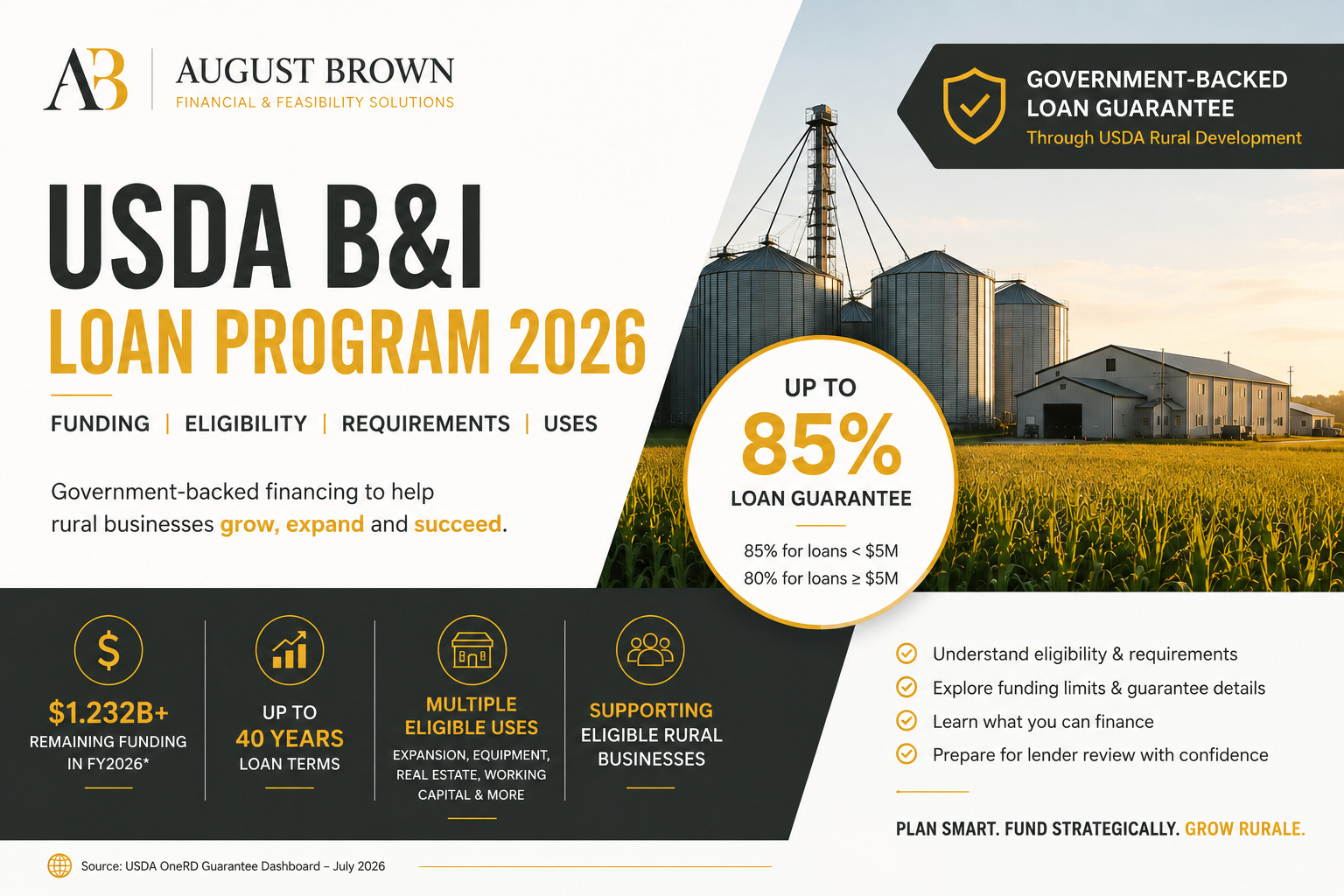
Quick Answer: The USDA Business & Industry Guaranteed Loan Program provides a loan guarantee that helps eligible rural businesses access financing through a commercial lender. In FY2026, USDA provides an 85% guarantee for applications requesting less than $5 million and an 80% guarantee for applications requesting $5 million or more. The program can support business expansion, working capital, equipment financing, real estate acquisition, and other eligible capital investments. Businesses seeking USDA B&I financing should be prepared to demonstrate eligibility, repayment capacity, and overall project viability through appropriate financial and market analysis.
Introduction
Access to capital can determine whether a rural business can expand, modernize, acquire equipment, or bring a new project to market. The USDA Rural Development offers several programs designed to improve access to capital and support economic development in rural communities.
Among them, the Business & Industry Guaranteed Loan Program is particularly relevant for businesses seeking larger-scale financing. Rather than lending directly in most cases, USDA provides a B&I loan guarantee to support financing arranged through participating lenders.
For businesses considering expansion or a major capital investment, the opportunity is significant. However, eligibility alone does not guarantee financing. A lender will also evaluate the project’s financial strength, market opportunity, repayment capacity, and overall viability.
This is where proper preparation, including financial feasibility and market feasibility, becomes critical.
What Is the USDA Business & Industry Guaranteed Loan Program?
The Business & Industry Guaranteed Loan Program is a USDA Rural Development program designed to increase access to business capital in eligible rural areas. USDA describes B&I as its flagship business program for improving rural economic health through loan guarantees that enable commercial lenders to provide financing to rural businesses. [USDA B&I Official Program Page]
The program can support eligible businesses seeking financing for expansion, modernization, acquisition, equipment, real estate, working capital, and other approved purposes.
The key point is that the USDA guarantee supports the lender. The borrower still receives financing from a participating financial institution and remains responsible for repaying the loan.
How Does USDA B&I Financing Work?
USDA B&I financing generally involves three parties: the business, the commercial lender, and USDA Rural Development.
The business approaches a lender with its proposed project and financing requirements. The lender evaluates the application and determines whether it is willing to provide financing under the USDA guarantee structure. USDA then provides the applicable loan guarantee to the lender, subject to program requirements.
This structure can make rural business financing more accessible for qualifying projects while maintaining traditional lender underwriting and repayment requirements.
For businesses unsure about the right financing structure, professional government funding solutions can help evaluate the project before significant resources are committed.
How Much Can You Borrow Through USDA B&I Financing in 2026?
USDA’s FY2026 B&I program has significant funding capacity. The USDA OneRD Guarantee page currently reports approximately $2.093 billion in total B&I funding, with about $861.1 million obligated and $1.232 billion remaining.
For FY2026, applications requesting less than $5 million receive an 85% guarantee, while applications requesting $5 million or more receive an 80% guarantee. USDA also states that guaranteed loan terms cannot exceed 40 years, with the specific term determined according to the project, assets being financed, collateral, and repayment ability. [USDA B&I Official Program Page]
These figures make USDA B&I financing an important option for businesses evaluating substantial capital requirements in eligible rural areas.
What Can USDA B&I Loans Be Used For?
One of the program’s major advantages is the range of eligible project uses. Depending on program requirements, USDA B&I financing can support projects involving:
- Business expansion and modernization
- Equipment financing and machinery
- Working capital
- Real estate acquisition
- Construction and improvements
- Acquisition of businesses
- Certain refinancing and other eligible purposes
The exact eligibility of a project depends on USDA requirements and lender review, so businesses should verify their proposed use before proceeding. [USDA B&I Official Program Page]
For projects involving substantial capital investment, understanding the funding requirements before approaching a lender can prevent costly delays.
Who Is Eligible for a USDA B&I Loan?
Eligibility depends on both the borrower and the proposed project. In general, the program is designed to support an eligible rural business and projects that contribute to economic development in rural communities.
USDA Rural Development Business Programs provide financial assistance to businesses, cooperatives, nonprofits, public bodies, and other eligible entities through various programs.
For B&I specifically, businesses must also satisfy program-specific requirements concerning location, ownership, project purpose, creditworthiness, collateral, and repayment ability.
A business should therefore evaluate both its own eligibility and the eligibility of the proposed project before investing significant time in an application.
What Are the USDA B&I Loan Requirements?
Meeting basic eligibility requirements is only one part of the process. A lender will typically examine the strength of the business, the proposed project, financial projections, available equity, collateral, and repayment capacity.
This is where lender underwriting becomes important. The lender needs sufficient evidence that the proposed project can generate the cash flow required to service the debt.
Documentation and analysis may include financial statements, projections, market research, project costs, management information, and feasibility analysis.
For complex projects, a professional feasibility analysis can help identify financial risks, market assumptions, operational challenges, and other factors that may influence the lender’s decision.
Why Financial Feasibility Matters for USDA B&I Financing
A strong USDA application needs more than an attractive business concept. It needs evidence that the project is financially sustainable.
Financial feasibility examines factors such as projected revenue, operating costs, cash flow, investment requirements, debt obligations, and expected returns. It helps determine whether the business can realistically support the proposed financing and maintain sufficient repayment capacity.
For a lender, this analysis helps answer a fundamental question: can the project generate enough sustainable cash flow to repay the loan?
A well-developed financial feasibility analysis can therefore strengthen the overall assessment of project viability.
How Market Feasibility Supports a USDA B&I Loan Application
Financial projections are only as reliable as the market assumptions behind them. Market feasibility evaluates whether sufficient demand exists for the product or service and whether the proposed business can compete effectively.
This can involve analyzing market size, customer segments, competitors, industry conditions, pricing, demand trends, and geographic factors.
Businesses can use resources such as the Census Business Builder and official market research resources to gather relevant market information.
Combining market evidence with financial analysis gives lenders a more complete view of the project’s potential and risks.
USDA B&I Financing vs. Traditional Business Financing
USDA B&I financing differs from conventional financing primarily because of the USDA loan guarantee supporting the lender.
| Factor | USDA B&I Financing | Traditional Financing |
|---|---|---|
| Government guarantee | Yes | Generally no |
| Lender involvement | Yes | Yes |
| Rural eligibility | Required | Usually broader |
| Repayment | Required | Required |
| Project requirements | Program-specific | Lender-specific |
| Feasibility requirements | May apply | Varies |
USDA B&I financing can therefore be worth exploring when a qualifying rural project requires substantial capital and may benefit from a government-backed guarantee.
How to Prepare for USDA B&I Lender Underwriting
Preparation should begin before submitting an application. Businesses should have a clear understanding of their project costs, funding requirements, market opportunity, projected cash flow, and repayment capacity.
A strong preparation process may include:
- Market feasibility analysis
- Financial feasibility analysis
- Detailed project budget
- Revenue and expense projections
- Sources and uses of funds
- Management information
- Supporting market and industry data
- Documentation required by the lender and USDA
A professional feasibility analysis can help businesses identify weaknesses before they become issues during lender underwriting.
Common Mistakes Businesses Make When Seeking USDA B&I Financing
Businesses can weaken an otherwise viable application by:
- Applying before establishing project viability
- Using unsupported revenue assumptions
- Underestimating project costs
- Ignoring market competition
- Failing to demonstrate repayment capacity
- Treating the USDA guarantee like a grant
- Approaching the financing process without understanding lender underwriting
The strongest applications connect the proposed investment, market opportunity, financial projections, and repayment strategy into one coherent business case.
Is USDA B&I Financing Right for Your Business?
USDA B&I financing may be worth exploring if your business:
- Operates or plans to develop an eligible rural project
- Requires financing for business expansion or capital investment
- Has a clearly defined project
- Can demonstrate repayment capacity
- Has a credible market opportunity
- Is prepared to work with a commercial lender
- Can provide the financial and feasibility documentation required for review
If these conditions align with your project, the next step is to assess eligibility and determine whether the financing structure fits your objectives.
How August Brown Can Help With USDA B&I Financing
Understanding the USDA program is only the beginning. Businesses must also demonstrate that their proposed project is commercially, financially, and operationally viable.
August Brown helps businesses evaluate projects through financial feasibility, market feasibility, project analysis, and funding strategy. A structured feasibility process can help identify risks, validate assumptions, strengthen project documentation, and prepare businesses for discussions with lenders and funding agencies.
For businesses exploring USDA B&I financing, August Brown can help turn a proposed project into a more structured, evidence-based funding case.
Contact August Brown to discuss your project and explore the appropriate feasibility and funding strategy.
Frequently Asked Questions About USDA B&I Loans
What is a USDA B&I loan?
A USDA B&I loan is financing provided through a lender and supported by a USDA loan guarantee for eligible rural business projects. Learn more about the USDA B&I program.
Who qualifies for a USDA B&I loan?
Eligible borrowers and projects must satisfy USDA Rural Development program requirements, including applicable rural location, project, financial, and credit requirements.
How does the USDA B&I loan guarantee work?
USDA provides a guarantee to an eligible lender, reducing a portion of the lender’s risk while the borrower remains responsible for repaying the loan according to its terms.
What can USDA B&I financing be used for?
Eligible uses can include business expansion, working capital, equipment financing, real estate acquisition, construction, and other approved purposes.
Does a USDA B&I loan require a feasibility study?
Feasibility requirements can depend on the project and applicable USDA and lender requirements. Businesses should determine what analysis and documentation their specific project requires before applying.
What does a lender look for in a USDA B&I application?
A lender may evaluate the business’s financial position, market opportunity, project viability, collateral, management, and repayment capacity as part of its underwriting process.