Key Insights for 2026 Rural Funding
- REAP Dominance: The Rural Energy for America Program (REAP) continues to offer up to 50% grant coverage for energy efficiency and solar projects in 2026.
- New Restrictions: Ground-mounted solar projects exceeding 50kW now face higher scrutiny and deprioritization.
- Infrastructure Shift: Recent federal focus has shifted toward “climate-smart” agriculture and domestic supply chain resilience.
- Indirect Access: Programs like the USDA RBDG are awarded to nonprofits and public bodies to benefit small businesses, rather than direct cash to individuals.
- Digital Prep: An active SAM.gov registration and Unique Entity Identifier (UEI) are mandatory and take 2–4 weeks to process.
Introduction: The Rural Growth Engine
For many entrepreneurs, the path to scaling an agricultural or rural operation is paved with USDA grants for rural businesses. In 2026, the landscape for rural business funding has evolved, with a heavy emphasis on sustainability and energy independence.
USDA business grants are not just “free money”—they are strategic partnerships designed to keep rural economies competitive. Whether you are looking to lower your utility bills with solar or need technical assistance to launch a new product, understanding the USDA grant programs available this year is the first step toward long-term viability.
What Are USDA Business Grants?
USDA business grants are financial awards from the U.S. Department of Agriculture that do not require repayment (unlike loans). Most of these programs are managed by USDA Rural Development (RD), a mission area specifically dedicated to improving the economy and quality of life in rural America.
USDA Grants vs. Loans: A Consultant’s View
| Feature | USDA Grants | USDA Guaranteed Loans |
| Repayment | $0 (No repayment required) | Must be repaid with interest |
| Availability | Highly competitive; specific windows | Available year-round; higher volume |
| Best For | Innovation, energy, and planning | Large-scale construction and real estate |
| Funding Cap | Usually capped (e.g., $500k–$1M) | Can exceed $25 million (B&I Loans) |
Types of USDA Grants for Rural Businesses
The USDA categorizes its support into three main buckets to address different business needs:
- Business Development Grants: Focus on training, USDA grant feasibility studies, and market expansion.
- Energy & Renewable Grants: Help businesses lower operating costs through solar, wind, or HVAC upgrades.
- Rural Infrastructure Grants: Target water, waste disposal, and high-speed internet in rural communities.
By identifying which bucket your project falls into, you can narrow down the USDA rural business grants that match your goals.
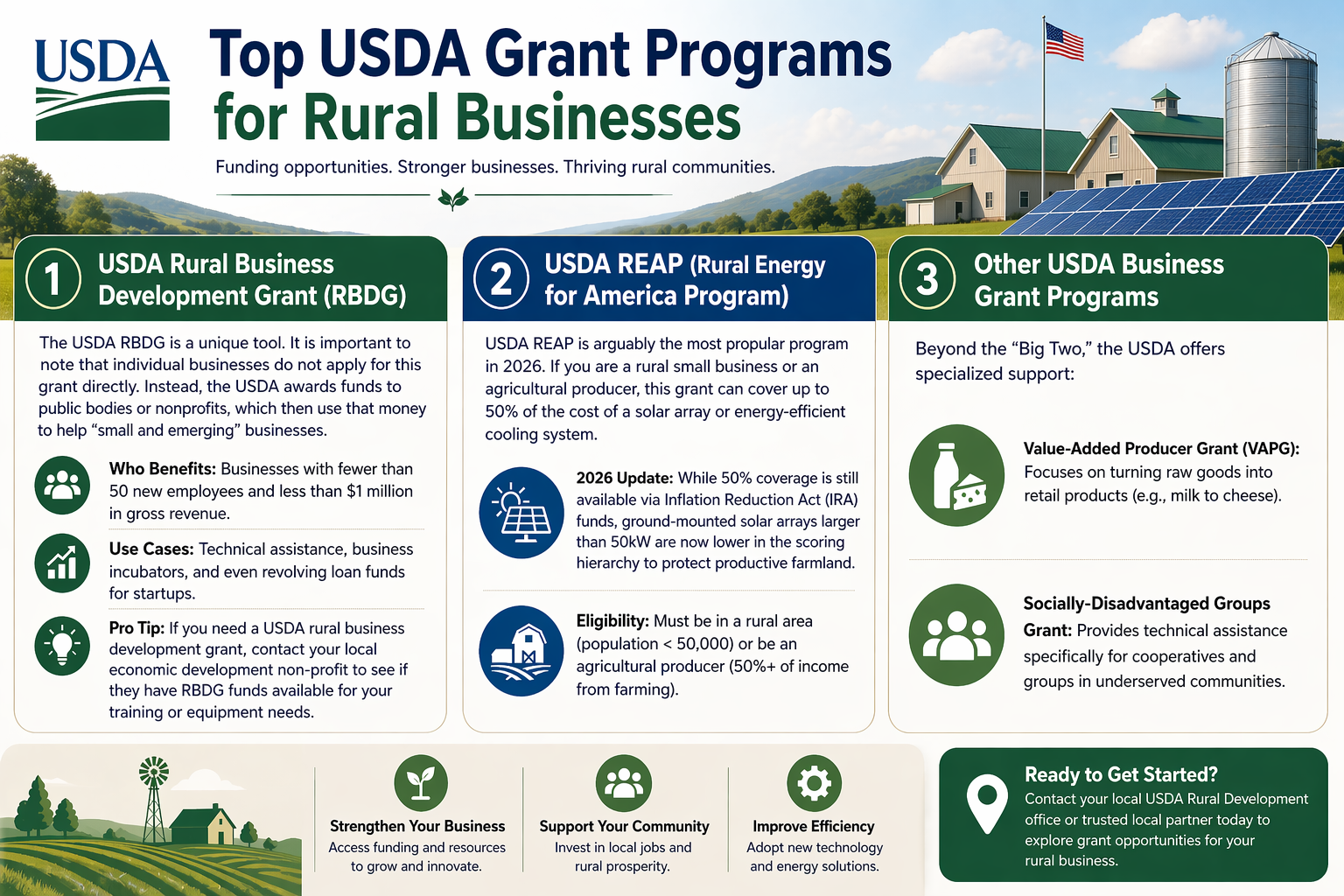
Top USDA Grant Programs for Rural Businesses
1. USDA Rural Business Development Grant (RBDG)
The USDA RBDG is a unique tool. It is important to note that individual businesses do not apply for this grant directly. Instead, the USDA awards funds to public bodies or nonprofits, which then use that money to help “small and emerging” businesses.
- Who Benefits: Businesses with fewer than 50 new employees and less than $1 million in gross revenue.
- Use Cases: Technical assistance, business incubators, and even revolving loan funds for startups.
- Pro Tip: If you need a USDA rural business development grant, contact your local economic development non-profit to see if they have RBDG funds available for your training or equipment needs.
2. USDA REAP (Rural Energy for America Program)
USDA REAP is arguably the most popular program in 2026. If you are a rural small business or an agricultural producer, this grant can cover up to 50% of the cost of a solar array or energy-efficient cooling system.
- 2026 Update: While 50% coverage is still available via Inflation Reduction Act (IRA) funds, ground-mounted solar arrays larger than 50kW are now lower in the scoring hierarchy to protect productive farmland.
- Eligibility: Must be in a rural area (population < 50,000) or be an agricultural producer (50%+ of income from farming).
3. Other USDA Business Grant Programs
Beyond the “Big Two,” the USDA offers specialized support:
- Value-Added Producer Grant (VAPG): Focuses on turning raw goods into retail products (e.g., milk to cheese). Read our complete guide to the USDA VAPG for a deep dive into this program.
- Socially-Disadvantaged Groups Grant: Provides technical assistance specifically for cooperatives and groups in underserved communities.
Eligibility Criteria for USDA Rural Business Grants
To secure USDA business grants, your project must meet strict “Rural” and “Small Business” definitions
- Rural Location: Most programs require the project to be in an area with a population of less than 50,000. You can check your specific address on the USDA Eligibility Map.
- Citizen Status: You must be a U.S. citizen or a qualified alien.
- For-Profit vs. Non-Profit: While REAP is for-profit, RBDG is for public entities. Ensure your business structure aligns with the program rules.
How to Apply for USDA Grants (Step-by-Step)
Capturing rural business funding requires a methodical approach. Don’t rush the paperwork—the USDA is famous for its attention to detail.
- Step 1: Identify the Program. Don’t try to fit a “square” project into a “round” grant window.
- Step 2: Get Your UEI. Register at SAM.gov. This is a non-negotiable first step.
- Step 3: Contact your State Office. Before writing, call your USDA State Energy Coordinator. They are often willing to review a “concept paper.”
- Step 4: Build Your Narrative. Explain how the grant creates jobs or saves energy in your rural community.
- Step 5: Submit & Follow Up. Most applications are submitted through your local office or Grants.gov.
Tips to Increase Your Chances of Approval
Winning federal rural business grants is competitive. To stand out:
- Quantify Everything: Don’t say you’ll “create jobs”—say you’ll “create 4 full-time equivalent (FTE) positions.”
- Leverage Feasibility Studies: A professional analysis shows the USDA you’ve done the math.
- Start Early: SAM.gov registration issues are the #1 reason applications are late.
Common Mistakes to Avoid
- The “Double Dipping” Myth: You generally cannot use two different federal grants for the exact same dollar of a project.
- Incomplete Environmental Reviews: If your project involves construction, you must pass the USDA environmental review before you start work
- Ignoring the Match: Most USDA grants require a 1:1 match. Ensure your bank statements show you have the matching funds ready to go.
Conclusion
Navigating USDA grant programs in 2026 requires a blend of technical knowledge and strategic planning. Whether you’re looking to slash energy costs with REAP or expand your market through VAPG, these programs offer a transformative opportunity for rural entrepreneurs.
Ready to take the next step? Contact August Brown today for expert advisory support to help align your project with federal requirements and maximize your chances of approval.
Frequently Asked Questions (FAQs)
1. What is the most common USDA grant for small businesses?
The USDA REAP grant is the most common, as it applies to almost any rural small business (from grocery stores to manufacturers) looking to upgrade their energy systems.
2. Can I apply for a USDA grant if I live in a city?
Generally, no. The project itself must be located in a designated rural area (typically under 50,000 population). However, agricultural producers can sometimes qualify regardless of their home address if their production is rural.
3. How long does the USDA grant process take?
From submission to funding, expect a 6–9 month window. The scoring and ranking process takes time, and environmental reviews can add several weeks.
4. What is the difference between REAP and RBDG?
REAP provides direct grants to for-profit businesses for energy. RBDG provides grants to nonprofits and towns to help small businesses with training and equipment.
5. Do I have to pay taxes on USDA grants?
Yes, in most cases, federal grants are considered taxable income. Always consult with a tax professional regarding your specific award.