The USDA Value-Added Producer Grant (VAPG) is a federal funding program that helps agricultural producers create, process, and market value-added products. It supports farmers and rural businesses in increasing income by moving beyond raw production into higher-value activities such as processing, branding, and direct sales.
Key Takeaways
- Financial Support: The USDA Value-Added Producer Grant (VAPG) provides funding for value-added agriculture projects.
Provides up to $50,000 for Planning and $200,000 for Working Capital.
- Strategic Growth: Focuses on processing, marketing, and expanding existing agricultural products.
- Expertise Matters: A robust business plan and third-party feasibility study are often required for approval.
- Competitive Edge: Applications are scored on work plan quality, personnel qualifications, and commitment.
- Eligible applicants include farmers, producer groups, and cooperatives.
What Is the USDA Value-Added Producer Grant (VAPG)?
The USDA Value-Added Producer Grant program is designed to help agricultural producers increase the value of what they produce. Instead of selling raw products, businesses can use the grant to process, package, or market their products more effectively.
To qualify as “Value-Added“, the USDA looks for projects that meet one of five specific methodologies:
-
Change in Physical State: (e.g., turning berries into jam or wheat into flour).
-
Produced in a Manner that Enhances Value: (e.g., Organic or Grass-fed certifications).
-
Physical Segregation: (e.g., keeping non-GMO corn separate from standard corn).
-
Farmer-to-Consumer: (e.g., selling directly to local schools or through a CSA).
-
Locally-Produced Food: Locally-Produced Food: (e.g., marketing products within 400 miles or within the same state).
The program supports both planning activities (like market research) and working capital activities (like packaging and labor) related to these projects.
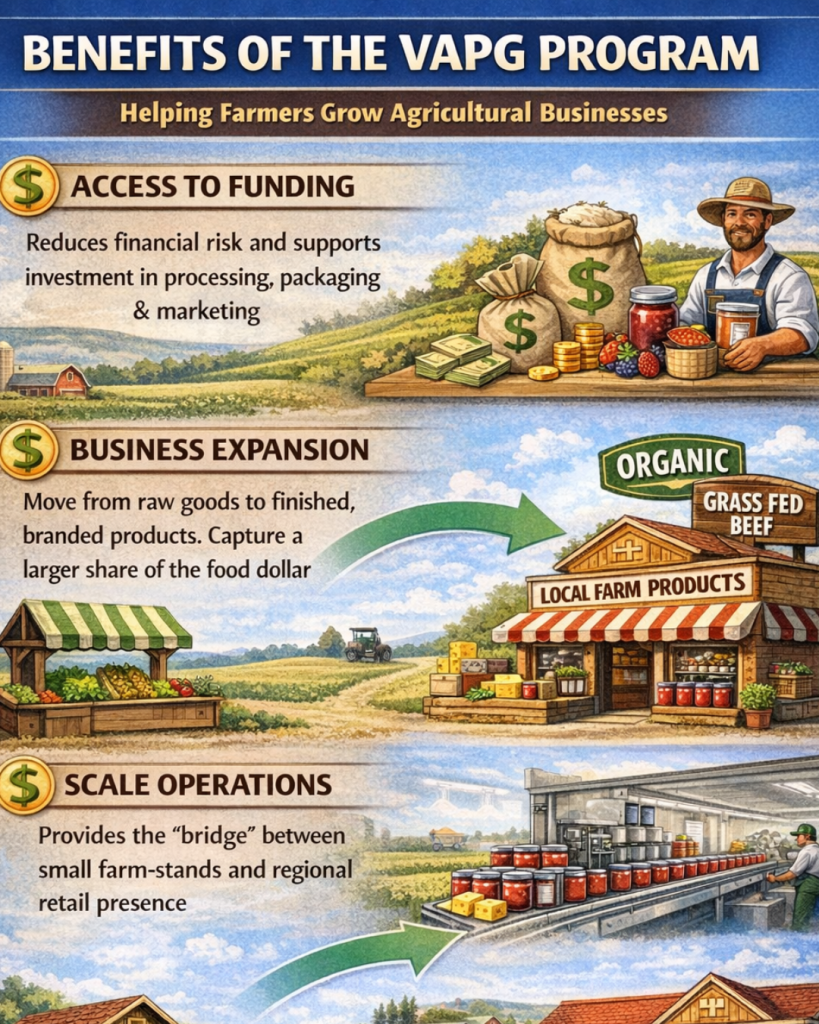
Benefits of the VAPG Program
The program provides practical support for businesses looking to grow. One of the main benefits is access to agricultural business funding, which reduces the financial risk of starting or expanding a value-added project. It allows producers to invest in processing, packaging, and marketing activities that increase product value.
Another key benefit is business expansion. Producers can move from selling raw goods to offering finished or branded products. This vertical integration allows the producer to capture a larger share of the food dollar, creating a more resilient business model against fluctuating commodity prices.
The grant also supports farm product processing, enabling businesses to scale operations. For many producers, this funding acts as the “bridge” between a small farm-stand operation and a regional retail presence.
USDA VAPG Eligibility Criteria
Understanding USDA VAPG eligibility is essential before applying. The program is open to several types of applicants. Eligible applicants include independent agricultural producers, farmer or rancher cooperatives, agricultural producer groups, and majority-controlled producer-based businesses.
To meet VAPG eligibility requirements, applicants must be actively involved in agricultural production and clearly show how their project adds value. Eligible activities must focus on value-added agriculture, such as processing, product development, marketing, or expanding into new markets.
Applicants must also provide a clear business plan, financial information, and a defined project scope. Applications that do not clearly explain how value is being added are often rejected.
How to Apply for USDA VAPG?
The value added producer grant application process requires careful planning.
First, confirm eligibility by reviewing the USDA VAPG eligibility criteria and ensuring your business qualifies. A VAPG Self-Assessment Survey is available to help determine your eligibility.
Second, prepare a detailed business plan. This should include your product, target market, financial projections, and how the grant will be used.
Third, gather all required documents such as financial statements, proof of agricultural activity, and project details.
Fourth, submit your VAPG Application through the USDA system before the deadline.
Fifth, follow up after submission by tracking your application and responding to any additional requests.
Applicants should also review official USDA Value Added Producer Grants resources to understand current requirements and real project outcomes.
Funding Details and Use Cases
The USDA VAPG grant provides funding for activities that support value addition. Grant amounts vary depending on the project type and scope.
Funding can be used for processing setup, marketing, branding, feasibility studies, and working capital related to value-added activities. These are common forms of agricultural business funding and farm product processing grants.
Typical use cases include setting up a food processing unit, launching a branded farm product, improving packaging, or expanding into new markets. The goal is always to increase the value of existing agricultural products.
Common Mistakes to Avoid
- Many applications fail due to avoidable issues. One common mistake is applying without meeting USDA VAPG eligibility requirements. This leads to immediate rejection.
- Another issue is a weak business plan. Applications without clear financials or market strategy are often not approved.
- Missing or incomplete documents in the VAPG application can also lead to disqualification.
- A major mistake is failing to clearly show value addition. If the project does not explain how the product becomes more valuable, it will not meet program criteria.
Real Examples of VAPG Grants
Looking at value added producer grant examples helps understand what works in practice.