The 2026 Energy Opportunity
Right now, the federal government is making one of the biggest pushes in history to help rural America cut energy costs and build energy independence. At the center of that effort is the USDA REAP Grant, the Rural Energy for America Program and if you haven’t looked into it yet, 2026 is the year to start.
The REAP program provides grants and loan guarantees to help agricultural producers and rural small businesses invest in renewable energy systems and make energy efficiency improvements. The funding has been significantly boosted in recent years, and USDA REAP grant eligibility 2026 is now broader and more accessible than ever before.
What makes this such a significant opportunity? Two things. First, REAP can cover up to 50% of your eligible project costs & that’s not a discount, that’s free money you never have to pay back. Second, the program is designed specifically for people who often don’t have access to the same capital markets as large corporations: farmers, ranchers, and small business owners in rural communities.
Whether you want to install solar panels on your barn, upgrade your facility’s HVAC system, add wind energy to your operation, or make other energy improvements, the USDA REAP Grant could be the funding vehicle that makes it happen. But the window is competitive, and the process has specific requirements. This guide walks you through everything you need to know.
Eligibility – Who Can Secure Funding?
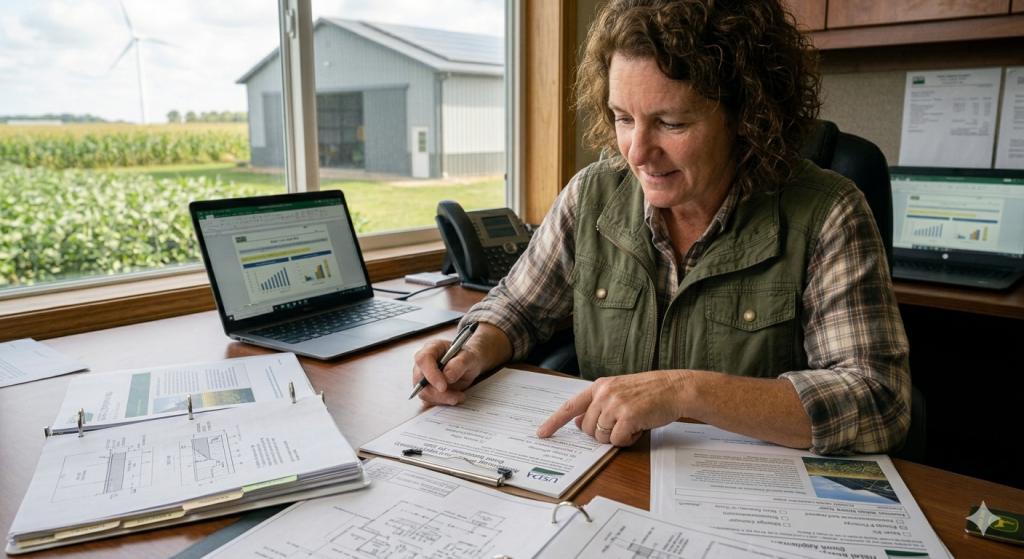
Before starting the usda reap grant application, the first step is to check if you qualify.
The program is open to two main groups:
- Agricultural producers: If you’re a farmer, rancher, or anyone who produces agricultural products, you fall into the agricultural producer category. The key rule here is income: at least 50% of your gross income must come from agricultural operations. That could mean crop production, livestock, aquaculture, or other related farming activities. Agricultural producers are eligible regardless of where their operation is located, you don’t need to be in a rural zone to qualify under this category. This is an important distinction. If you run a farm anywhere in the country and meet the income threshold, you’re in.
- Rural small businesses: The second category covers for-profit businesses that are located in rural areas. The USDA defines rural as any area with a population under 50,000, and that covers a large portion of the country. If your business operates in one of those communities, you may qualify for rural small business solar financing and broader energy upgrade funding through REAP. Unlike agricultural producers, rural small businesses must be located in an eligible rural area. The business also needs to be the primary applicant (not a lender, contractor, or third party)
Many business owners think REAP is only for farms, but that is not true. Rural businesses can qualify as long as they meet the location and size rules.
REAP Grant vs Guaranteed Loan
One of the most common questions is the difference between a grant and a loan. Understanding REAP grant vs guaranteed loan is important before planning a project.
| Feature | REAP Grant | REAP Guaranteed Loan |
| Type | Grant (no repayment) | Loan (must be repaid) |
| Coverage | Up to 50% of project cost | Up to 75% of project cost |
| Competition | High | Moderate |
| Can be combined | Yes | Yes |
| Project size | Small to large | Medium to very large |
Many successful projects use both.
For example:
- 50% grant
- 40% guaranteed loan
- 10% owner contribution
This allows businesses to complete large energy projects without paying the full cost upfront. Understanding the difference between REAP grant vs guaranteed loan helps applicants choose the right financing structure and improve their chances of approval.
The 33% Rule & Solar Technicalities
If you’re planning a solar energy project which is one of the most popular uses of REAP funding, there’s a critical technical rule you must understand before you size your system. Get this wrong, and your application can be disqualified before anyone even reads it.
What Is the 33% Rule in Solar Panels?
The 33% rule in solar panels refers to the REAP program’s limitation on how much energy a new renewable energy system can generate relative to your facility’s existing energy consumption. Specifically, the solar installation you propose can only generate up to 125% of your current energy needs as documented in your energy audit.
So where does the 33% rule come into play? In practical terms, it means REAP is designed to offset energy consumption, not to create a surplus generation operation. If your facility uses 100 kWh of electricity per month, your REAP-funded solar system cannot be sized to generate 300 kWh: it’s meant to serve the building, not function as a small power plant.
This rule matters most for rural small business solar financing projects where applicants try to oversize their systems to maximize the grant dollar amount. If your system size exceeds what’s allowed under this formula, the USDA will flag it immediately, and your application will not move forward.
Why This Is a Make-or-Break Requirement
The 33% rule exists to keep REAP focused on real energy cost reduction for the applicant, not on speculative energy production. The USDA wants to see that the system you’re proposing directly offsets your actual measured energy consumption and the only way to prove that is through a proper energy audit.
This is exactly why a professional energy assessment is not just recommended for many projects, it’s required. Without accurate baseline energy consumption data, you can’t correctly size the system, and you can’t prove to the USDA that your project meets this requirement.
Scoring Your Success: The Technical Merit Score
Here’s something many applicants don’t realize until it’s too late: REAP is a competitive program. The USDA doesn’t just hand out grants to everyone who applies and qualifies. Applications are ranked against each other using a scoring system, and the Technical Merit Score is the single most important factor in whether you get funded.
The technical merit score looks at:
- Project feasibility
- Energy savings accuracy
- Financial strength
- Environmental benefit
- Engineering quality
- Completeness of documents
Because the program is competitive, the Technical merit score (Critical for REAP approval) often decides whether the project gets funded. Two projects may both qualify, but the one with better documentation and stronger technical support will rank higher.
Projects with professional feasibility work usually score better because they include:
- Correct system sizing
- Verified energy data
- Financial modeling
- Risk analysis
- Clear project plan
Without these, the application may look incomplete, even if the idea itself is good.
USDA REAP Grant Application Process – Step by Step
Step 1: Understand the Two Application Tracks
Before you begin, know that REAP has two tracks:
- Small grants (< $20,000) – simpler process, reduced documentation.
- Larger grants & loans – competitive, quarterly cycles, full technical reports required.
This guide covers the standard process for larger projects.
Step 2: Confirm Your Eligibility (Quick Check)
- You are an agricultural producer (≥50% income from farming) OR a rural small business (located in an area with <50,000 population).
- Your project is either renewable energy (solar, wind, biomass, etc.) or energy efficiency (HVAC, insulation, lighting, etc.).
Step 3: Complete Mandatory Federal Registrations – DO THIS FIRST
Missing this step is the #1 reason applications get rejected.
You cannot apply without these registrations, and they take 2–4 weeks to process.
- Get a UEI (Unique Entity Identifier) – free at SAM.gov.
- Register in SAM.gov (System for Award Management) – keep your registration active.
- Obtain a DUNS number (if you don’t already have one – though UEI is now the primary).
Step 4: Prepare Your Technical Documentation
The quality of these documents directly determines your Technical Merit Score.
- For energy efficiency projects – a professional Energy Audit (ASHRAE Level 1 or 2 recommended).
- For renewable energy projects – a Technical Report including:
1. Energy production estimates
2. System design and sizing (must comply with the 33% rule)
3. Feasibility analysis
4. Environmental questionnaire (USDA Form RD 4280-3)
Step 5: Gather Financial and Supporting Documents
You will need:
- Last 3 years of financial statements (balance sheet, P&L)
- Vendor quotes or installation cost estimates
- Proof of ownership or long‑term lease for the project site
- Business plan (1–2 pages describing your operation and why you need the grant)
Step 6: Complete the Required Application Forms
The following forms are mandatory for all standard REAP applications:
| Form Number | Name |
|---|---|
| SF-424 | Application for Federal Assistance |
| RD 4280-2 | Application for REAP Grant/Loan |
| SF-424C | Budget Information |
| SF-424D | Assurances – Construction Programs |
| RD 4280-3 | Environmental Questionnaire |
Small grants under $20,000 use a simplified form – RD 4280‑2 (short version). Check with your state office.
Step 7: Submit Your Application – WHERE to Submit Matters
❌ Do NOT submit on Grants.gov – that is a common mistake.
✅ Submit directly to your USDA Rural Development State Office.
- Find your state office here: rd.usda.gov/contact
- Submission method: email (PDF) or physical mail – confirm with your state contact.
- Keep proof of submission (timestamped email receipt).
Step 8: Know the Quarterly Deadlines
Applications are accepted in competitive cycles – usually:
| Cycle | Deadline (approx.) |
|---|---|
| Q1 | January 31 |
| Q2 | April 30 |
| Q3 | July 31 |
| Q4 | October 31 |
Apply early in the cycle – funding is limited, and late applications are held for the next quarter.
Step 9: What Happens After Submission – Scoring & Approval
- Eligibility check – your state office confirms basic requirements.
- Technical review – your application is scored (0–100 points) based on:
1. Energy savings / production
2. Environmental benefits
3. Financial feasibility
4. Project readiness - Ranking – highest scores receive funding until the quarterly pool is exhausted.
- Notification – if selected, you receive a Letter of Conditions.
- Grant agreement – you sign and return it.
Step 10: Execute Your Project – CRITICAL WARNING
DO NOT start your project before you receive written approval from USDA.
Starting early will disqualify you from reimbursement.
You must wait until the grant agreement is fully executed.
Once approved:
- Complete the project according to the approved scope.
- Submit invoices and proof of payment.
- USDA reimburses the grant portion (up to 50% of eligible costs, or 75% for combined grant+loan).
Why Partner with August Brown?
Small projects can sometimes be completed with basic documentation. Larger projects require much more detail.
For projects above $200,000, the USDA expects:
- Full feasibility analysis
- Accurate energy calculations
- Financial modeling
- Engineering support
- Risk review
- Clear business case
This is where professional support becomes important.
August Brown provides feasibility studies, technical reviews, and financial analysis that help projects meet federal requirements and improve the chances of approval because the Technical merit score plays such a big role, having the right documentation can make the difference between receiving funding and missing the opportunity.
August Brown works with agricultural producers, rural businesses, developers, and lenders to prepare projects that meet USDA standards and stay within program rules. A properly prepared application not only follows the guidelines but also shows reviewers that the project is realistic, efficient, and worth funding.
Don’t leave your 50% grant to chance. Contact August Brown to make sure your REAP application meets every technical and federal requirement.
Frequently Asked Question (FAQs)
1. What is the USDA REAP Grant?
The USDA REAP (Rural Energy for America Program) Grant is a federal funding program that helps agricultural producers and rural small businesses invest in renewable energy systems and energy efficiency improvements. It can cover up to 50% of eligible project costs, and unlike loans, it does not need to be repaid.
2. Who is eligible for the USDA REAP Grant in 2026?
Eligibility falls into two categories:
- Agricultural producers: Must earn at least 50% of their income from farming operations.
- Rural small businesses: Must be located in areas with a population under 50,000.
Agricultural producers can apply regardless of location, while rural businesses must meet location criteria.
3. What types of projects qualify for REAP funding?
Eligible projects include:
- Solar panel installations
- Wind energy systems
- Biomass and geothermal energy
- HVAC upgrades
- Lighting and insulation improvements
Both renewable energy and energy efficiency projects are supported.
4. How much funding can I receive from the REAP Grant?
The REAP grant can cover up to 50% of total project costs. Applicants can also combine it with a USDA guaranteed loan (up to 75%), reducing their upfront investment significantly.
5. What is the difference between a REAP Grant and a Guaranteed Loan?
- REAP Grant: Free funding, no repayment required
- Guaranteed Loan: Must be repaid but backed by USDA
Many applicants combine both to finance large projects.