Smart Move: Microsoft Announces a Community-First Framework for Data Center Development

Data center developments are generally located in rural areas by necessity. Energy access, land availability, and grid configuration often leave few alternatives. Energy and rural development are core areas of our work at August Brown, so we see Microsoft’s move as a much-needed, smart, and constructive response to the growing friction between large-scale AI infrastructure and the small communities most directly affected by these projects.

Not every data center project raises power prices or stresses local water systems—but some do, and the perception that they will is nearly universal. That perception matters. Rural communities and local residents typically do not have the financial resources, technical expertise, or prior experience needed to navigate complex negotiations with large infrastructure developers. When concerns aren’t addressed early and clearly, uncertainty fills the gap. Too often, that uncertainty turns into resistance, media pressure, and eventually litigation.

Microsoft’s announcement is notable because it directly acknowledges that dynamic. Rather than treating community opposition as a communications problem, it treats it as a structural one. By clearly stating how it intends to address key stakeholder concerns—power costs, water stewardship, local employment, tax contributions, and community investment—Microsoft is giving communities something concrete to reference. That clarity helps align reality with perception, which ultimately makes good projects easier to execute and more likely to become genuine win-win outcomes.

From our vantage point, this approach is particularly important in rural markets. Smaller municipalities often operate with lean staff and limited access to independent technical or financial advisors. Even well-intentioned projects can feel one-sided when the scale and sophistication gap between developer and community is too wide. A publicly stated framework reduces that imbalance and establishes expectations before projects reach zoning boards or public hearings.

This is also sound long-term infrastructure strategy. Data centers are durable assets with multi-decade horizons. Their success depends not only on engineering performance and grid reliability, but on stable relationships with host communities, utilities, and regulators. Projects that begin with transparency and clearly articulated commitments tend to move faster, face fewer disruptions, and carry less long-term risk.

At August Brown, we applaud Microsoft for getting in front of this issue and formalizing its approach. We hope this becomes more common across the AI and energy infrastructure landscape—not because every project causes harm, but because communities deserve clarity, and developers benefit from trust.

Responsible growth depends on more than technical execution. It depends on supporting the communities that take on the burden of hosting critical infrastructure. Microsoft’s framework is a step in the right direction, and we hope it signals a broader shift in how this next generation of infrastructure is developed.

USDA Subsidies & Bridge Payments: A 2026 Guide for Farmers and Agribusinesses

If you’ve spent any time in American agriculture, you know that the only thing as unpredictable as the weather is the policy landscape in Washington. As we move into 2026, many producers are feeling the squeeze of rising input costs and market volatility.

Fortunately, the USDA has stepped in with a significant support package—but as always, the devil is in the details. Whether you are looking for immediate relief through the new “Bridge Payments” or planning a multi-million dollar expansion, understanding how USDA subsidies flow is the difference between a successful season and a missed opportunity.

What Are USDA Subsidies and Why Do They Exist?

In the simplest terms, a USDA subsidy is a financial safety net. Farming is one of the few industries where you can do everything right and still lose money due to factors entirely out of your control—like a global trade dispute or a 100-year flood.

The federal government provides these USDA agricultural subsidies to ensure food security and rural economic stability. By stabilizing farm income, the USDA ensures that farmers stay in business even during “down” years, which keeps food prices at the grocery store from skyrocketing.

The 2026 Landscape: The $12 Billion Farmer Bridge Assistance (FBA) Program

The biggest news for 2026 is the rollout of the Farmer Bridge Assistance (FBA) program. Following an announcement in late 2025, the USDA began deploying $12 billion in emergency relief to help producers combat “unfair” economic pressures and high input costs.

According to the official USDA announcement, these USDA farm subsidy payments are designed as a temporary lifeline. For most row crop producers, this looks like a flat-rate payment per acre (roughly $44 for corn and $30 for soybeans), intended to bridge the gap until more permanent Farm Bill provisions take hold.

How USDA Subsidies Work: The Loan Underwriting Process

Navigating USDA farm subsidy programs involves more than just filling out a form. Many agribusinesses are surprised by the complexity of the commercial loan underwriting process when applying for guaranteed funds.

Whether you are looking for USDA subsidies by county or seeking a USDA Rural Energy for America Program (REAP) grant, the process generally follows these steps:

  1. Eligibility Review: Verification of your farm’s production history and income limits.

  2. Technical Merit: For energy projects, the USDA evaluates the technology’s efficiency.

  3. Underwriting: Lenders evaluate your debt-to-income ratio and the project’s projected cash flow.

  4. Feasibility Verification: This is the most critical stage for large-scale funding.

Beyond the Check: USDA Programs for Agribusiness Growth

While bridge payments provide liquidity, programs like the REAP grant and Business & Industry (B&I) loans provide the capital needed for infrastructure.

Flowchart of the USDA Loan and Grant Application process including Independent Feasibility Study

Program Name Best For Feasibility Study Required?
Commodity Support (ARC/PLC) Protect against price drops No
Bridge Payments (FBA) Immediate 2026 market relief No
REAP Grant/Loan Solar, wind, energy efficiency Yes (projects >$200k)
B&I Guaranteed Loans Business expansion & equipment Yes (most cases)

The “Hidden Hurdle”: Why You Need a USDA Feasibility Study

For the “big money” programs, the USDA does not just take your word for it. They require an independent USDA feasibility study.

A common mistake is thinking a standard business plan is enough. In reality, a feasibility study is a very different tool. It is a rigorous analysis that proves to the USDA and the best lenders for the REAP program that your project is technically and financially viable. Without a study that meets specific USDA regulatory standards, your application—and your underwriting process—will likely stall.

Key Takeaways for 2026

  1. Bridge Payments are a start, not a strategy. Use them for liquidity, but don’t rely on them for long-term growth.

  2. Focus on Energy and Infrastructure. REAP funding is currently at record levels.

  3. Prepare for Underwriting early. The more professional your documentation, the faster your “Yes.”

Let’s Secure Your Project’s Future

Navigating the USDA’s requirements shouldn’t be a guessing game. At August Brown, we specialize in creating the high-level, compliant USDA feasibility studies that lenders and the government demand.

Ready to move beyond bridge payments? Contact our team today for a consultation on your 2026 application.

FAQs

1. Is the Farmer Bridge Assistance (FBA) a loan that I have to pay back?

No. The FBA program is a one-time government subsidy payment, not a loan. It is designed to provide immediate financial relief to USA farmers due to high input costs and market disruptions. You do not have to pay these funds back.

2. When will I receive my 2026 Bridge Payment?

The USDA began issuing pre-filled applications in February 2026. Most eligible producers who signed and returned their applications can expect to see payments disbursed by February 28, 2026.

3. How much can I expect to receive per acre?

Payment rates vary by commodity. For example, recent 2026 rates include approximately $44.36 per acre for corn, $30.88 per acre for soybeans, and $39.35 per acre for wheat. These rates are intended to bridge the gap until the higher reference prices of the “One Big Beautiful Bill Act” (OBBBA) kick in later this year.

4. Why does the USDA require a feasibility study for REAP and B&I loans?

For large-scale projects (typically over $200,000), the USDA uses the underwriting process to ensure that taxpayer money is being invested in a viable business. An independent third-party feasibility study provides the objective proof that your project—whether it’s solar energy or a new processing facility—will be profitable and sustainable over the long term.

5. Can I apply for a REAP grant if I’ve already started my project?

Generally, no. You should apply for REAP funding after your project design and costs are determined, but before you have spent money on equipment or signed construction contracts. Starting too early can disqualify you from receiving grant funds.

6. What is the payment limit for the 2026 Bridge Assistance?

The payment limit is currently set at $155,000 per person or legal entity. Additionally, your average Adjusted Gross Income (AGI) must be below $900,000 to qualify for these specific 2026 bridge payments.

7. Does August Brown help with the application itself or just the study?

August Brown specializes in the critical technical requirement: the Independent Feasibility Study. While you work with your local FSA office or lender on the application forms, we provide the high-level financial and operational analysis that “clears the path” for the underwriters to say “Yes.”

gordon nameni

Dr. Gordon Nameni, PhD
Managing Partner at August Brown

What is Business Valuation? Understanding Company Worth and Maximizing Value

Building a business is personal. Whether you run a family-owned manufacturing plant or a high-growth tech startup, your company likely represents your most significant asset. But despite the hard work poured into the operation, many business owners struggle to answer a fundamental question: “What is my business actually worth today?”

This is where a business valuation becomes essential. It is not just about putting a price tag on a company for the sake of selling it. It is about understanding the economic engine you have built. A proper valuation provides a clear, objective lens through which you can view your life’s work. It bridges the gap between what you feel your business is worth and what the market is actually willing to pay.

Understanding value is critical because the numbers on your tax returns rarely tell the whole story. They do not capture the loyalty of your customers, the strength of your brand, or the efficiency of your processes. A business valuation service digs deeper to uncover these hidden drivers of value. It looks at fair market value through a combination of art and science. It balances hard financial data with the intangible qualities that make your business unique.

At August Brown, our IP valuation services help uncover the full value of your intangible assets as part of a complete business valuation.

What Is Business Valuation?

A business valuation is a formal process used to estimate the economic value of an owner’s interest in a business. While that sounds technical, think of it as a comprehensive health check for your company. It combines rigorous financial analysis with professional judgment to determine what a willing buyer would pay a willing seller in an open market.

The output of this process is often referred to as the fair market value. However, arriving at this figure is rarely as simple as looking at a profit and loss statement. A professional business valuation appraisal is a deep dive investigation. It requires dissecting the company’s history, its current operations, and its future potential.

When we conduct a company appraisal process, we look at the business from multiple angles. We examine tangible assets like real estate, machinery, inventory, and cash. These are the things you can touch and see. But in the modern economy, physical assets are often a small part of the story.

The real value often lies in what you cannot see. This includes goodwill valuation. Goodwill is the premium a buyer pays for the reputation you have earned, the customer lists you have built, and the proprietary systems you have developed. If two companies both make $1 million in profit, but one has a recognizable brand and 10-year contracts with clients while the other relies on sporadic walk-in traffic, the first company is worth significantly more. A professional valuation identifies and quantifies these differences to ensure you are not leaving money on the table.

A professional business valuation appraisal helps determine the fair market value of your company, including goodwill and intangible assets that aren’t listed on the balance sheet.

Why Businesses Need Valuation?

There is a common misconception that you only need a valuation when you are ready to sell. While a business valuation for sale is a common trigger, waiting until the last minute can be a mistake. There are several strategic moments in a company’s lifecycle where having an up-to-date valuation is crucial.

Mergers and Acquisitions (M&A) If you are looking to acquire a competitor or merge with a partner, you need to know exactly what you are buying and what you are giving up. A business valuation for mergers and acquisitions ensures that the exchange ratio is fair. It prevents you from overpaying for an acquisition or undervaluing your own equity in a merger. It provides a baseline for negotiations that removes emotion from the equation.

Financial Reporting and Compliance As businesses grow, reporting requirements become more complex. Business valuation for financial reporting is often required by auditors, especially when dealing with stock options or purchase price allocations after an acquisition. A due diligence valuation ensures that your reporting is defensible and compliant. It protects you from costly audits or penalties down the road.

Attracting Investment If you are planning to raise capital, you need an investor-ready valuation. Whether you are approaching a commercial bank for a loan or a private equity group for cash, investors need to see that you understand your own worth. They want to know that the equity you are offering aligns with the risk and reward profile of the business. A professional report instills confidence.

Dispute Resolution Life is unpredictable. In cases of shareholder disputes, proceedings involving business owners, or estate planning, an objective valuation is necessary. It ensures assets are divided equitably and provides a neutral ground for all parties involved.

Accurate valuation supports due diligence in M&A transactions, ensures compliance during financial reporting, and helps owners prepare investor-ready valuations before approaching buyers.

Business Valuation Methods & Approaches

One of the reasons business valuation is considered a mix of art and science is that there is no single calculator that works for every company. Business valuation experts typically rely on three primary methodologies. Depending on the nature of your business, an appraiser might use one or a combination of these valuation approaches (income, market, cost approach) to find the most accurate figure.

1. The Income Approach

For most operating businesses that are generating profit, the income approach is the standard. This method is based on the idea that a business is worth the present value of its future income.

When calculating business valuation using this method, we ask: “How much cash will this business generate in the future, and what is that cash worth in today’s dollars?” This involves detailed EBITDA and cash flow analysis.

There are two main ways to do this. One is Capitalization of Earnings, used for stable businesses with predictable growth. The other is Discounted Cash Flow (DCF). DCF is used for newer companies or those with fluctuating growth. It projects revenue several years into the future and then “discounts” it back to the present using a rate that reflects risk. If your business has high customer concentration or operates in a volatile industry, the discount rate will be higher. This lowers the present value.

2. The Market Approach

The market approach is similar to how real estate works. If you want to sell your house, you look at what similar houses in your neighborhood sold for recently.

Business valuation firms use huge databases of transaction data to find “comparable” companies. If a competitor with similar revenue and profit margins recently sold for 5x their EBITDA, that multiple can serve as a benchmark for you. This method is excellent for establishing fair market value because it reflects what is actually happening in the real world. However, finding a perfect “comp” can be difficult for niche businesses. This is why professional business valuation requires adjustments to account for differences in size and location.

3. The Cost Approach (Asset-Based)

The asset-based valuation method looks at the business from a balance sheet perspective. It calculates value by taking the fair market value of all assets and subtracting all liabilities.

This is effectively a “replacement cost” analysis. It asks what it would cost to build this business from scratch today. This method is most useful for asset-heavy companies, such as real estate holding companies or manufacturers with significant machinery. However, for service businesses, the cost approach often results in a lower value because it ignores intangibles like brand value.

Experienced business valuation experts analyze financial data using the income approach, often based on EBITDA and cash flow analysis, to estimate your company’s earning potential.

Factors That Impact Business Valuation

You might wonder why two companies in the same industry with the same revenue can have vastly different valuations. The answer lies in the specific factors that drive risk and growth. During a private business valuation or small business valuation, analysts look for “value drivers” that reduce risk for a potential buyer.

Financial Performance and Trends Revenue is vanity, profit is sanity, but cash is king. A buyer will look closely at your historical performance. Are your revenues consistent, or is the graph jagged? A company with a three-year trend of steady growth will command a higher multiple than one that had a lucky year followed by a slump.

Customer Concentration This is a massive value killer. If one client accounts for 40% of your revenue, your business carries high risk. If that client leaves, the business collapses. A diversified customer base, where no single client makes up more than 5-10% of revenue, is much more attractive to investors.

Intangible Assets and Intellectual Property This is where professional valuation insights shine. Tangible assets depreciate, but intangible assets often appreciate. Intellectual property valuation assesses the worth of your patents, trademarks, and trade secrets. If you have a proprietary technology that no one else has, that is a massive value driver. Similarly, brand valuation looks at your recognition in the market. A strong brand allows you to charge premium prices.

Operational Independence Is the business dependent on the owner to function? If you are the only one who knows the passwords or has the client relationships, the business has “key person risk.” A valuable business is one that can run smoothly even if the owner takes a month-long vacation. Documented processes increase value significantly.

Market Position How hard is it for a competitor to steal your market share? If you operate in a niche with high barriers to entry, whether through regulations or specialized knowledge, your business is more defensible and therefore more valuable.

In a private business valuation, intangible factors such as brand value, intellectual property, and customer relationships often add significant worth beyond financial metrics.

Using a Business Valuation Calculator

Business Valuation Calculator

1. How to Use a Business Valuation Calculator

A business valuation calculator can provide a quick, preliminary estimate of your business value. To use a business valuation calculator, input relevant financial data such as revenue, profit margins, and growth rates. Some calculators also consider industry-specific factors. While a calculator can offer a general idea, it is not a substitute for a professional business valuation report prepared by an accredited business valuation analyst.

2. Benefits of Using a Business Valuation Calculator

Using a business valuation calculator offers several benefits, including a quick and accessible way to estimate the value of your business. It provides business owners with a quick and accessible way to estimate the value of their business, giving them a preliminary insight. This can be particularly useful for initial planning stages or for monitoring how changes in financial performance impact business value. The calculator can aid in understanding the key drivers of business value and highlighting areas for improvement.

Limitations of Business Valuation Calculators

While business valuation calculators are convenient, they have limitations and cannot replace the comprehensive analysis of an expert business appraiser. Calculators often simplify complex financial realities and may not account for qualitative factors such as brand reputation or competitive landscape. The accuracy of a business valuation calculator depends heavily on the quality of the input data, and it cannot replace the comprehensive analysis and judgment of an expert business appraiser. Always consult a professional firm.

Cost and Professional Expertise in Business Valuation

Business owners are sometimes hesitant to engage a professional because they are unsure about the business valuation cost. It is true that a high-quality valuation is an investment, but the cost varies depending on the complexity of the business and the intended use of the report.

A simple calculation might be free online, but it holds no weight with the IRS, a bank, or a savvy buyer. A formal appraisal requires hours of research and rigorous financial modeling.

This is why consulting business valuation professionals is so important. A certified valuation analyst (CVA) or an accredited appraiser adheres to strict ethical standards. They provide an objective voice that stands up to scrutiny.

When you work with an accredited business valuation firm like August Brown, you are paying for credibility. If you are in a legal dispute or a tax audit, a generic report will likely be dismissed. That could cost you far more in penalties than the price of a professional appraisal.

Furthermore, an independent valuation report acts as a shield. It proves that you acted in good faith and relied on expert advice. At August Brown, we combine our financial expertise with deep operational experience to provide valuations that are not only accurate but also actionable. We explain the “why” behind the numbers so you can use the information to make better decisions.

A certified valuation analyst prepares an independent valuation report that ensures accuracy and compliance. Partnering with an accredited business valuation firm provides trusted insight at a transparent business valuation cost.

Benefits of Professional Business Valuation

Ultimately, obtaining a professional business valuation is about empowerment. It moves you from a position of guessing to a position of knowing.

For business owners planning an exit, a valuation helps you set realistic expectations. It prevents the heartbreak of entering the market with an inflated price and watching the business sit unsold. Conversely, it prevents you from selling low and leaving millions on the table.

For those in growth mode, business valuation consulting for growth acts as a diagnostic tool. By identifying exactly what drives your company’s value, and what drags it down, you can focus your energy on the areas that matter most. Maybe you need to focus on recurring revenue, or perhaps you need to document your IP. A valuation report highlights these opportunities.

It also strengthens your hand in negotiations. Whether you are dealing with a partner buyout or a merger, having a business valuation expert in your corner gives you the data you need to defend your position. It signals to the other party that you are serious and prepared.

A professional business valuation gives business owners clarity on their true worth and helps plan for sustainable growth. August Brown’s business valuation services combine financial and intangible asset expertise to deliver actionable insights.

Key Takeaways

A professional business valuation helps business owners understand the real worth of their company and make informed decisions for the future. Knowing your company’s strengths and value drivers is the first step toward sustainable growth.

At August Brown, our feasibility studies and valuation consulting services help businesses validate new opportunities, reduce risk, and plan confidently for long-term success.

FAQs

1. What is a business valuation?

 A business valuation is the process of determining the fair market value of a company. It considers financial performance, assets, liabilities, goodwill, and market conditions to estimate what the business is truly worth.

2. Why is business valuation important?

A professional business valuation helps owners understand company worth, attract investors, plan mergers or acquisitions, and make informed financial decisions. It also supports compliance and tax or reporting requirements.

3. How is a business valuation calculated?

A business valuation is calculated using income, market, or cost-based approaches. Experts analyze factors like EBITDA, cash flow, assets, and market data to determine accurate value for private and small businesses.

4. Who performs a business valuation?

A business valuation expert or certified valuation analyst performs the process. They use standard valuation methods and financial models to prepare an independent valuation report that reflects true company value.

5. How much does a business valuation cost?

The cost of business valuation depends on company size, complexity, and purpose. Small business valuations are typically less expensive than full-scale appraisals for mergers or financial reporting.

gordon nameni

Dr. Gordon Nameni, PhD
Managing Partner at August Brown

Brand Valuation: How to Measure and Maximize the Value of Your Brand

If you looked at your company’s balance sheet right now, you would see your cash, inventory, equipment, and maybe real estate. These are tangible things. You can touch them, count them, and easily put a price tag on them.

But there is likely a massive asset missing from that list, and it might be the most valuable thing you own.

Your brand.

For many business owners, a brand feels abstract. It is a logo, a reputation, or the “goodwill” built with customers over years. But in the financial world, your brand is an economic tool that carries a specific monetary figure. Knowing that figure is what brand valuation is all about.

When you understand the true value of your brand, you stop viewing marketing as just an expense. You start seeing it as an investment in an asset. Whether you are thinking about selling your company, looking for a loan, or simply benchmarking against competitors, you need to know what your name is actually worth.

At August Brown, we believe businesses shouldn’t fly blind. We help clients dig deep into their data to find opportunities others miss. Brand valuation is a crucial part of a company’s overall IP valuation services strategy because it turns the intangible into something real and actionable.

What Is Brand Valuation?

Let’s keep this simple. Brand valuation is the process of calculating the financial value of your brand name, trademark, and the reputation attached to it.

Imagine two companies sell the exact same white t-shirt. One is unknown, and the other is a famous luxury label. The unknown company sells the shirt for $10. The luxury brand sells it for $100. That extra $90 is the financial power of the brand.

Brand valuation takes that concept and applies rigorous math to it. It answers a specific question: If you were to sell just the brand, without the factories, employees, or inventory, how much would a buyer pay for it?

It is important not to confuse this with brand equity valuation. Brand equity usually refers to “soft” metrics like customer loyalty or awareness. While those are vital, brand valuation assessment goes a step further by translating that loyalty into a hard dollar amount.

This falls under the umbrella of intellectual property valuation. Just like you would appraise a piece of land, you can appraise a brand. This assessment includes trademarks, visual assets, and the goodwill valuation that allows your business to earn more than a generic competitor.

Why Brand Valuation Matters?

You might think that unless you are a global giant like Apple, this doesn’t apply to you. Or perhaps you think you only need to worry about this if you are selling the business tomorrow.

That is a common misconception. Brand valuation assessment is a tool savvy business owners use to make better decisions right now. If you don’t know what your brand is worth today, you won’t know if it’s growing in value next year.

Here is why this matters for businesses ofall sizes:

1. Mergers and Acquisitions

When selling or merging, the brand is often the biggest point of contention. Brand valuation for mergers and acquisitions justifies the asking price. If you are the seller, you want to be paid for the reputation you spent decades building. A formal valuation ensures you don’t give that away for free and helps both sides agree on a price that reflects future revenue potential.

2. Financial Reporting

Sometimes, you have to put a number on the board for the accountants. Brand valuation for financial reporting is often required for compliance, especially after a purchase. It gives shareholders and tax authorities a transparent view of the company’s true health.

3. Licensing and Franchising

If you have a strong brand, others might want to use it. If you plan to franchise or license your logo, you need to know what that right is worth. You can’t just guess a royalty rate. A solid valuation helps you set fees that are fair and profitable, effectively turning brand recognition and customer loyalty into a paycheck.

4. Securing Capital

Banks are starting to look beyond just bricks and mortar. If you have a strong brand reputation and perception, you may be able to use it as collateral for a loan. Investors also view strong brand value as a sign of safety. A professional report from a valuation expert gives them the confidence they need to sign the check.

Brand Valuation Methods & Approaches

So, how do we actually come up with the number? It is not a guessing game. It is a scientific process that combines finance, marketing, and legal analysis.

There isn’t one single way to do it. The method we choose depends on your specific business, industry, and goals. However, most professional valuations align with the ISO 10668 brand valuation standard. This international standard ensures the process is transparent and reliable.

Generally, we look at three main brand valuation methods:

1. Cost-Based Brand Valuation

This is the most straightforward approach. Cost-based brand valuation essentially asks: “How much would it cost to recreate this brand from scratch?”

We analyze historical costs like advertising spend, campaign costs, trademark registration fees, and design work. Alternatively, we might calculate the cost to build a new brand of equivalent utility in today’s market.

  • When it is used: This is often best for new brands or those that don’t generate direct revenue yet. It provides a conservative “floor” value, telling you the minimum the asset is worth based on what you put into it.

2. Market-Based Brand Valuation

This uses real estate logic. If you want to know what your house is worth, you look at what the house down the street sold for. Market-based brand valuation looks at comparable transactions in your industry.

We look for recent sales of similar brands or companies, analyze multiples (like price-to-revenue ratios), and apply them to your business.

  • When it is used: This is effective when there is plenty of market data. If there have been many acquisitions in your sector recently, this method gives a clear picture of what the market is currently willing to pay.

3. Income-Based Brand Valuation

For most established businesses, this is the gold standard. This method values the brand based on the future money it is expected to earn. It assumes the brand’s value is equal to the present value of its future cash flow.

A common technique here is the royalty relief method.

  • How it works: Imagine you didn’t own your brand name and had to rent it. How much royalty would you pay? This method calculates those hypothetical payments. Since you do own the brand, you are “relieved” from paying those royalties. That savings represents the brand’s value.
  • When it is used: This is widely used for tax compliance and financial reporting because it ties value directly to profitability.

Choosing the Right Method

Selecting the correct brand valuation formula is where art meets science.

If we used a cost-based approach for Nike, we would vastly undervalue it. The cost to design the “Swoosh” was negligible, but its value is astronomical. Conversely, an income-based approach for a pre-revenue startup would be pure speculation.

This is why engaging brand valuation experts is critical. At August Brown, we don’t just plug numbers into a spreadsheet. We evaluate your business maturity, market stability, and legal strength. Professional brand valuation companies and brand valuation agencies often use a mix of these methods to “triangulate” a value, ensuring the final number is defensible.

The Role of Brand Valuation in Business Strategy

Once you have the report, what do you do with it? A valuation shouldn’t just sit in a drawer. Brand valuation services are about giving you the insight to make better moves.

Smarter Investment Decisions

When you treat your brand as an asset, you manage it differently. Valuation helps you see which parts of your portfolio drive value. You might find a smaller sub-brand has high growth potential and deserves more budget. Conversely, brand portfolio valuation might show a legacy product is losing relevance, signaling it’s time to rebrand.

Monetizing Brand Value

Your brand should work for you. If you are entering a joint venture or partnership, your valuation dictates the terms. It helps you negotiate from a position of strength and is key to monetizing brand value through licensing deals or franchising.

Strengthening the Balance Sheet

For a long time, intangible assets were invisible on financial statements. But in certain scenarios, placing intangible assets on the balance sheet can improve financial ratios. This brand asset valuation shows creditors and investors that your company has depth and resources beyond just cash and inventory.

Tracking Performance

We recommend viewing valuation as a movie, not a photograph. Annual valuations allow you to track brand performance metrics over time. Is your brand value rising faster than revenue? That means your pricing power is increasing. Is it slipping? That is an early warning sign that customer perception might be changing.

Standards, Frameworks, and Expert Consultation

Because this involves complex math, tax laws, and market analysis, this is not a DIY project. You wouldn’t perform your own root canal, and you shouldn’t try to value your own brand.

Credible valuation requires following global frameworks like the ISO 10668 brand valuation standard. This standard mandates that a proper valuation must look at three things:

  1. Legal Analysis: Do you actually own the trademarks? Are they protected?
  2. Behavioral Analysis: Why do customers buy from you? Is it price, or is it the brand?
  3. Financial Analysis: Accurate forecasting of what the business will earn in the future.

This requires a mix of skills: marketing, legal, and financial.

At August Brown, we bring that diverse expertise to the table. Our brand valuation consulting is never boilerplate. We know that a feasibility study for a USDA loan requires a different touch than a brand strength analysis for a tech startup so we custom-tailor our approach to fit your specific needs.

We also specialize in brand portfolio valuation for groups owning multiple companies, helping you understand how those brands interact and how to structure them for tax efficiency and growth.

Key Takeaways

We hope this clears up the mystery around brand valuation. It is not magic. It is a strategic business practice that reveals the true economic worth of your reputation.

  • It’s Real Money: Your brand is an asset with a hard value. Don’t ignore it just because you can’t touch it.
  • It Drives Strategy: Use valuation to guide decisions in M&A, licensing, and marketing investment.
  • Context is King: The right method, whether cost, market, or income-based, depends on your specific situation.
  • Trust the Experts: To get a number that stands up to scrutiny, you need professional brand valuation that adheres to standards like ISO 10668.

Your brand is likely the most enduring thing your business will build. It deserves to be measured, managed, and maximized.

To understand the real worth of your brand and intangible assets, speak with our brand valuation experts at August Brown.

FAQ

1. What is brand valuation?

Brand valuation is the process of figuring out the financial value of your brand. It looks at market strength, reputation, and future earning potential to calculate what the brand would be worth if sold separately.

2. Why is brand valuation important for a business?

It helps businesses understand their brand equity, attract investors, and make informed decisions during mergers, acquisitions, or financial reporting. It turns an intangible reputation into a tangible financial figure.

3. What are the main brand valuation methods?

The three common methods are the cost-based approach (cost to create), the market-based approach (comparable sales), and the income-based approach (future earnings), as defined under ISO 10668.

4. Who performs brand valuation?

Brand valuation experts or specialized agencies analyze market data, financial history, and legal standing to calculate an accurate value. These professionals combine financial, legal, and marketing expertise.

5. How does brand valuation differ from IP valuation?

Brand valuation focuses specifically on trademarks, names, and reputation. IP valuation is broader and covers all intangible assets, including patents, copyrights, and trade secrets.

6. What is the ISO 10668 brand valuation standard?

 ISO 10668 is the international standard defining best practices for reliable, transparent, and comparable brand valuations. It ensures the valuation considers legal, behavioral, and financial aspects.

gordon nameni

Dr. Gordon Nameni, PhD
Managing Partner at August Brown

How to Conduct a Market Feasibility Study (2026 Guide)

The business world in 2026 is defined by one word: volatility. Economic uncertainty and rapid shifts in technology like Generative AI mean that launching anything new, whether it’s a product or an entry into a new region, is a risk. That is precisely why a meticulous, data-driven assessment isn’t just nice to have; it’s a non-negotiable requirement for success.

A market feasibility study is a structured process for evaluating the true potential of a business idea within a specific market. It acts as the essential pre-launch health check, answering the question of whether an opportunity exists and, more importantly, whether it is viable. The importance of a market feasibility study cannot be overstated in this climate; it serves as a defense against costly assumptions, guiding resource allocation, and maximizing potential ROI. This comprehensive guide will walk you through the key steps, essential components of market feasibility study, and practical examples to successfully conduct your own.

What is the purpose of a market feasibility study? The primary purpose is to equip decision-makers with a data-backed recommendation on whether to pursue a business idea, product, or expansion by verifying demand, identifying risks, and predicting financial viability.

What Exactly is a Market Feasibility Study?

A market feasibility study is a deep-dive analysis used to determine if a product, service, or business will achieve success in a defined market. It is the critical evaluation you complete before finalizing your business plan.

Its core function is validation: It tests the fundamental assumption of market demand. It’s an exploration into consumer appetite, competitive presence, and the economic climate to confirm your business opportunity assessment.

Market Feasibility Study vs. Market Research

While they are related, a market feasibility analysis is distinct from pure market research.

Executive Summary

Feature Market Research (The Data) Market Feasibility (The Decision)
Objective Information gathering & trend analysis “Go/No-Go” validation for a specific idea
Scope Broad industry & audience overview Narrow, project-specific analysis
Outcome Customer personas & competitive maps ROI projections & Risk Mitigation
Timing Ongoing / Exploratory phase Pre-Launch / Pre-Investment
  • Market research is broad. It focuses on gathering data about customers, competitors, and industry trends. It is fundamentally an information-gathering exercise.
  • A market feasibility study takes the gathered data and applies it to a specific business idea to render a decisive ‘Go’ or ‘No-Go’ recommendation. It is a decision-making exercise, used specifically before launching new products or entering new regions to minimize initial investment risk.

In short, the difference between market research and market feasibility study is that Market research is the process of gathering broad information and data. A market feasibility study takes that data and applies it to your specific idea to deliver a decisive “Go/No-Go” recommendation.

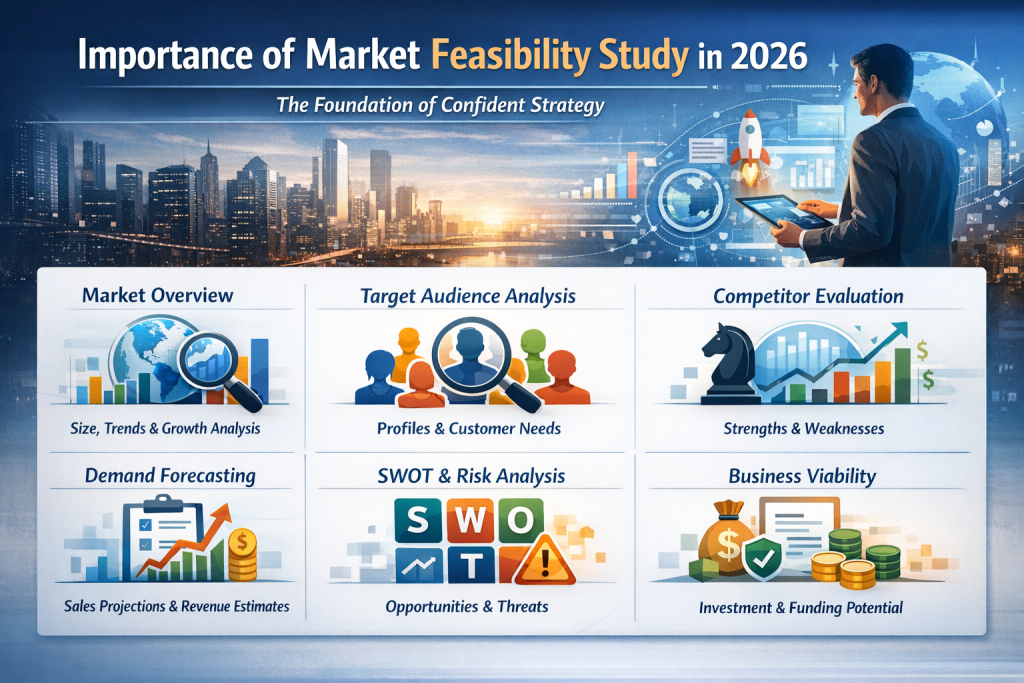
Importance Of Market Feasibility Study In 2026

Why is this analysis critical for any serious venture in 2026? Simply put, it is the foundation of confident strategy.

market-feasibility-2026.

  • Identifies Demand and Customer Segments: Confirms that a viable target audience exists and actually has an unmet need.
  • Helps Forecast Sales and ROI: Provides the hard data required for reliable demand forecasting.
  • Reduces Investment Risk: Pinpoints insurmountable obstacles before significant capital is committed.
  • Guides Business Planning and Funding: Provides the essential evidence required to secure investment or loans

The Essential Components of the Market Study

To be truly comprehensive, your report must synthesize various layers of data. Understanding the components of a market feasibility study ensures your analysis is holistic and actionable.

  • Market Overview: This section defines the sandbox you plan to play in. It analyzes the current market size, historical growth potential, projected growth rate, and relevant industry trends (e.g., the rise of GenAI, sustainability mandates). This sets the stage for validating the overall business opportunity assessment.
  • Target Audience Analysis: This goes far beyond basic demographics. It involves in-depth profiles (psychographics, behaviors, pain points) to identify specific customer segmentation that your proposed offering is uniquely positioned to serve. This clarifies who the product is for and why they will buy it.
  • Competitor Evaluation: A thorough competitor evaluation identifies both direct and indirect existing players. It assesses their market share, pricing strategies, strengths, weaknesses, and potential barriers to entry for your proposed solution. This helps you define your unique value proposition.
  • Demand Forecasting: This is the financial core. It uses research data to estimate potential sales volume, projected revenue, and long-term growth estimates. Accurate demand forecasting relies on realistic assumptions regarding market share capture.
  • SWOT / Risk Analysis: This component summarizes internal strengths and weaknesses against external opportunities and threats within the market. It also proactively assesses potential risks (regulatory changes, technology obsolescence) and outlines mitigation strategies.

Steps in Conducting a Market Feasibility Study

The most critical part of the process is executing the research correctly. Here are the core steps in a market feasibility study that form a proven methodology.

  1. Define Your Objective: Before spending a single dollar, you should know what you are actually testing. Are you validating a new product, assessing geographical expansion, or simply seeking funding for an existing concept? When you have a clear objective, you can narrow the scope of the market feasibility analysis.
  2. Collect Market Data: This step involves rigorous market research. You must utilize both primary sources (new surveys, focus groups) and secondary sources (government reports, trade publications, reliable competitor analyses). The data must be current and relevant to industry trends.
  3. Analyze the Target Market: Evaluate the collected data to understand customer needs, purchase behavior, and trends. The goal here is to identify unmet needs or underserved segments that represent a genuine opportunity. Effective target audience analysis will confirm if your proposed offering solves a genuine problem.
  4. Study Competitors: A comprehensive competitor evaluation identifies market gaps, assesses their operational efficiency, and scrutinizes their customer reviews. Understanding their vulnerabilities helps you craft a truly differentiated entry strategy.
  5. Estimate Market Demand: This requires translating the qualitative and quantitative market data into concrete numbers. Forecast potential market share, projected sales volume, and expected revenue over a 3- to 5-year period. This is where solid demand forecasting transforms research into finance.
  6. Assess Financial Viability: A market feasibility analysis must tie back to the money. Conduct a cost-benefit analysis, map out a provisional pricing strategy, and calculate your break-even points. This step determines if the revenue potential outweighs the required investment and operational costs. For a deeper dive into the financials, you can review our previous analysis on Business Feasibility Analysis.
  7. Prepare the Market Feasibility Report: The final step is to synthesize all findings into a concise, professional report. The market feasibility report should clearly summarize the data, state the key assumptions made, and culminate in a final, data-driven recommendation: Proceed, Proceed with Modifications, or Abandon.

Example of a Market Feasibility Study

Sometimes, the concept is best understood through a scenario.

Imagine an artisanal, locally-sourced coffee roaster in Seattle (The Company) that wants to launch a line of high-end, aluminum-free cold-brew cans across the U.S. West Coast.

The first step of the example of market feasibility study would be to analyze the ready-to-drink (RTD) coffee market (Market Overview). They would then conduct target audience analysis to profile consumers willing to pay a premium for eco-friendly, high-quality cold-brew (Customer Segmentation). The competitor evaluation would map existing RTD leaders and their distribution. If the study reveals sufficient premium demand, weak local competition in specific regions, and a financially viable pricing point, the report would recommend a ‘Go.’

Smart Tools and Data Sources to Use

Executing a high-quality market feasibility analysis requires the right resources:

  • Free Tools: Leverage Google Trends for quick industry trends, Statista for accessible data summaries, and the U.S. Census Bureau for foundational demographic and economic statistics.
  • Paid Tools: NielsenIQ and Euromonitor offer detailed consumer purchasing data. For comprehensive B2B insights and competitive intelligence, tools like SEMrush and IBISWorld provide excellent b2b market research.

Consulting experts like August Brown often use these tools in tandem with advanced financial modeling and proprietary primary research to ensure the deepest level of competitor evaluation and accurate demand forecasting.

Common Mistakes to Avoid

Even with a perfect plan, pitfalls exist. Be sure to avoid these common missteps:

  • Ignoring Market Size Data: Proceeding based on enthusiasm rather than quantifiable total available market (TAM).
  • Overestimating Demand: Assuming rapid, massive market share capture without historical evidence.
  • Skipping Competitor Research: Focusing solely on your idea and failing to conduct a thorough competitor evaluation.
  • Confusing Market Research with Market Feasibility: Mistaking information gathering for a final, decision-ready analysis.
  • Not Updating Data Regularly: Using stale data, especially in fast-moving sectors.

The August Brown 7-Step Methodology

  1. Define the “Go/No-Go” Criteria: What specific numbers must we hit to move forward?
  2. Multimodal Data Collection: Combining AI-driven secondary data with “boots on the ground” primary research.
  3. Gap Identification: Pinpointing the exact unmet need in the current market.
  4. Vulnerability Audit: Scrutinizing competitor weaknesses and operational gaps.
  5. Financial Stress-Testing: Calculating break-even points against 10%–15% market volatility.
  6. Regulatory GEO-Mapping: Ensuring compliance across different regional jurisdictions.
  7. Final Recommendation: A definitive report concluding in Proceed, Pivot, or Abandon.

Conclusion

The goal of launching a successful venture in 2026 has moved from simple innovation to calculated validation. A well-planned market feasibility study helps businesses minimize risk, allocate capital intelligently, and make confident, data-driven decisions that stand up to market scrutiny. Whether you are launching a new product line or entering a new market, the right research and analysis can be the difference between a high-cost failure and sustained, profitable success.

Need expert help preparing a world-class market feasibility report? Contact August Brown’s team can guide you from initial market research to actionable, validated insights.

FAQs

1. What is the main purpose of a market feasibility study? 

A market feasibility study is a due diligence firewall. Before you commit time, capital, and reputation, you need to run a deep check on whether your product or service is actually viable in the market. This rigorous, data-driven assessment determines if the economic environment (competition, trends, size) supports a profitable and sustainable outcome.

2. How do you make a market feasibility study rigorous?

The process begins with clearly defining the project’s scope and the crucial ‘Go/No-Go’ criteria. We then employ a structured approach: gathering comprehensive data on customer segments and demand via primary (surveys/interviews) and secondary research, followed by a meticulous competitor evaluation and the creation of reliable demand forecasts. The rigor comes from sensitivity analysis, which tests financial projections against varying market assumptions, ensuring the final recommendation is robust and defensible.

3. What are the key parts of a market feasibility study?

While a complete study is multifaceted (also covering technical, financial, and management aspects), the core of the market component includes: a detailed Market Overview (size, growth, and trends), in-depth Customer Analysis (needs, willingness to pay, and segments), a thorough Competitor Evaluation (strengths, strategies, and market share), and conservative Demand Forecasting (realistic sales and adoption projections).

4. What is the difference between market feasibility and marketing strategy? 

A market feasibility study is a diagnostic tool that answers the binary question: “Should we proceed? Is the opportunity real?” It’s a foundational step.
The marketing strategy, however, is a prescriptive plan that answers the question: “How will we achieve success?” It defines the execution—pricing, distribution channels, promotional tactics, and specific positioning—that will be implemented after feasibility has been confirmed.

5. Why is market feasibility important before launching a business? 

Launching a business without a market feasibility study is guesswork…expensive guesswork. A proper analysis validates the core idea, proving that a real customer need exists, and critically, that the opportunity is large enough to justify your effort. Furthermore, it provides the cold, hard financial data (like projected ROI and break-even points) that bankers and serious investors demand, giving your leadership team the clarity to strategically deploy capital and avoid irreversible mistakes.

gordon nameni

Dr. Gordon Nameni, PhD
Managing Partner at August Brown

What is Business Feasibility Analysis? Why It Matters & How to Conduct It

Before a new business or project moves from idea to execution, it needs proof that it can actually work. A business feasibility analysis provides that proof. It’s a structured assessment that evaluates whether an idea is realistic from a market, financial, and operational standpoint. In short, it helps decision-makers avoid investing time or capital into a concept that won’t perform as expected.

At August Brown, we’ve seen how an early feasibility study can change the way a project goes. This matters because the earlier you spot a showstopper, the less you’ll lose. Good feasibility work reduces risk, sharpens your ask for investors or lenders, and helps you choose the best version of the idea to pursue. In this blog we’ll walk you through what a feasibility analysis is, how it differs from a business plan, the core components (market, financial, technical, legal, and operational), a clear step-by-step process you can follow, and a short, realistic example you can relate to.

What Is a Business Feasibility Analysis?

A business feasibility analysis determines whether an idea or project can actually succeed in the market. It examines financial feasibility, market demand, operational capability, and compliance with regulatory requirements before a formal business plan is developed.

Distinguishing feasibility analysis from business planning is essential. The two fulfill distinct roles.  A feasibility analysis evaluates the worth of chasing an idea, whereas a business strategy details how it will be implemented. A feasibility study in a business plan evaluates whether the concept is achievable and likely to generate profits prior to moving forward

The outcome is a clear recommendation: proceed, modify, or pause. For lenders, grant reviewers, and investors, this analysis provides confidence that key assumptions have been tested and financial risks have been evaluated objectively.

Why Business Feasibility Analysis Matters?

A strong business feasibility analysis helps business owners and project developers make confident, data-driven decisions. It minimizes uncertainty, sharpens focus, and often determines whether an idea moves forward or stays on the drawing board.

  • Reduces risk
    A thorough analysis exposes potential roadblocks early, from underestimated costs to weak demand or supply constraints, allowing teams to adjust their strategy before major investments are made.
  • Strengthens funding and grant applications
    Lenders and grant agencies, including USDA, SBA, and EDA programs, rely on feasibility reports to assess financial soundness. A detailed study signals credibility, financial discipline, and readiness to execute.
  • Improves strategic clarity
    By identifying what works and what doesn’t, the analysis guides where to invest, where to scale back, and how to sequence implementation for best results.
  • Supports compliance and long-term sustainability
    Well-documented feasibility findings also help businesses stay aligned with ongoing reporting or audit requirements, strengthening relationships with funders and regulators

In practice, a well-prepared feasibility report isn’t just a document, it’s a foundation for smarter business planning.

Steps of Conducting a Business Feasibility Analysis

A structured process helps ensure no key area is overlooked.

  1. Define the scope and objectives
    Clarify what’s being evaluated, for example, a new product line, a regional expansion, or a site investment, and identify the decision criteria for moving forward.
  2. Conduct preliminary research
    Review high-level data such as market size, trends, and regulatory considerations to spot any obvious challenges early.
  3. Perform detailed market analysis
    Gather primary and secondary data on target customers, competitors, and pricing. The findings form the basis for sales forecasts and marketing strategy.
  4. Build financial projections and run cost-benefit analysis
    Estimate startup and operating costs, revenue, margins, and cash flow. Use multiple scenarios to show how outcomes shift under different assumptions.
  5. Assess technical and operational feasibility
    Evaluate whether the necessary facilities, technology, and workforce are accessible. Capacity utilization and supply chain reliability often determine whether the plan is realistic.
  6. Prepare the feasibility report and recommendation
    Compile the findings into a clear report summarizing the evidence, assumptions, and recommendation; go, modify, or stop.

Including a business feasibility analysis example in the final report helps stakeholders quickly understand how the findings translate into action.

Expert Tip: For agribusiness projects, market feasibility often hinges on specialized funding. Check the latest 2026 guide on USDA Subsidies to see how bridge payments can impact your cash flow projections.

Common Mistakes in Business Feasibility Analysis

Some of the most frequent issues we encounter include:

  • Incomplete or overly optimistic data that paints an unrealistic picture of demand or costs.
  • Lack of sensitivity testing on financial models, leaving decision-makers unprepared for changes in key assumptions.
  • Overlooking competitive threats or substitute products that can limit market share.
  • Ignoring operational or regulatory constraints that later delay approvals or increase expenses.

Even small oversights in these areas can undermine the credibility of a feasibility report. Avoiding these pitfalls often marks the difference between a well-supported investment decision and a costly, avoidable setback.

Business Feasibility Analysis Example

Consider a regional food processing venture evaluating expansion. The market study confirmed strong demand and interest from buyers, but also revealed that specialized equipment and cold storage costs were higher than expected.

The financial analysis showed that 60% capacity utilization in the first year could generate positive cash flow only with bridge financing. The recommendation was to launch a smaller pilot facility first, track performance, and reassess after six months. This business feasibility analysis example demonstrates how data-driven adjustments can strengthen project outcomes.

Other Key Components of a Feasibility Analysis

A comprehensive feasibility analysis covers several dimensions of viability. Each provides insight into whether the project can move forward with confidence.

1. Market Feasibility

Examines demand, competition, and customer segments. The goal is to confirm there’s sufficient market need and to define realistic sales or adoption expectations. This section may include surveys, competitor analysis, and pricing research.

2. Technical Feasibility

Assesses whether the required systems, technologies, and infrastructure are in place or attainable. It reviews production methods, supply chain reliability, and access to necessary resources.

3. Financial Feasibility

Determines if the numbers work. This section estimates capital requirements, operating costs, break-even timelines, and profit potential. It also includes ROI projections and a cost-benefit analysis to measure expected returns against investment.

4. Organizational / Operational Feasibility

Looks at internal readiness, management capability, staffing, logistics, and workflow design. It helps identify operational gaps and determine whether the organization can support the new initiative effectively.

5. Legal / Regulatory Feasibility

Confirms that the business or project can operate within local, state, and federal regulations. This may include environmental permits, licensing, or compliance with specific industry standards.


Summary:

Component

Focus

Key Outcomes

Market

Demand and competition

Customer base, market potential

Technical

Delivery capacity

Equipment, technology, logistics

Financial

Profitability

ROI, break-even, funding needs

Operational

Internal capability

Staffing, structure, supply chain

Legal

Compliance

Permits, certifications, regulations

Conclusion

A feasibility analysis doesn’t just assess whether a business idea can work, it builds the foundation for confident, evidence-based decision-making. It helps organizations allocate capital wisely, prepare stronger funding applications, and avoid preventable setbacks.

At August Brown, we help businesses and public entities conduct feasibility studies that meet USDA, SBA, and private lender standards. Our team combines technical, financial, and operational expertise to produce clear, defensible reports that drive better outcomes.

To discuss your project or request a custom feasibility analysis, contact our team. We’re here to help you move from concept to execution with confidence.

FAQs (Frequently Asked Questions)

1. What is a business feasibility analysis?

A business feasibility analysis is a study that helps determine if a business idea or project can succeed. It looks at factors like market demand, financial costs, and operational readiness to decide whether the idea is practical and profitable.

2. Why is business feasibility analysis important?

It helps reduce the risk of failure by identifying potential problems early. Through market and financial feasibility, it ensures your business idea is realistic, fundable, and aligned with your resources and goals.

3. What are the key components of a feasibility analysis?

The main components include market feasibility, technical feasibility, financial feasibility, operational feasibility, and legal or regulatory feasibility. Each component assesses a different aspect of business viability before you invest time or money.

4. How is a business feasibility analysis different from a business plan?

A feasibility analysis is done before creating a business plan to see if the idea is worth pursuing. A business plan, on the other hand, explains how the business will operate once the idea has been proven feasible.

5. Who needs to conduct a business feasibility analysis?

Entrepreneurs, investors, lenders, and project developers often conduct a business feasibility analysis. It’s especially important when applying for funding, grants, or USDA/SBA loans, as it demonstrates the project’s financial and operational viability.

6. What are the benefits of conducting a business feasibility analysis?

It helps identify strengths, weaknesses, and potential challenges before launching a project. The process saves time, reduces financial risk, and increases your chances of success by validating your idea early.

gordon nameni

Dr. Gordon Nameni, PhD
Managing Partner at August Brown

ESG Assessments 2026 Guide: Frameworks, Processes, and Best Practices

ESG is no longer a peripheral concern for U.S. businesses. In 2026, it has become a central pillar of fiduciary duty and corporate strategy. Whether you are running a startup, managing a growing company, or leading a global enterprise, the requirement for an ESG assessment is now a standard feature of board meetings, investor calls, and credit committee reviews.

An ESG assessment in 2026 is a rigorous, data driven audit of an organization’s resilience. It measures your environmental footprint, social impact, and governance integrity against a backdrop of mandatory federal disclosures. The “importance of ESG assessment” has shifted from a voluntary reputational exercise to a fundamental requirement for capital access. Investors now demand granular transparency, and U.S. regulators are enforcing strict compliance standards that equate ESG data with financial reporting quality.

This guide explains the ESG assessment process, the primary frameworks utilized by August Brown, and how to leverage these tools to secure institutional confidence.

What is an ESG Assessment?

Think of an ESG assessment as a comprehensive risk and opportunity audit. It examines how your environmental, social, and governance policies align with both global best practices and specific U.S. regulatory mandates.

At August Brown, we view the ESG assessment as a diagnostic tool to establish an “ESG baseline” that is audit ready. This process goes beyond qualitative narratives to focus on quantitative metrics. A strong assessment pinpoints systemic risks, identifies operational efficiencies, and ensures that sustainability is integrated into the company’s internal control environment.

For example:

  • A manufacturer might focus on carbon intensity, hazardous waste protocols, and Tier 1 through Tier 3 supply chain labor practices.
  • A financial institution would assess the “Green Asset Ratio” of its portfolio, board oversight of climate risk, and cybersecurity resilience.
  • An infrastructure fund might examine the physical climate risk of its assets and the “Social License to Operate” in local jurisdictions.

Different industries have unique priorities, but the goal of every ESG assessment is to measure, understand, and improve. Organizations often begin with an internal ESG assessment before moving on to a third-party ESG assessment for verification and credibility.

Who Actually Needs an ESG Assessment?

In 2026, practically every business in the U.S. ecosystem requires a structured ESG assessment. Startups rely on ESG credentials to satisfy the “Responsible Investment” (RI) mandates of Venture Capital and Private Equity firms. Mid sized companies use supplier ESG assessments to maintain their position within the value chains of multi national corporations.

Large corporations, specifically those with EU exposure, are now navigating the Corporate Sustainability Reporting Directive (CSRD), which requires U.S. subsidiaries to provide extensive disclosures. Furthermore, private equity and infrastructure funds are increasingly using ESG assessments as a pre acquisition due diligence tool to identify hidden liabilities and post close value creation levers.

Strong ESG performance opens access to capital, enhances reputation, and lowers risk. Whether you’re bidding for government contracts or applying for green financing, your ESG assessment framework can make or break your eligibility.

If you want to see how these pieces connect, check out August Brown’s guide to feasibility studies or our article on site readiness for industrial investment. Both show how ESG fits naturally into early-stage business planning.

Why ESG Assessments Matter in 2026: The Regulatory Shift

The importance of ESG assessment in 2026 is driven by three major regulatory pillars:

  1. SEC Climate Disclosure Rules: The SEC now requires public filers to disclose material climate related risks, including Scope 1 and Scope 2 emissions for larger entities, along with the financial impact of severe weather events.
  2. The CSRD Impact: Any U.S. company with significant European revenue (exceeding €150 million) must now comply with EU sustainability standards, regardless of where they are headquartered.
  3. IFRS Sustainability Standards (S1 & S2): These have become the global baseline for financial materiality, requiring companies to disclose how sustainability risks affect their balance sheet and income statement.

The ESG Assessment Process – Step by Step

If you’ve never done it before, the ESG assessment process can seem intimidating. But once you break it down, it’s straightforward and repeatable.

It usually follows five core stages:

  1. Preparation: Define your purpose and scope. Establish your ESG baseline by gathering existing data — such as energy use, HR policies, governance practices, and supplier information.

  2. Assessment: Evaluate performance against global standards. Conduct an ESG materiality assessment to identify which issues matter most to your stakeholders.

  3. Scoring and Benchmarking: Use an ESG risk assessment tool or ESG assessment tool like EcoVadis or Diligent ESG to score performance and benchmark against peers.

  4. Reporting: Share results clearly, aligning your data with recognized frameworks for transparent sustainability reporting.

  5. Action Plan: Address gaps with measurable goals, timelines, and responsibilities.

The ESG assessment process isn’t a one-time task — it’s an ongoing cycle that promotes continuous improvement.

ESG Frameworks and Methodologies

Choosing the right ESG assessment framework is crucial. Frameworks provide structure, consistency, and credibility to your ESG assessment methodology. The most popular ones include:

  • GRI (Global Reporting Initiative) – Best for comprehensive sustainability and stakeholder reporting.
  • SASB (Sustainability Accounting Standards Board) – Focused on financial materiality for investors.
  • TCFD (Task Force on Climate-Related Financial Disclosures) – Ideal for organizations exposed to climate risk.
  • UN SDGs (Sustainable Development Goals) – Great for companies aligning with global social and environmental objectives.

Each organization should select or combine frameworks based on its goals, sector, and geography. The right ESG assessment framework ensures consistent measurement, easier compliance, and clear communication with investors.

ESG Materiality and Risk Assessment

Not every issue is equally important to every company. That’s where ESG materiality comes into play. A focused ESG materiality assessment identifies the sustainability factors that truly influence your business value and stakeholder trust.

Next comes the ESG risk assessment. This step highlights potential threats — environmental, social, or governance-related — that could damage performance or reputation. For example, carbon emissions are highly material for manufacturers, while data ethics dominate for tech firms.

Using a structured ESG risk assessment tool ensures objectivity and accuracy in identifying and prioritizing risks. Together, ESG materiality assessments and risk evaluations ensure your strategy targets what really matters.

Impact on Underwriting, Capital Access, and M&A

ESG assessments now directly influence the cost of capital. Lenders are increasingly utilizing “Sustainability Linked Loans” (SLLs) where interest rates are tied to ESG performance targets. In M&A transactions, an ESG assessment serves as a proxy for management quality. A company with a mature ESG baseline is seen as lower risk, often commanding a higher valuation multiple. Conversely, a poor ESG profile can trigger “red flags” during the underwriting process, leading to higher insurance premiums or loan denials.

ESG Data Quality and Lender Confidence

The era of “greenwashing” has ended, replaced by a demand for “Investment Grade ESG Data.” Lenders and investors now view poor ESG data quality as a sign of weak internal controls. When a company provides third party ESG assessments that are verified and backed by a transparent ESG assessment methodology, it builds a “Trust Premium.” High quality data reduces the perceived risk of regulatory fines and litigation, giving lenders the confidence to offer more favorable terms.

Tools and Technology that Simplify ESG Work

If you’re still tracking ESG data in spreadsheets, it’s time to upgrade. Modern ESG assessment tools automate data collection, validation, and reporting. Platforms like EcoVadis, Sphera, and Microsoft Sustainability Manager offer integrated dashboards for easier management.

Automation improves ESG data quality, reduces human error, and strengthens accountability. These systems also simplify ESG compliance and prepare you for independent verification during third-party ESG assessments.

Assessing ESG Maturity and Readiness

Before publishing formal reports, assess where you stand with an ESG maturity assessment. This identifies how deeply ESG is integrated into your company’s strategy and operations.

Next, conduct an ESG gap assessment to pinpoint missing data, outdated policies, or weak governance areas. Then, perform an ESG readiness assessment to ensure your systems and teams are equipped for external audits.

These assessments build upon your ESG baseline and demonstrate consistent progress. Mature organizations don’t just comply — they lead by example, embedding sustainability into every decision.

Common Pitfalls and How to Avoid Them

Three common challenges can undermine your ESG assessment methodology: poor data, poor follow-through, and poor differentiation.

  1. Poor ESG data quality: Without reliable data, your assessment loses credibility. Use trusted systems and audits to maintain accuracy.

  2. No follow-through: An assessment without an action plan is just paperwork. Turn insights into measurable goals.

  3. Copying competitors: Your ESG materiality profile is unique. Avoid mimicking other reports — focus on your business priorities.

Avoiding these pitfalls ensures your ESG assessment process remains meaningful and authentic.

Benefits of Conducting an ESG Assessment

The benefits of ESG assessment extend across your entire organization. Companies that take it seriously enjoy:

  • Improved risk management and governance performance.
  • Increased investor and stakeholder trust.
  • Cost savings from efficiency improvements.
  • Greater employee engagement and retention.
  • Enhanced brand reputation through verified sustainability reporting.
  • Stronger partnerships due to transparent supplier ESG assessments.

Ultimately, an effective ESG assessment enhances resilience, innovation, and long-term profitability.

How ESG Assessments Fit into the Bigger Picture

An ESG assessment doesn’t exist in isolation. It supports core business processes such as feasibility studies, underwriting, and site readiness. Integrating ESG into these functions strengthens financial modeling and operational planning.

When ESG insights drive your strategic decisions, sustainability reporting becomes more meaningful, and your company is better positioned for long-term success. The importance of ESG assessment lies not only in compliance but in using it as a tool for innovation, resilience, and leadership.

Conclusion

In 2026, ESG assessments are not optional — they’re essential to sustainable growth. They help organizations understand impact, manage risk, and build credibility. Whether you’re performing an internal ESG assessment, a supplier ESG assessment, or preparing for a third-party ESG assessment, every step brings you closer to stronger performance and transparency.

Start with your ESG baseline, refine it with ESG assessment methodologies, and strengthen it with tools and frameworks that ensure continuous improvement. Focus on progress, not perfection. By knowing where you stand today, you’ll be ready to lead with confidence, purpose, and responsibility tomorrow.

If you’re ready to take your ESG strategy to the next level or want expert guidance on building a practical, data-driven approach, contact the August Brown team today to discuss how we can help your organization achieve measurable ESG success.

FAQs

  1. What is an ESG assessment?

    An ESG assessment evaluates how well a company manages its environmental, social, and governance practices compared to industry standards.

  2. Why is ESG assessment important in 2026?

    It helps companies identify risks, improve transparency, and meet growing investor and regulatory expectations.

  3. How is ESG assessment different from ESG audit?

    An assessment reviews performance and identifies gaps, while an audit provides independent assurance on reported ESG data.

  4. What tools are used for ESG assessment?

    Companies use ESG software platforms like EcoVadis, Diligent ESG, or Microsoft Sustainability Manager to measure and report performance.

  5. How does the SEC Climate Disclosure rule affect private U.S. companies?

    While the SEC rule primarily targets public filers, private companies are often required to provide ESG data as part of “Scope 3” disclosures for their public customers or as a requirement for bank financing.

  6. What is the difference between Financial Materiality and Double Materiality?

    Financial materiality looks at how ESG issues affect a company’s bottom line. Double materiality adds a second dimension, looking at how the company’s activities impact society and the environment.

  7. Why is ‘Board Oversight’ a critical part of a 2026 ESG assessment?
    Regulators and investors now view ESG as a fiduciary duty. An assessment must prove that the board has the expertise and structured processes to monitor and mitigate ESG related risks.

gordon nameni

Dr. Gordon Nameni, PhD
Managing Partner at August Brown

Industrial Capacity Utilization: What It Means, Why It Matters, and How to Improve It

Here’s a question worth asking: Are you really getting the most out of your plant’s capacity? Many manufacturers think they are, but when you look closely, a surprising amount of production potential is unused.

That’s what industrial capacity utilization helps uncover. You see, most plants think they’re running efficiently until they measure it. The gap between what’s possible and what’s actually produced can reveal bottlenecks you didn’t even know existed. It shows how much of your total production capability you’re actually using. If your factory can produce 1,000 units a day but you’re only making 750, that’s a 75% utilization rate, and it’s a sign that something’s being left on the table.

Understanding this number matters more today than ever. It affects everything from profits to energy costs to your ability to respond when market demand spikes. Whether you’re managing a manufacturing plant or analyzing economic data, capacity utilization is one of those quiet metrics that speaks volumes about performance.

By the time you finish this article, you’ll know exactly what it means, how to calculate it, and most importantly, what steps you can take to improve it.

What Is Industrial Capacity Utilization?

At its simplest, industrial capacity utilization is the percentage of your production potential that’s currently being used. Think of it like your factory’s heartbeat — it tells you how efficiently your machines, people, and processes are working together.

Let’s make it tangible. Say your plant can make 10,000 components in a week, but you’re producing 8,000. Your utilization rate is 80%. That 20% gap might not sound dramatic, but it represents idle machinery, lost output, and higher costs per unit. Think about it like leaving part of your kitchen unused during dinner rush, the tools are there, but they’re not helping you serve more customers. Manufacturing works the same way.

Governments also watch this number carefully. It’s a big part of the industrial production and capacity utilization reports that economists use to track economic health. A high utilization rate means factories are humming and demand is strong. A drop usually signals a slowdown.

For businesses, though, this metric does something even more valuable: it shines a light on where performance can improve. Understanding your manufacturing capacity utilization helps you plan better, reduce waste, and make smarter investments.

Why Industrial Capacity Utilization Matters

Let’s be real … running a plant is expensive. Every idle machine, delayed order, or unused hour of labor costs money. That’s why capacity utilization matters so much.

When your utilization rate is healthy, you’re spreading your fixed costs across more units, lowering your overhead, and getting more return from the same assets. In plain terms, you’re squeezing more value out of the same space, staff, and machine, that’s the kind of efficiency investors and CFOs love to see. 

If utilization drops, it often points to weak demand, poor planning, or outdated equipment. Those are warning signs, not just numbers on a spreadsheet.

On a bigger scale, industrial capacity utilization reflects the rhythm of the economy. When utilization rates rise, production is strong and investors take it as a sign of growth. When rates fall, it can indicate that companies are cutting back or that consumer demand is softening.

As we move through 2025, new challenges are shaping how businesses think about capacity. Automation, sustainability targets, and supply chain recovery all play a part. The companies that find a balance between efficiency and flexibility are the ones likely to thrive. And here’s the thing, when utilization rates rise across multiple plants, it doesn’t just boost individual profits; it lifts entire supply chains.

(If you’re planning long-term production or financing, check out Feasibility Study vs Business Plan — it explores how operational data connects to strategic growth decisions.)

How to Calculate Capacity Utilization (with Formula & Example)

Here’s the good news: you don’t need a data scientist to figure out your utilization rate. The math is simple.

Formula:

Capacity Utilization Rate = (Actual Output / Maximum Possible Output) × 100

Let’s put it into practice. If your factory can produce 50,000 units in a month but you’re currently turning out 42,000, here’s the calculation:

(42,000 ÷ 50,000) × 100 = 84%

That’s your utilization rate. Now pause for a second and think – where does your operation stand? Even a few percentage points of improvement here can mean hundreds of thousands in annual savings.

A rate between 80% and 85% is generally considered healthy. It means you’re operating efficiently while still leaving room for maintenance or unexpected surges in demand. Once you go above 90%, you might be stretching your capacity a bit too far, which can lead to wear and tear or production bottlenecks.

If you want to dive deeper into how this calculation plays out in real-world operations, August Brown has an insightful article: Capacity Utilization: The 3 Facts They Don’t Tell You.

Factors That Affect Industrial Capacity Utilization

Now, what actually determines your utilization rate? It’s not just about production numbers, several moving parts come into play.

Internal factors: These are the things within your control, the nuts and bolts of daily operations.

  • Equipment maintenance and downtime
  • Workforce skill levels and availability
  • Efficiency of production scheduling

External factors: These are harder to manage, but smart planning can soften their impact.

  • Market demand changes
  • Supply chain disruptions
  • Raw material or energy costs

Larger economic influences: These broader forces often set the tone for how flexible manufacturers need to be.

  • Inflation
  • Trade regulations
  • Global industrial trends

The challenge isn’t just knowing these factors but rather learning how to respond to them in real time. That’s where technology and data step in. As 2025 continues, more manufacturers are using technology to stabilize these variables. Predictive maintenance powered by AI, for instance, helps prevent costly breakdowns. Digital supply chain tools improve visibility and reduce the risk of material shortages.

The bottom line? The more you understand what’s affecting your utilization, the better equipped you are to fix it.

How to Improve Industrial Capacity Utilization

Let’s talk about solutions. Improving industrial capacity utilization doesn’t always mean buying new machines or expanding your facility. Often, it’s about improving how you use what you already have.

Here are some tried-and-true ways to do that:

  1. Schedule maintenance smarter
    Preventive care beats reactive repairs every time. Regular maintenance keeps your equipment running smoothly and minimizes unplanned downtime.
  2. Improve forecasting
    Use data analytics to align production with demand. Better forecasts reduce overproduction and idle time.
  3. Invest in smart technology
    Automation and IoT sensors can help monitor machine performance and predict issues before they cause stoppages.
  4. Train your workforce
    Skilled employees can adapt quickly to production changes, troubleshoot problems faster, and increase output consistency.
  5. Streamline operations

Review every stage of your production line to identify and eliminate bottlenecks. Even small changes in workflow can make a big difference.

Keep in mind that running at full capacity isn’t always the goal. Operating at 100% may seem ideal, but it often leads to stress on machines and people. The goal is balance. Finding your optimal capacity utilization rate and keeping it stable.

Common Challenges and Solutions

Every plant faces challenges that impact utilization. Maybe it’s aging equipment, unreliable suppliers, or inconsistent demand. The key is to recognize these patterns early and address them before they become costly habits.

Here are a few examples:

  • Challenge: Unplanned downtime from machine failure
    Solution: Use predictive maintenance tools and keep spare parts inventory ready.
  • Challenge: Inaccurate demand forecasts
    Solution: Integrate sales data and market analytics into production planning.
  • Challenge: Inefficient process flow
    Solution: Conduct regular time studies and lean reviews to remove bottlenecks.

By staying proactive, you can improve operational efficiency, reduce idle capacity, and maintain a smoother production rhythm.


Conclusion

To sum it up, capacity utilization for industries is more than a performance metric, it’s a guide to better business decisions. It tells you how well you’re using what you already have and where there’s room to grow.

When you manage this number effectively, you cut waste, improve throughput, and strengthen profitability. And in 2025, with smarter tools and data-driven insights, optimizing utilization isn’t just possible, it’s essential. 

The goal isn’t to push harder; it’s to work smarter and make every resource count.

So If you’d like expert help analyzing your capacity utilization or building strategies to boost production efficiency, reach out to the August Brown team. We’ve helped manufacturers across industries uncover hidden potential and turn efficiency into long-term growth.

FAQs

1. What is industrial capacity utilization?

Industrial capacity utilization is a measure of how much of your production potential is currently being used compared to your total manufacturing capacity. In simple terms, it reflects the percentage of your available resources — machinery, labor, and time — that are actively contributing to output. In industrial production and capacity utilization reports, this metric is a key indicator of both manufacturing productivity and economic health.

2. What is a good capacity utilization rate in manufacturing?

 A good or optimal capacity utilization rate in manufacturing typically falls between 80% and 85%. This range shows that production efficiency is high without pushing systems into overuse. Running consistently above 90% may signal a risk of excess capacity strain or reduced operational efficiency, while anything below 75% often indicates underutilized resources or idle capacity.

3. How do you improve industrial capacity utilization?

 You can improve industrial capacity utilization by enhancing forecasting accuracy, adopting predictive maintenance, and optimizing production scheduling. These steps reduce downtime and improve throughput. Best practices to increase capacity utilization include employee training, workflow optimization, and data-driven production capacity planning. Leveraging smart technology also helps measure and improve manufacturing efficiency over time.

4. Why does capacity utilization matter in manufacturing and the economy?

Capacity utilization matters in manufacturing because it directly impacts profit margins, energy consumption, and production efficiency. For the economy, it’s a critical signal — when industrial production and capacity utilization rates rise, it indicates growth and strong demand; when they fall, it often reflects an output gap or economic slowdown. Governments and analysts regularly monitor this data to gauge industrial performance.

5. What factors affect industrial capacity utilization in 2025?

In 2025, several factors affecting industrial capacity utilization include automation, supply chain agility, skilled labor availability, and energy costs. Global economic conditions, inflation, and trade regulations also influence utilization rates. Emerging capacity utilization trends 2025 show that manufacturers are increasingly using AI, IoT, and data analytics to measure capacity utilization in manufacturing and improve operational efficiency across plants.

gordon nameni

Dr. Gordon Nameni, PhD
Managing Partner at August Brown

Valuing a Patent in 2026: Methods, Costs & Business Impact

Patents are not just pieces of paper. For startups, inventors, and established companies, they represent high-yield business assets that can attract institutional investors, secure senior debt, or drive massive exit multiples in a sale. But the big question many innovators face is this: how do you go about valuing a patent in a volatile economy?

In 2026, the valuation landscape has shifted. We are operating in a “higher-for-longer” interest rate environment, which has fundamentally changed how investors perceive risk and the time value of money. Patents are no longer valued on potential alone; they are scrutinized for their immediate ability to generate cash flow or provide a defensive moat against aggressive competitors in AI and Biotech.

At August Brown, we’ve spent years specializing in the preparation of patent-compliant valuation reports for clients across global markets. We provide the financial rigor required to stand up to the most intense due diligence.

What Does Valuing a Patent Mean?

At its core, valuing a patent means assigning a financial worth to an invention that’s legally protected by intellectual property rights. Think of it as answering the question: “If I own this patent, how much money could it realistically generate or save me?”

In professional advisory, this is viewed as the valuation of a Level 3 Intangible Asset. Unlike liquid stocks, patents lack an active secondary market with daily pricing. Therefore, intellectual property valuation requires a synthesis of legal strength, technological relevance, and financial forecasting.

For startups and lenders, this is critical. In 2026, IP-backed lending has become a mainstream alternative to dilutive equity. A strong patent valuation is the collateral that allows a company to leverage its “intellectual capital” to fund operations without giving up ownership.

This is where professional advisory firms like August Brown step in. Their role is to provide independent, objective reports that can be trusted in financial transactions. The valuation isn’t just about putting a price tag on an invention. It’s about building credibility with investors, regulators, and partners.

Why Patent Valuation is Important?

When business owners ask, “why is patent valuation important?”, the answer often depends on context. But across industries, five main reasons stand out:

1. Raising Money

Investors and banks don’t just look at your idea, they look at numbers. How much is my patent worth? is a question lenders will expect you to answer before providing funding. A well-prepared valuation makes fundraising smoother and more persuasive.

2. Mergers & Acquisitions (M&A)

The 2026 M&A climate is characterized by “Strategic Consolidation.” Large-cap firms are acquiring smaller players not just for their revenue, but to “acqui-hire” their patent portfolios to prevent litigation. IP for M&A transactions is now a primary driver of the “Control Premium” paid during a buyout.

3. Licensing and Relief from Royalty

Valuation helps set defensible royalty rates. Without this, you risk undervaluing your patent and failing to capture the economic rent of your innovation.

4. Enforcement Risk and Litigation Impact

A patent’s value is intrinsically linked to its “litigation health.” In 2026, with the rise of third-party litigation funding, a patent that can withstand an Inter Partes Review (IPR) or a “Post-Grant Review” is significantly more valuable. We factor in the probability of “Validity Risk” when determining the final fair market value.

5. Financial Reporting

For compliance and accounting, patents need to appear on balance sheets at fair values. This impacts taxes, audits, and investor confidence.

In other words, patent valuation is important not only for strategic deals but also for financial transparency.

Economic Cycles and Patent Value

Patent values are pro-cyclical but offer unique hedging characteristics. During inflationary periods, patents in “Clean Tech” and “Agri-Tech” often appreciate as the underlying commodities they optimize become more expensive. Conversely, in a high-interest-rate environment, the “Discount Factor” applied to future cash flows increases, which can suppress the present value of long-term patents. Understanding where we sit in the 2026 economic cycle is vital for a realistic appraisal.

How to Value a Patent: Step-by-Step Approach

So, how to value a patent in practical terms? Here’s a structured approach professionals follow:

1.  Confirm Ownership and Scope

  • First, validate who legally owns the patent.
  • Define what the patent actually protects — product, process, or design.

2. Assess Strength and Remaining Life

  • Is the patent enforceable in court?
  • How many years are left before it expires? A patent with 15 years left is worth more than one about to lapse.

3. Estimate Earning Potential

  • Look at how the patent could generate income — through sales, licensing, or cost savings.

4. Select a Valuation Method

  • Income method
  • Market method
  • Cost method

5. Adjust for Risk

  • Markets shift. Competitors emerge. Enforcement isn’t always easy. A credible valuation adjusts numbers to reflect these risks.

This structured patent valuation process is how firms like August Brown ensure results that investors, banks, and regulators will take seriously.

Patent Valuation Methods Explained

There’s no one-size-fits-all way to calculate patent value. Professionals use three main patent valuation methods:

1. Income Approach: The DCF and Relief from Royalty

The Income Approach is the gold standard for valuing intangible assets. It relies on the Discounted Cash Flow (DCF) model.

To calculate the value (V), we use the formula

V = ∑t=1n CFt / (1 + r)t

Where:

  • CFt is the net cash flow attributed to the patent in year t.
  • r is the Discount Rate, typically derived from the Weighted Average Cost of Capital (WACC) plus a specific risk premium for IP.
  • n is the remaining economic life of the patent.

Within this, the relief from royalty method is frequently utilized. It calculates the value of the patent by estimating the royalty payments a company is “relieved” from paying because it owns the asset.

In 2026, August Brown applies rigorous Sensitivity Analysis to these models. We test how the value changes if market adoption is 20% slower or if the WACC increases due to central bank policy shifts. This ensures the valuation is not just a “best case” scenario, but a realistic one.

2. Market Approach

This method compares your asset to “comparable” transactions. However, in 2026, “comparables” are harder to find due to the highly specialized nature of AI and Quantum Computing patents. We use proprietary databases to find “proxy” deals that reflect current market sentiments.

3. Cost Approach

Here, the valuation looks at what it would cost to recreate the invention today. It factors in research, development, testing, and related expenses. This method is especially useful when there’s no reliable market or income data.

At August Brown, experts choose the method (or combination of methods) that best matches the industry, the type of patent, and the client’s goals.

How Much is My Patent Worth? Key Cost Drivers

The value of a patent is shaped by several drivers:

1. Patent Scope & Enforceability

Broad patents that cover widely used technology are usually worth more. Weak or narrowly scoped patents often attract lower valuations.

2. Industry Application

In booming sectors like biotech or AI, patent value often rises significantly. The same type of invention in a declining industry may not hold much weight.

3. Market Demand & Competition

If the market has strong demand for the innovation, value rises. If competitors have alternatives, value may drop.

4. Stage of Commercialization

Patents tied to already profitable products are far more valuable than those still in the concept phase.

This is why companies often ask “how much is my patent worth?” early on in strategy planning.

Patent Valuation Example (Case Snapshot)

Let’s walk through a realistic scenario to illustrate:

Scenario: A mid-sized medical device company owns a patented technology that improves the accuracy of portable diagnostic kits. They want a valuation before licensing.

Step 1: Estimating Revenue Impact

  • Market potential = $50M annually.
  • Patent feature projected to capture 10% share → $5M annual revenue.

Step 2: Applying a Royalty Rate

  • Benchmark royalty rate = 5%.
  • $5,000,000 × 5% = $250,000 annual royalty stream.

Step 3: Discounting Future Earnings

  • Remaining patent life = 10 years.
  • Discount rate = 10%.
  • Present value of royalties ≈ $1.5M.

Result: The patent’s estimated fair value = $1.5 million.

This case uses the income approach and the relief from royalty method. It’s exactly the type of structured analysis August Brown provides clients — professional, defensible, and investor-ready.

Challenges in Patent Valuation & How Experts Solve Them

Valuing a patent isn’t always straightforward. Some of the biggest hurdles include:

  • Lack of Public Data: Unlike real estate, patent sales are rarely public, so it’s hard to find comparable deals to determine a value. You can’t just look up a “comps” list.
  • Predicting the Future: A patent’s worth depends on future market trends, demand, and competition, all of which are uncertain and hard to predict years in advance.
  • Enforcement Risk: A patent is only as valuable as its legal strength. The risk and high cost of a legal challenge or infringement lawsuit can significantly devalue it.

Expert firms like August Brown overcome these challenges by blending financial models with industry knowledge, ensuring the valuation holds up under scrutiny.

Why Work With a Professional Valuation Firm Like August Brown?

In the boardroom, a “guess” is a liability. Whether you are navigating an IP for M&A transaction or seeking a DCF patent valuation for a bank, you need a report that uses the same language as a CFA or a Tier 1 auditor.

At August Brown, we don’t just provide a number. We provide a narrative of value that helps you win the deal. Our reports are compliant with International Valuation Standards (IVS) and are designed to be “bulletproof” during the due diligence process.

Conclusion

Valuing a patent in 2026 requires more than a simple calculation; it requires an understanding of global macroeconomics, interest rate sensitivity, and deep legal analysis. By utilizing a mix of patent valuation methods and staying ahead of 2026 market trends, August Brown ensures your intellectual property is treated as the powerhouse asset it truly is. The team specializes in valuing patents and broader intellectual property valuation methods. The reports are designed to be credible, compliant, and strategically useful; whether you’re raising funds, entering a licensing deal, or planning an acquisition.

Ready to understand the true worth of your patent? Contact August Brown for a professional valuation report you can trust.

FAQs

1. How is IP valuation done?

It’s done by confirming ownership, assessing strength and lifespan, estimating earnings, applying valuation methods, and adjusting for risks.

2. Who does IP valuation?

Professional valuation firms, accountants, and IP advisory experts like August Brown provide credible patent valuations.

3. What is the most common patent valuation method?

The income approach, particularly the relief from royalty method, is the most widely used.

4. How long does a patent valuation take?

Typically between 2–6 weeks depending on patent complexity and industry data availability.

5. Can I value my own patent?

You can make a rough estimate, but for funding, M&A, or legal purposes, only certified independent reports are considered reliable.

6. How do rising interest rates in 2026 specifically affect my patent’s value?

Higher interest rates increase the “Discount Rate” used in your $DCF$ model. Because future cash flows are worth less in today’s dollars when rates are high, a patent with “long-term” payoff potential may see a decrease in its “Present Value” compared to a low-rate environment.

7. What is “Technical Obsolescence” and why does August Brown include it?

A patent may be legally valid for 20 years, but if a new, superior technology makes your invention irrelevant in 5 years, its value is significantly lower. We assess the “Economic Life” of the patent, not just the “Legal Life.”

8. Can I use a patent valuation to get a bank loan in 2026?

Yes. “IP-Backed Lending” is a growing trend. Banks use our valuations to determine the “Loan-to-Value” (LTV) ratio, essentially using your patent as the collateral instead of physical real estate.

gordon nameni

Dr. Gordon Nameni, PhD
Managing Partner at August Brown

How Much Does a USDA Feasibility Study Cost in 2026?

When you’re preparing for a USDA grant, or any USDA rural development program in 2026, one of the first hurdles you’ll face is the requirement for a USDA feasibility study. For many applicants, this report is not just another item on the checklist. It is the definitive document that convinces federal underwriters and private lenders that your project is a viable investment in an increasingly complex economic landscape.

In 2026, the stakes for these studies have never been higher. With the USDA placing a renewed emphasis on “climate-smart” agriculture and regional food resiliency, your study must do more than just crunch numbers. It must prove that your project can withstand 2026 market volatility, shifting consumer demands, and the “new normal” of higher operational overhead.

At August Brown, we’ve spent years specializing in the preparation of USDA-compliant feasibility studies for clients across agriculture, renewable energy, food processing, and community development. We’ve seen firsthand how the quality of a feasibility study can make or break a USDA application.

One of the most common questions we hear is: how much does a USDA feasibility study cost in 2026? The answer depends on your project type, size, and industry, but we’ll walk you through all the details in this guide.

What is a USDA Feasibility Study?

A USDA feasibility study is an independent, comprehensive evaluation of whether your project idea is practical, financially sustainable, and aligned with USDA program goals. It is required in many funding programs, including:

1.  USDA loan feasibility study – typically required for USDA guaranteed loan programs.

2. USDA grant feasibility study – essential for grants like the Value-Added Producer Grant or the Rural Energy for America Program (REAP).

3. USDA food supply chain loan feasibility study – introduced in recent years to strengthen food system resilience.

4. USDA rural development feasibility study – covering a broad set of projects, from rural hospitals to renewable energy cooperatives.

Beyond the basic definition, the rural development feasibility requirements in 2026 demand a deeper look at long-term sustainability. These feasibility study report components now frequently include “stress tests” for supply chain disruptions and labor availability, ensuring the project remains solvent even if initial conditions change.

For example, when a dairy cooperative applies for a USDA loan to expand processing capacity, the USDA will not approve funding without a feasibility study report that shows there’s enough milk supply, demand from buyers, and a clear financial pathway.

Real-World Mini Case Examples

Case 1: The REAP Solar Expansion

A rural manufacturing plant sought a $500,000 REAP grant for a massive solar array. Because the project exceeded $200,000, a formal REAP feasibility study was required. Cost: $12,500. Result: The study proved a 7-year payback period, leading to full grant approval.

Case 2: Regional Meat Processing Facility

A group of cattle ranchers applied for a USDA Food Supply Chain loan to build a $10M processing plant. The USDA loan feasibility study required extensive local competition analysis and environmental impact reviews. Cost: $38,000. Result: The study identified a gap in local organic processing, which allowed the facility to secure a premium market position.

Case 3: Rural Community Health Center

A non-profit utilized the Community Facilities program for a $5M expansion. The USDA rural development feasibility study focused on patient demographics and federal reimbursement rates. Cost: $22,000. Result: The report secured both the USDA guarantee and a secondary private bridge loan.

How Much Does a Feasibility Study Cost in the U.S. (2026)?

In 2026, the feasibility study cost for USDA projects generally falls between $10,000 and $50,000. The variation is due to differences in project size, complexity, and industry.

  • Smaller, straightforward projects such as a farm installing solar panels under the REAP grant may require a USDA feasibility study on the lower end of that range, around $10,000–$15,000.
  • Larger, multi-million-dollar projects, like building a regional food hub or expanding a meat processing facility, often require in-depth market research, multi-year financial projections, and stakeholder interviews, pushing the cost closer to $40,000–$50,000.

So if you’re wondering, “how much does a feasibility study cost?”, the honest answer is: it depends on the resources required to prove your project is viable.

The 2026 Economic Impact: Construction and Financing Costs

In 2026, we are seeing a direct correlation between rising construction costs and feasibility study pricing. Because material costs (steel, concrete, specialized equipment) have become more volatile, consultants must spend more time on “sensitivity analysis.” This means modeling “best-case” and “worst-case” scenarios for your capital expenditures. Furthermore, with interest rates plateauing at higher levels than the previous decade, the cost of “carrying debt” must be analyzed with extreme precision. This extra layer of financial scrutiny adds 10% to 15% to the average study cost compared to three years ago, but it is essential for preventing project failure during the construction phase.

Factors That Influence USDA Feasibility Study Cost

1. Project Type

  • For USDA loans, the feasibility study focuses heavily on repayment ability, debt coverage ratios, and risk analysis.
  • When applying for grants, the study emphasizes community benefit, value addition, or environmental impact.
  • Rural development projects, meanwhile, may involve additional compliance with social, environmental, and community criteria.

For example, when a renewable energy company applies for a USDA loan to finance a biomass facility, the feasibility study must include not just financial data but also technical feasibility, feedstock supply analysis, and environmental impact review. This makes it more expensive than a simpler project like installing cold storage equipment.

2. Industry Sector

The industry your project is in plays a huge role. Feasibility studies for agriculture, food processing, renewable energy, and rural infrastructure differ greatly in complexity. The more specialized the industry, the more expertise and data collection are needed, which can increase the overall feasibility study cost.

  • A fruit-packing facility expansion may require detailed perishable logistics data.
  • A rural broadband project will need a technical network design and customer adoption forecast

Each industry has its own set of challenges, which directly influences the USDA feasibility study cost.

3. USDA Deliverables

The USDA feasibility study requirements can include:

  • Multi-year financial projections.
  • Market and supply chain analysis.
  • Risk assessments.
  • Governance structures.

Meeting these requirements adds research time and consultant hours, increasing costs.

4. Consultant Expertise

Hiring a general consultant might look cheaper, but if they lack USDA experience, you risk rejection. Firms like August Brown that specialize in USDA-compliant feasibility studies charge more but deliver reports that meet every requirement, improving your funding chances significantly.

Advanced Financial Projections and Lender Expectations

The “Financial Feasibility” section is the heart of your report. In 2026, the USDA and participating lenders have tightened their requirements for pro forma modeling. A standard 3-year projection is no longer enough; most USDA programs now require a 5-year to 10-year outlook.

Key metrics that August Brown focuses on include:

  • Debt Service Coverage Ratio (DSCR): Lenders typically look for a DSCR of 1.20x to 1.25x. Our studies provide a month-by-month breakdown of how your project will maintain this ratio during the critical “ramp-up” phase.
  • Working Capital Requirements: We model the “cash gap” between paying for inputs and receiving payment from customers, a vital component for food processing and manufacturing.
  • Breakeven Analysis: We identify the exact occupancy rate or production volume required to cover all fixed and variable costs.

Without these detailed feasibility study report components, your application may be flagged as “high risk,” leading to higher interest rates or outright denial.

What Do You Get in a Feasibility Study Report?

When you invest in a feasibility study report, you’re paying for more than just a document. You’re paying for a structured, independent analysis that USDA reviewers can rely on. A typical report includes:

  • Market analysis – This provides a deep dive into your target market, identifying demand, competition, pricing, and marketing strategy. A strong market analysis is a crucial part of a USDA feasibility study and shows that you have a viable customer base.
  • Financial projections – This report will include a detailed financial feasibility study example, with a projected income statement, balance sheet, and cash flow analysis for a multi-year period (often 10 years). This section must clearly demonstrate the project’s ability to generate sufficient revenue to cover all expenses and debt obligations.
  • Risk assessment – Every project has risks. This section identifies potential threats; from market fluctuations to regulatory changes; and outlines a clear plan to mitigate them.
  • Management plan – The USDA wants to know that the people behind the project have the skills and experience to make it a success. This part of the feasibility study report details the management team’s qualifications and organizational structure.
  • Compliance review – making sure the project meets USDA standards.

To illustrate, a financial feasibility study example for a poultry processing facility would include multi-year income statements, balance sheets, and cash flow models that prove the operation can remain solvent while servicing USDA debt.

Some clients start with a feasibility study template or look for a sample feasibility study report. While templates can help structure early thoughts, USDA expects customized, project-specific analysis. A USDA feasibility study example typically runs 60–100 pages, backed by appendices.

Want to see how August Brown structures a USDA feasibility study? Contact us today to request our outline.

Timeframe – How Long Does a USDA Feasibility Study Take?

A USDA feasibility study generally takes 4 to 12 weeks to complete.

There’s no getting around it: a proper feasibility study takes time. The typical timeline for a USDA feasibility study is between 4 and 12 weeks, though this can vary depending on the complexity of the project and the availability of data. The clock starts ticking the moment you engage a consultant and provide them with the necessary information.

  • Data collection speed – if financial records, supply contracts, or technical specifications are delayed, the study will take longer.
  • Third-party inputs – engineering studies, environmental assessments, or soil tests can slow progress.
  • Project complexity – a local food hub may be completed in 6 weeks, while a regional renewable energy project may need the full 12 weeks.

If you’re planning a feasibility study for loan application, start early. A project rushing against a USDA grant deadline often risks errors or incomplete documentation.

Structuring a Feasibility Study: Steps and Components

USDA feasibility studies follow a structured process.

5 Elements of a Feasibility Study

The standard five elements are:

  1. Technical feasibility
  2. Financial feasibility.
  3. Market feasibility.
  4. Operational feasibility.
  5. Managerial feasibility.

 5 Major Components of a Feasibility Study

  1. Executive summary.
  2. Market analysis.
  3. Financial projections.
  4. Organizational structure.
  5. Risk assessment.

 4 Elements of a Feasibility Analysis?

  1. Market.
  2. Technical.
  3. Financial.
  4. Organizational.

5 Steps in Performing a Feasibility Study?

  1. Define the project scope.
  2. Conduct market research.
  3. Develop financial models.
  4. Identify risks and constraints.
  5. Compile the feasibility study report.

What is the Format of a Feasibility Study?

The format of a feasibility study typically includes an introduction, methodology, analysis, financial projections, and conclusions. USDA requires the report to be professional, well-documented, and independently prepared.

Pre-Feasibility Studies

A pre-feasibility study is a lighter version of a full report. It answers the question: “What are the basic elements of a pre-feasibility study?” These usually include preliminary market data, estimated capital requirements, and high-level financial forecasts.
For instance, a cooperative exploring a cheese production facility may commission a pre-feasibility study before committing to a full USDA feasibility study.

Types of Feasibility Studies

There are 5 types of feasibility study undertaken by a business:

  1. Technical feasibility.
  2. Financial feasibility.
  3. Market feasibility.
  4. Legal feasibility.
  5. Operational feasibility.

Each type may be emphasized differently depending on the USDA program.

Special Cost Cases You Should Know

Sometimes, costs vary due to land-related or industry-specific factors.

1. How much does a land feasibility study cost? ($5,000–$20,000)
While $5,000–$15,000 is still the standard for a basic site due diligence report, 2026 pricing for comprehensive land studies (including Phase I Environmental Site Assessments, which the USDA often requires) has pushed closer to $7,500–$20,000.

Tip: If the study must include a “Technical Feasibility” section for a USDA loan (like B&I or REAP), the cost often jumps to $15,000+ because it requires a certified third party.

2. How much does land preparation cost? ($4,000–$15,000+ per acre)
Your range of $2,000–$10,000 is now on the low end for 2026. Due to increased labor and diesel costs, clearing and grading alone typically start at $3,500/acre. If “utilities” includes extending lines (a common rural challenge), the cost can easily exceed $15,000 per acre.

3. What is a feasibility study for buying land?

This is correct. It focuses on “physical” and “legal” viability. However, you should clarify that for the USDA, this is often just one component of the Environmental Review (NEPA) process.

4. How much do architects charge for a feasibility study? ($3,000–$10,000) 

Your range of $2,000–$8,000 is still fairly accurate for a site analysis/schematic design phase, but for 2026, most firms are starting at $3,000 for professional site layouts and zoning checks.

Why Are Feasibility Studies Expensive?

Clients often ask, “Why are feasibility studies so expensive?” The answer lies in the level of “defensibility” required by federal underwriters. A feasibility study functions much like underwriting services, as both require an expert opinion to secure business financing. To learn more about the process, check out our complete guide on underwriting services in 2026.

  • Qualified Independent Consultant (QIC) Requirements: To avoid a conflict of interest, the USDA requires that the study be performed by a third party with no financial stake in the project. You are paying for an unbiased, professional opinion that carries legal weight.
  • Depth of Financial Stress-Testing: A 2026 financial feasibility study example must include sensitivity analysis. This means the consultant must model how your project survives if interest rates rise another 1% or if your raw material costs spike by 20%.
  • Primary Market Research: High-quality studies involve “boots on the ground” research, including interviews with potential off-take partners and competitors. This primary data is what separates a successful USDA grant feasibility study from a rejected one.

How to estimate feasibility study cost?

Base your budget on the total project cost. For a $1M project, a $15,000 study (1.5%) is standard. For a $20M project, the complexity of the pro forma modeling and supply chain validation will naturally push the cost toward the $40,000 to $50,000 range.

How much should I pay for a feasibility study?

In 2026, expect to pay between $10,000 and $50,000. If a consultant offers a “USDA-compliant” study for $5,000, proceed with extreme caution. The USDA frequently rejects “templated” reports that lack the depth of feasibility study report components required under RD Instruction 4279-B. Paying for expertise upfront with a firm like August Brown prevents the much higher cost of a denied application.

Can You Hire Someone to Do a Feasibility Study?

Yes. In fact, USDA prefers independent, third-party consultants to avoid conflicts of interest. That’s why businesses work with August Brown. Our expertise in USDA loan feasibility studies, USDA grant feasibility studies, and USDA rural development feasibility studies means your project will be positioned for approval.  Contact August Brown today to commission your USDA feasibility study.

Conclusion

A USDA feasibility study in 2026 costs between $10,000 and $50,000 and takes 4–12 weeks. While the cost may feel significant, the return on investment is clear: without a strong, USDA-compliant feasibility study, your loan or grant application is unlikely to succeed. Hiring experts like August Brown ensures your feasibility study report meets every USDA requirement while giving your project the best chance of approval.

Ready to budget for your USDA feasibility study in 2026? Speak to August Brown today.

FAQs

Q1. What are the 5 elements of a feasibility study?

A feasibility study is a comprehensive analysis of a project’s viability. The five key elements are technical, economic, legal, operational, and scheduling feasibility. A USDA feasibility study will include a thorough review of all these areas to determine if a project is a sound investment.

Q2. How much does a land feasibility study cost in the U.S.?

The cost of a land feasibility study varies depending on the location, size, and specific details required. It can range from a few thousand dollars to over $15,000. This type of study is often part of a larger USDA feasibility study and is essential for projects involving new land acquisition or construction.

Q3. How long should a feasibility study take?

A typical USDA feasibility study takes between 4 to 12 weeks to complete. The timeline can vary based on the complexity of the project and the time needed for data collection, market research, and third-party assessments.

Q4. Why are feasibility studies so expensive?

Feasibility studies are expensive because they require a high level of expertise, intensive data collection, and detailed financial modeling. The cost reflects the value of an independent, unbiased report that validates your project and significantly improves your chances of securing a USDA loan or grant.

Q5. Can I hire someone to do a feasibility study?

Yes, it is highly recommended to hire a professional to perform a USDA feasibility study. The USDA requires an independent, third-party analysis, and a specialized firm like August Brown can ensure all USDA feasibility study requirements are met, maximizing your project’s chance of approval.

Q6. Does the USDA provide a specific feasibility study template?

No, the USDA provides guidelines rather than a rigid template. Every project is unique, and while they outline the required components (Market, Technical, Financial, etc.), they expect a custom report tailored to your specific industry and location.

Q7. Can the cost of the feasibility study be included in the USDA loan or grant request?

In many cases, yes. Certain programs allow for “soft costs” or “pre-development costs” to be reimbursed or used as part of your applicant match, provided they meet the program’s timing and eligibility rules.

Q8. What is the most common reason a USDA feasibility study is rejected?

The most common reason is a lack of “independent” data. If the study relies too heavily on the applicant’s own assumptions without third-party market validation or realistic financial stress-testing, the USDA may deem the report biased or incomplete.

gordon nameni

Dr. Gordon Nameni, PhD
Managing Partner at August Brown