The Ultimate Guide to USDA Disaster Payments 2026: Securing Relief and Planning for Growth

Farming is perhaps the only business where your entire year’s work can be upended by a single afternoon of bad weather. Whether it’s a flash flood, a lingering drought, or a sudden frost, the financial stakes are incredibly high.

Fortunately, the U.S. Department of Agriculture provides a robust safety net through various usda disaster relief programs. Understanding how to navigate these payments—and more importantly, how to turn that relief into long-term stability—is essential for any modern agricultural operation.

What is a USDA Disaster Payment?

At its core, a usda disaster payment is a form of financial assistance designed to help producers recover from “Acts of God” that result in significant crop or livestock losses. While many farmers are familiar with the Emergency Relief Program (ERP), the USDA has recently transitioned much of this support into the Supplemental Disaster Relief Program (SDRP).

These payments are not just handouts; they are strategic injections of capital intended to keep the American food supply chain secure.

 Supplemental Disaster Relief Program 2026 update

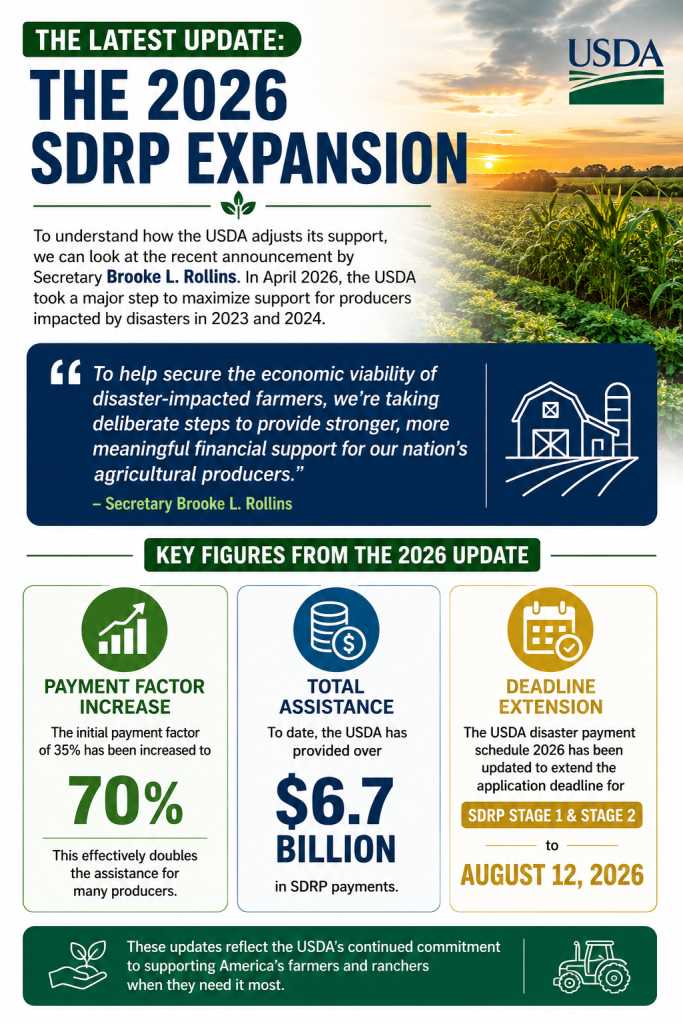
The Latest Update: The 2026 SDRP Expansion

To understand how the USDA adjusts its support, we can look at the recent announcement by Secretary Brooke L. Rollins. In April 2026, the USDA took a major step to maximize support for producers impacted by disasters in 2023 and 2024.

As Secretary Rollins stated:

“To help secure the economic viability of disaster-impacted farmers, we’re taking deliberate steps to provide stronger, more meaningful financial support for our nation’s agricultural producers.”

Key Figures from the 2026 Update:

  • Payment Factor Increase: The initial payment factor of 35% has been increased to 70%. This effectively doubles the assistance for many producers.
  • Total Assistance: To date, the USDA has provided over $6.7 billion in SDRP payments.
  • Deadline Extension: The USDA disaster payment schedule 2026 has been updated to extend the application deadline for SDRP Stage 1 and Stage 2 to August 12, 2026.

USDA Disaster Payment Eligibility Requirements

Not every weather event triggers a payment. To maintain an evergreen operation, you should know the specific triggers for usda disaster assistance:

  • Qualifying Events: Includes wildfires, hurricanes, floods, excessive heat, tornadoes, winter storms, and smoke exposure.
  • Drought Specifics: For usda drought payments, the loss must occur in a county rated by the U.S. Drought Monitor as D2 (severe drought) for eight consecutive weeks, or D3 (extreme drought) or higher.
  • Small vs. Large Operations: There is specific usda disaster payment for small farms support, ensuring that smaller acreage operations aren’t overshadowed by industrial giants.

Comparing Your Options: USDA Disaster Payment vs. Crop Insurance

One common question we hear is: If I have insurance, do I still need disaster payments? The answer is almost always yes.

Feature Crop Insurance USDA Disaster Payment (SDRP)
Source Private policies (often subsidized) Direct Federal Government funding
Purpose Immediate indemnity for specific yield loss Supplemental relief for “shallow” or quality losses
Timing Paid shortly after loss adjustment Dependent on Congressional funding/cycles
Coverage Based on your specific policy level Covers gaps left by insurance or Noninsured Crop Disaster Assistance Program (NAP)

For those with livestock, the livestock indemnity program acts as a parallel safety net, specifically covering deaths in excess of normal mortality caused by adverse weather.

How to Apply: The USDA Disaster Payment Application

Applying for federal aid can feel like a mountain of paperwork, but it’s manageable if you are organized. The process usually begins at your local Farm Service Agency (FSA) office. A great place to start is the FSA disaster assistance discovery tool, which helps you identify which programs fit your specific loss.

To ensure your usda disaster payment application is processed quickly, have the following ready:

  • AD-3117 Form: The primary application for disaster relief.
  • Acreage Reports: Documentation of what was planted and where.
  • Evidence of Loss: Photos, vet records (for livestock), or insurance adjuster reports.
  • FSA Record-keeping: Ensure your farm records are updated in the Federal Register system through your local office.

Turning Relief into a Roadmap: The Specialist Perspective

As a USDA feasibility study specialist, I see disaster payments as more than just “emergency money.” They are a bridge.

Often, a disaster reveals a weakness in a farm’s infrastructure—perhaps a lack of efficient irrigation or the need for more resilient storage facilities. When you receive a usda erp payment or SDRP funds, it’s the perfect time to look at Rural Development loans.

Many of these long-term, low-interest loans require a professional feasibility study to prove the project’s viability. This is where agricultural management consulting becomes invaluable. We help you take the capital from a disaster payment and leverage it into a loan for a project that ensures you won’t be as vulnerable the next time the weather turns.

Closing Thoughts

While the August 12, 2026 deadline is the current priority, the mechanics of usda disaster relief remain a constant in the industry. By staying organized, keeping meticulous records for the FSA, and looking toward long-term development, you turn a season of loss into a foundation for growth.

Are you planning to use your disaster relief funds to expand or modernize? Get in touch with August Brown USDA feasibility study experts today to discuss how a professional feasibility study can help you secure the next stage of your farm’s journey.

Frequently Asked Questions (FAQs)

1. What is the current USDA disaster payment status?

As of May 2026, USDA disaster payments for the Supplemental Disaster Relief Program (SDRP) are actively being processed. Producers with approved applications for 2023 and 2024 losses are currently receiving their funds. You can check your individual status by contacting your local Farm Service Agency (FSA) office or logging into the Farmers.gov portal.

2. When will SDRP payments be made?

SDRP payments are being issued on a rolling basis. According to the USDA announcement on April 24, 2026, the second round of payments (the “top-up”) began immediately following the analysis that increased the payment factor. Most producers with approved Stage 1 and Stage 2 applications should see funds in their accounts throughout May and June 2026.

3. How is the USDA disaster payment amount calculated?

The payment amount is determined by your total calculated loss minus any prior insurance indemnities. The most critical figure for 2026 is the 70% payment factor.

  • Previous Factor: 35%
  • New 2026 Factor: 70%
  • Formula: (Total Calculated Loss x 70%) – Previous Payments = Remaining Amount Due.

4. What is the USDA drought relief 2026 payment schedule?

The deadline to apply for drought-related relief under the SDRP is August 12, 2026. Payments are typically disbursed within weeks of application approval. For losses occurring in 2023 and 2024, the USDA has prioritized these payments to help farmers recover from “D2 Severe” or “D3 Extreme” drought conditions.

5. Is there an SDRP payment limit?

Yes, SDRP payments are subject to per-person or legal entity limitations as mandated by the American Relief Act of 2025. While limits vary based on the specific type of farming operation and Adjusted Gross Income (AGI), the standard cap for most supplemental disaster programs typically ranges between $125,000 and $250,000. Contact a consultant or your FSA representative for specific entity-based caps.

6. What is the SDRP Stage 1 second payment?

The “Stage 1 second payment” refers to the additional 35% being sent to producers who previously received an initial payment at the 35% factor. Because the USDA increased the factor to 70%, this second payment acts as a “catch-up” to ensure all eligible farmers receive the full 70% of their calculated disaster relief.

7. How do I get the SDRP top-up payment?

The SDRP top-up payment is issued automatically to producers who have already submitted an approved application. You do not need to file a new application to receive the increase from 35% to 70%. However, if your application requires modifications, you have until the August 12, 2026 extension deadline to make changes.

8. Is there an SDRP payment calculator?

While the USDA does not provide a public-facing automated calculator, farmers can use the FSA-639 or AD-3117 worksheets provided by their local office. To estimate your payment:

  1. Take your total crop/livestock loss value.
  2. Multiply by 0.70.
  3. Subtract any insurance or NAP payments received.
  4. The remainder is your estimated SDRP payout.

gordon nameni

Dr. Gordon Nameni, PhD
Managing Partner at August Brown

Best USDA Grants for Rural Businesses in 2026 [Complete Guide]

Key Insights for 2026 Rural Funding

  • REAP Dominance: The Rural Energy for America Program (REAP) continues to offer up to 50% grant coverage for energy efficiency and solar projects in 2026.
  • New Restrictions: Ground-mounted solar projects exceeding 50kW now face higher scrutiny and deprioritization.
  • Infrastructure Shift: Recent federal focus has shifted toward “climate-smart” agriculture and domestic supply chain resilience.
  • Indirect Access: Programs like the USDA RBDG are awarded to nonprofits and public bodies to benefit small businesses, rather than direct cash to individuals.
  • Digital Prep: An active SAM.gov registration and Unique Entity Identifier (UEI) are mandatory and take 2–4 weeks to process.

Introduction: The Rural Growth Engine

For many entrepreneurs, the path to scaling an agricultural or rural operation is paved with USDA grants for rural businesses. In 2026, the landscape for rural business funding has evolved, with a heavy emphasis on sustainability and energy independence.

USDA business grants are not just “free money”—they are strategic partnerships designed to keep rural economies competitive. Whether you are looking to lower your utility bills with solar or need technical assistance to launch a new product, understanding the USDA grant programs available this year is the first step toward long-term viability.

What Are USDA Business Grants?

USDA business grants are financial awards from the U.S. Department of Agriculture that do not require repayment (unlike loans). Most of these programs are managed by USDA Rural Development (RD), a mission area specifically dedicated to improving the economy and quality of life in rural America.

USDA Grants vs. Loans: A Consultant’s View

Feature USDA Grants USDA Guaranteed Loans
Repayment $0 (No repayment required) Must be repaid with interest
Availability Highly competitive; specific windows Available year-round; higher volume
Best For Innovation, energy, and planning Large-scale construction and real estate
Funding Cap Usually capped (e.g., $500k–$1M) Can exceed $25 million (B&I Loans)

Types of USDA Grants for Rural Businesses

The USDA categorizes its support into three main buckets to address different business needs:

  • Business Development Grants: Focus on training, USDA grant feasibility studies, and market expansion.
  • Energy & Renewable Grants: Help businesses lower operating costs through solar, wind, or HVAC upgrades.
  • Rural Infrastructure Grants: Target water, waste disposal, and high-speed internet in rural communities.

By identifying which bucket your project falls into, you can narrow down the USDA rural business grants that match your goals.

Top USDA Grant Programs for Rural Businesses

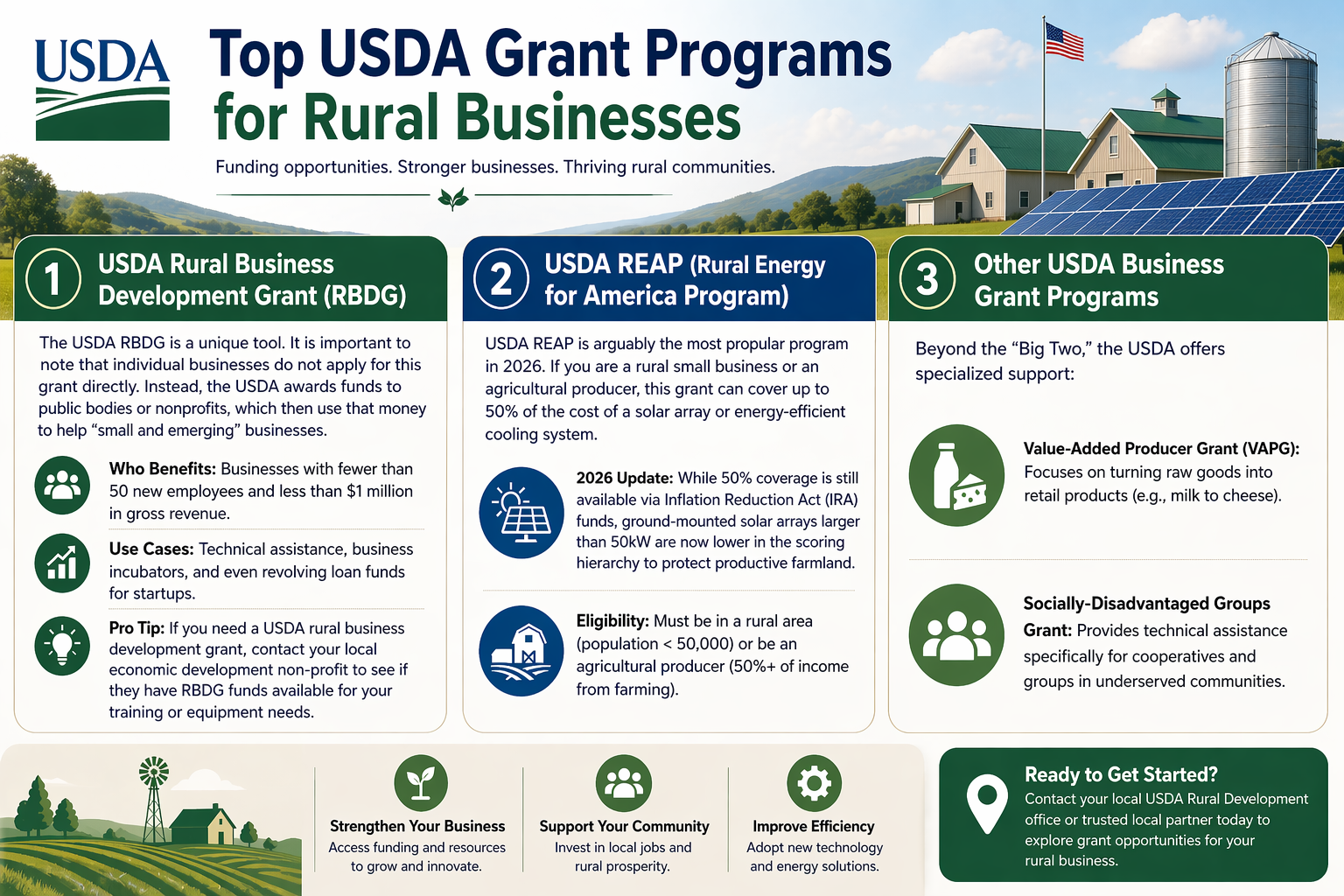
1. USDA Rural Business Development Grant (RBDG)

The USDA RBDG is a unique tool. It is important to note that individual businesses do not apply for this grant directly. Instead, the USDA awards funds to public bodies or nonprofits, which then use that money to help “small and emerging” businesses.

  • Who Benefits: Businesses with fewer than 50 new employees and less than $1 million in gross revenue.
  • Use Cases: Technical assistance, business incubators, and even revolving loan funds for startups.
  • Pro Tip: If you need a USDA rural business development grant, contact your local economic development non-profit to see if they have RBDG funds available for your training or equipment needs.

2. USDA REAP (Rural Energy for America Program)

USDA REAP is arguably the most popular program in 2026. If you are a rural small business or an agricultural producer, this grant can cover up to 50% of the cost of a solar array or energy-efficient cooling system.

  • 2026 Update: While 50% coverage is still available via Inflation Reduction Act (IRA) funds, ground-mounted solar arrays larger than 50kW are now lower in the scoring hierarchy to protect productive farmland.
  • Eligibility: Must be in a rural area (population < 50,000) or be an agricultural producer (50%+ of income from farming).

3. Other USDA Business Grant Programs

Beyond the “Big Two,” the USDA offers specialized support:

  • Value-Added Producer Grant (VAPG): Focuses on turning raw goods into retail products (e.g., milk to cheese). Read our complete guide to the USDA VAPG for a deep dive into this program.
  • Socially-Disadvantaged Groups Grant: Provides technical assistance specifically for cooperatives and groups in underserved communities.

Eligibility Criteria for USDA Rural Business Grants

To secure USDA business grants, your project must meet strict “Rural” and “Small Business” definitions

  1. Rural Location: Most programs require the project to be in an area with a population of less than 50,000. You can check your specific address on the USDA Eligibility Map.
  2. Citizen Status: You must be a U.S. citizen or a qualified alien.
  3. For-Profit vs. Non-Profit: While REAP is for-profit, RBDG is for public entities. Ensure your business structure aligns with the program rules.

How to Apply for USDA Grants (Step-by-Step)

Capturing rural business funding requires a methodical approach. Don’t rush the paperwork—the USDA is famous for its attention to detail.

  • Step 1: Identify the Program. Don’t try to fit a “square” project into a “round” grant window.
  • Step 2: Get Your UEI. Register at SAM.gov. This is a non-negotiable first step.
  • Step 3: Contact your State Office. Before writing, call your USDA State Energy Coordinator. They are often willing to review a “concept paper.”
  • Step 4: Build Your Narrative. Explain how the grant creates jobs or saves energy in your rural community.
  • Step 5: Submit & Follow Up. Most applications are submitted through your local office or Grants.gov.

Tips to Increase Your Chances of Approval

Winning federal rural business grants is competitive. To stand out:

  • Quantify Everything: Don’t say you’ll “create jobs”—say you’ll “create 4 full-time equivalent (FTE) positions.”
  • Leverage Feasibility Studies: A professional analysis shows the USDA you’ve done the math.
  • Start Early: SAM.gov registration issues are the #1 reason applications are late.

Common Mistakes to Avoid

  • The “Double Dipping” Myth: You generally cannot use two different federal grants for the exact same dollar of a project.
  • Incomplete Environmental Reviews: If your project involves construction, you must pass the USDA environmental review before you start work
  • Ignoring the Match: Most USDA grants require a 1:1 match. Ensure your bank statements show you have the matching funds ready to go.

Conclusion

Navigating USDA grant programs in 2026 requires a blend of technical knowledge and strategic planning. Whether you’re looking to slash energy costs with REAP or expand your market through VAPG, these programs offer a transformative opportunity for rural entrepreneurs.

Ready to take the next step? Contact August Brown today for expert advisory support to help align your project with federal requirements and maximize your chances of approval.

Frequently Asked Questions (FAQs)

1. What is the most common USDA grant for small businesses?

The USDA REAP grant is the most common, as it applies to almost any rural small business (from grocery stores to manufacturers) looking to upgrade their energy systems.

2. Can I apply for a USDA grant if I live in a city?

Generally, no. The project itself must be located in a designated rural area (typically under 50,000 population). However, agricultural producers can sometimes qualify regardless of their home address if their production is rural.

3. How long does the USDA grant process take?

From submission to funding, expect a 6–9 month window. The scoring and ranking process takes time, and environmental reviews can add several weeks.

4. What is the difference between REAP and RBDG?

REAP provides direct grants to for-profit businesses for energy. RBDG provides grants to nonprofits and towns to help small businesses with training and equipment.

5. Do I have to pay taxes on USDA grants?

Yes, in most cases, federal grants are considered taxable income. Always consult with a tax professional regarding your specific award.

gordon nameni

Dr. Gordon Nameni, PhD
Managing Partner at August Brown

USDA Value-Added Producer Grant (VAPG) 2026: Complete Guide To Eligibility & Application Process

The USDA Value-Added Producer Grant (VAPG) is a federal funding program that helps agricultural producers create, process, and market value-added products. It supports farmers and rural businesses in increasing income by moving beyond raw production into higher-value activities such as processing, branding, and direct sales.

Key Takeaways

  • Financial Support: The USDA Value-Added Producer Grant (VAPG) provides funding for value-added agriculture projects.
    Provides up to $50,000 for Planning and $200,000 for Working Capital.

  • Strategic Growth: Focuses on processing, marketing, and expanding existing agricultural products.
  • Expertise Matters: A robust business plan and third-party feasibility study are often required for approval.
  • Competitive Edge: Applications are scored on work plan quality, personnel qualifications, and commitment.
  • Eligible applicants include farmers, producer groups, and cooperatives.

What Is the USDA Value-Added Producer Grant (VAPG)?

The USDA Value-Added Producer Grant program is designed to help agricultural producers increase the value of what they produce. Instead of selling raw products, businesses can use the grant to process, package, or market their products more effectively.

To qualify as “Value-Added“, the USDA looks for projects that meet one of five specific methodologies:

  1. Change in Physical State: (e.g., turning berries into jam or wheat into flour).

  2. Produced in a Manner that Enhances Value: (e.g., Organic or Grass-fed certifications).

  3. Physical Segregation: (e.g., keeping non-GMO corn separate from standard corn).

  4. Farmer-to-Consumer: (e.g., selling directly to local schools or through a CSA).

  5. Locally-Produced Food: Locally-Produced Food: (e.g., marketing products within 400 miles or within the same state).

The program supports both planning activities (like market research) and working capital activities (like packaging and labor) related to these projects.

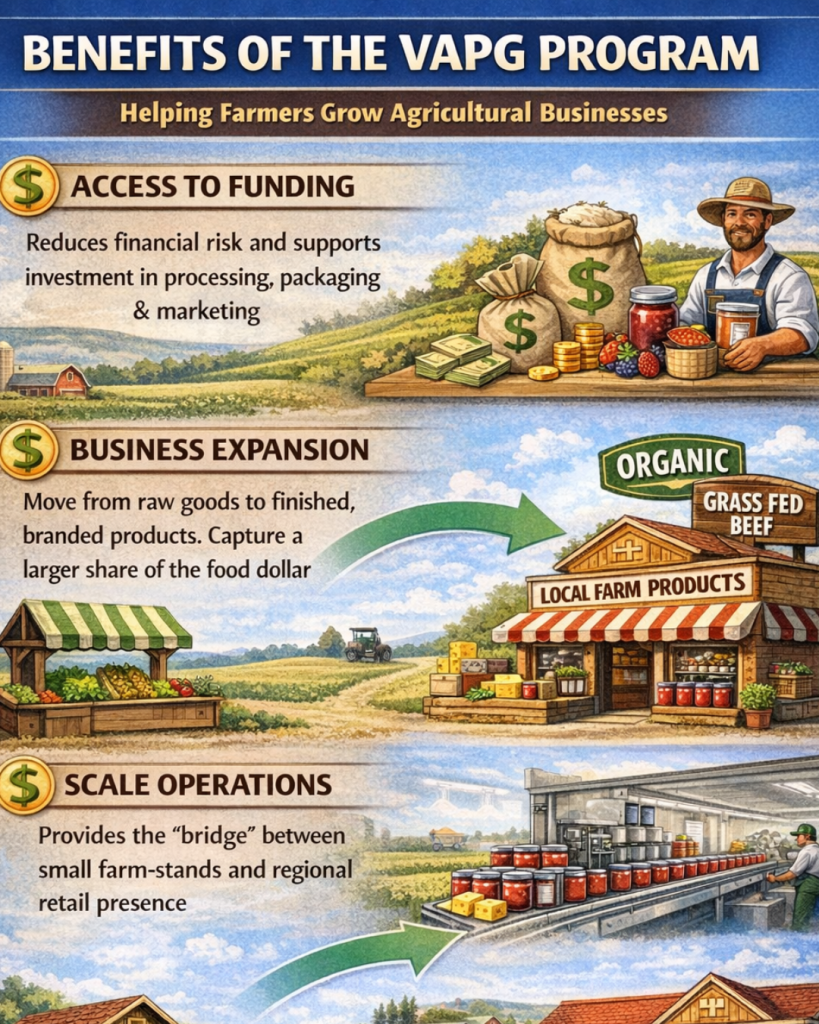
VAPG program benefits for farmers.png

Benefits of the VAPG Program

The program provides practical support for businesses looking to grow. One of the main benefits is access to agricultural business funding, which reduces the financial risk of starting or expanding a value-added project. It allows producers to invest in processing, packaging, and marketing activities that increase product value.

Another key benefit is business expansion. Producers can move from selling raw goods to offering finished or branded products. This vertical integration allows the producer to capture a larger share of the food dollar, creating a more resilient business model against fluctuating commodity prices.

The grant also supports farm product processing, enabling businesses to scale operations. For many producers, this funding acts as the “bridge” between a small farm-stand operation and a regional retail presence.

USDA VAPG Eligibility Criteria

Understanding USDA VAPG eligibility is essential before applying. The program is open to several types of applicants. Eligible applicants include independent agricultural producers, farmer or rancher cooperatives, agricultural producer groups, and majority-controlled producer-based businesses.

To meet VAPG eligibility requirements, applicants must be actively involved in agricultural production and clearly show how their project adds value. Eligible activities must focus on value-added agriculture, such as processing, product development, marketing, or expanding into new markets.

Applicants must also provide a clear business plan, financial information, and a defined project scope. Applications that do not clearly explain how value is being added are often rejected.

How to Apply for USDA VAPG?

The value added producer grant application process requires careful planning.

First, confirm eligibility by reviewing the USDA VAPG eligibility criteria and ensuring your business qualifies. A VAPG Self-Assessment Survey is available to help determine your eligibility.

Second, prepare a detailed business plan. This should include your product, target market, financial projections, and how the grant will be used.

Third, gather all required documents such as financial statements, proof of agricultural activity, and project details.

Fourth, submit your VAPG Application through the USDA system before the deadline.

Fifth, follow up after submission by tracking your application and responding to any additional requests.

Applicants should also review official USDA Value Added Producer Grants resources to understand current requirements and real project outcomes.

Funding Details and Use Cases

The USDA VAPG grant provides funding for activities that support value addition. Grant amounts vary depending on the project type and scope.

Funding can be used for processing setup, marketing, branding, feasibility studies, and working capital related to value-added activities. These are common forms of agricultural business funding and farm product processing grants.

Typical use cases include setting up a food processing unit, launching a branded farm product, improving packaging, or expanding into new markets. The goal is always to increase the value of existing agricultural products.

Common Mistakes to Avoid

  1. Many applications fail due to avoidable issues. One common mistake is applying without meeting USDA VAPG eligibility requirements. This leads to immediate rejection.
  2. Another issue is a weak business plan. Applications without clear financials or market strategy are often not approved.
  3. Missing or incomplete documents in the VAPG application can also lead to disqualification.
  4. A major mistake is failing to clearly show value addition. If the project does not explain how the product becomes more valuable, it will not meet program criteria.

Real Examples of VAPG Grants

Looking at value added producer grant examples helps understand what works in practice.

USDA’s Value-Added Producer Grants (VAPG) help farmers increase income by turning raw produce into branded, higher-value products. For example, Living Water Farms used VAPG support to expand the market for its hydroponic greens, reaching supermarkets, restaurants, and institutional buyers across the Midwest. Such real-world success stories show how funding can help small farms scale sustainably and access larger markets.

Want to explore more such success stories? Read the complete article here:

These examples show that successful applications clearly connect production with value addition, market demand, and long-term business growth.

Conclusion

The USDA Value-Added Producer Grant (VAPG) is a strong opportunity for farmers and rural businesses to increase income through value-added agriculture. It supports processing, marketing, and expansion, helping businesses move beyond raw production.

Success depends on preparation. Understanding eligibility, building a strong business plan, and clearly showing value addition are critical.

For businesses planning to apply, structured analysis and feasibility planning can improve approval chances and reduce risk. Contact August Brown to receive advisory support that aligns your project with funding requirements and long-term business goals.

Frequently Asked Questions (FAQs)

1. Can I use VAPG funds to buy farm equipment?

No. VAPG funds are restricted to processing and marketing activities. They cannot be used for the purchase of land, buildings, or production equipment like tractors. If you are looking for equipment funding, you might explore the checkout August Brown’s blog on USDA REAP Grant.

2. What is the matching requirement for the VAPG?

The program requires a 1:1 match. This means for every $1 in grant funds you request, you must contribute $1 of your own. This match can be cash or eligible in-kind contributions, such as the value of the raw commodity you are providing to the project.

3. Is a feasibility study required for all VAPG applications?

A third-party feasibility study is required for all Working Capital grant requests over $50,000. It is not strictly required for Planning grants or smaller Working Capital requests, though a solid business case is still necessary.

5. How long do I have to spend the grant funds?

Planning grants are typically expected to be completed within 12 months. Working capital grants can span up to 36 months, depending on the project scope defined in your work plan.

gordon nameni

Dr. Gordon Nameni, PhD
Managing Partner at August Brown

USDA REAP Grant 2026: Eligibility & Application Process Steps

The 2026 Energy Opportunity

Right now, the federal government is making one of the biggest pushes in history to help rural America cut energy costs and build energy independence. At the center of that effort is the USDA REAP Grant, the Rural Energy for America Program and if you haven’t looked into it yet, 2026 is the year to start.

The REAP program provides grants and loan guarantees to help agricultural producers and rural small businesses invest in renewable energy systems and make energy efficiency improvements. The funding has been significantly boosted in recent years, and USDA REAP grant eligibility 2026 is now broader and more accessible than ever before.

What makes this such a significant opportunity? Two things. First, REAP can cover up to 50% of your eligible project costs & that’s not a discount, that’s free money you never have to pay back. Second, the program is designed specifically for people who often don’t have access to the same capital markets as large corporations: farmers, ranchers, and small business owners in rural communities.

Whether you want to install solar panels on your barn, upgrade your facility’s HVAC system, add wind energy to your operation, or make other energy improvements, the USDA REAP Grant could be the funding vehicle that makes it happen. But the window is competitive, and the process has specific requirements. This guide walks you through everything you need to know.

Eligibility – Who Can Secure Funding?

usda-reap-grant-application

Before starting the usda reap grant application, the first step is to check if you qualify.

The program is open to two main groups:

  • Agricultural producers: If you’re a farmer, rancher, or anyone who produces agricultural products, you fall into the agricultural producer category. The key rule here is income: at least 50% of your gross income must come from agricultural operations. That could mean crop production, livestock, aquaculture, or other related farming activities. Agricultural producers are eligible regardless of where their operation is located, you don’t need to be in a rural zone to qualify under this category. This is an important distinction. If you run a farm anywhere in the country and meet the income threshold, you’re in.
  • Rural small businesses: The second category covers for-profit businesses that are located in rural areas. The USDA defines rural as any area with a population under 50,000, and that covers a large portion of the country. If your business operates in one of those communities, you may qualify for rural small business solar financing and broader energy upgrade funding through REAP. Unlike agricultural producers, rural small businesses must be located in an eligible rural area. The business also needs to be the primary applicant (not a lender, contractor, or third party)

Many business owners think REAP is only for farms, but that is not true. Rural businesses can qualify as long as they meet the location and size rules.

REAP Grant vs Guaranteed Loan

One of the most common questions is the difference between a grant and a loan. Understanding REAP grant vs guaranteed loan is important before planning a project.

Feature REAP Grant REAP Guaranteed Loan
Type Grant (no repayment) Loan (must be repaid)
Coverage Up to 50% of project cost Up to 75% of project cost
Competition High Moderate
Can be combined Yes Yes
Project size Small to large Medium to very large

Many successful projects use both.

For example:

  • 50% grant
  • 40% guaranteed loan
  • 10% owner contribution

This allows businesses to complete large energy projects without paying the full cost upfront. Understanding the difference between REAP grant vs guaranteed loan helps applicants choose the right financing structure and improve their chances of approval.

The 33% Rule & Solar Technicalities

If you’re planning a solar energy project which is one of the most popular uses of REAP funding, there’s a critical technical rule you must understand before you size your system. Get this wrong, and your application can be disqualified before anyone even reads it.

What Is the 33% Rule in Solar Panels?

The 33% rule in solar panels refers to the REAP program’s limitation on how much energy a new renewable energy system can generate relative to your facility’s existing energy consumption. Specifically, the solar installation you propose can only generate up to 125% of your current energy needs as documented in your energy audit.

So where does the 33% rule come into play? In practical terms, it means REAP is designed to offset energy consumption, not to create a surplus generation operation. If your facility uses 100 kWh of electricity per month, your REAP-funded solar system cannot be sized to generate 300 kWh: it’s meant to serve the building, not function as a small power plant.

This rule matters most for rural small business solar financing projects where applicants try to oversize their systems to maximize the grant dollar amount. If your system size exceeds what’s allowed under this formula, the USDA will flag it immediately, and your application will not move forward.

Why This Is a Make-or-Break Requirement

The 33% rule exists to keep REAP focused on real energy cost reduction for the applicant, not on speculative energy production. The USDA wants to see that the system you’re proposing directly offsets your actual measured energy consumption and the only way to prove that is through a proper energy audit.

This is exactly why a professional energy assessment is not just recommended for many projects, it’s required. Without accurate baseline energy consumption data, you can’t correctly size the system, and you can’t prove to the USDA that your project meets this requirement.

Scoring Your Success: The Technical Merit Score

Here’s something many applicants don’t realize until it’s too late: REAP is a competitive program. The USDA doesn’t just hand out grants to everyone who applies and qualifies. Applications are ranked against each other using a scoring system, and the Technical Merit Score is the single most important factor in whether you get funded.

The technical merit score looks at:

  • Project feasibility
  • Energy savings accuracy
  • Financial strength
  • Environmental benefit
  • Engineering quality
  • Completeness of documents

Because the program is competitive, the Technical merit score (Critical for REAP approval) often decides whether the project gets funded. Two projects may both qualify, but the one with better documentation and stronger technical support will rank higher.

Projects with professional feasibility work usually score better because they include:

  • Correct system sizing
  • Verified energy data
  • Financial modeling
  • Risk analysis
  • Clear project plan

Without these, the application may look incomplete, even if the idea itself is good.

USDA REAP Grant Application Process – Step by Step

Step 1: Understand the Two Application Tracks

Before you begin, know that REAP has two tracks:

  • Small grants (< $20,000) – simpler process, reduced documentation.
  • Larger grants & loans – competitive, quarterly cycles, full technical reports required.

This guide covers the standard process for larger projects.

Step 2: Confirm Your Eligibility (Quick Check)

  • You are an agricultural producer (≥50% income from farming) OR a rural small business (located in an area with <50,000 population).
  • Your project is either renewable energy (solar, wind, biomass, etc.) or energy efficiency (HVAC, insulation, lighting, etc.).

Step 3: Complete Mandatory Federal Registrations – DO THIS FIRST

Missing this step is the #1 reason applications get rejected.
You cannot apply without these registrations, and they take 2–4 weeks to process.

  • Get a UEI (Unique Entity Identifier) – free at SAM.gov.
  • Register in SAM.gov (System for Award Management) – keep your registration active.
  • Obtain a DUNS number (if you don’t already have one – though UEI is now the primary).

Step 4: Prepare Your Technical Documentation

The quality of these documents directly determines your Technical Merit Score.

  • For energy efficiency projects – a professional Energy Audit (ASHRAE Level 1 or 2 recommended).
  • For renewable energy projects – a Technical Report including:
    1. Energy production estimates
    2. System design and sizing (must comply with the 33% rule)
    3. Feasibility analysis
    4. Environmental questionnaire (USDA Form RD 4280-3)

Step 5: Gather Financial and Supporting Documents

You will need:

  • Last 3 years of financial statements (balance sheet, P&L)
  • Vendor quotes or installation cost estimates
  • Proof of ownership or long‑term lease for the project site
  • Business plan (1–2 pages describing your operation and why you need the grant)

Step 6: Complete the Required Application Forms

The following forms are mandatory for all standard REAP applications:

Form Number Name
SF-424 Application for Federal Assistance
RD 4280-2 Application for REAP Grant/Loan
SF-424C Budget Information
SF-424D Assurances – Construction Programs
RD 4280-3 Environmental Questionnaire

 Small grants under $20,000 use a simplified form – RD 4280‑2 (short version). Check with your state office.

Step 7: Submit Your Application – WHERE to Submit Matters

❌ Do NOT submit on Grants.gov – that is a common mistake.
✅ Submit directly to your USDA Rural Development State Office.

  • Find your state office here: rd.usda.gov/contact
  • Submission method: email (PDF) or physical mail – confirm with your state contact.
  • Keep proof of submission (timestamped email receipt).

Step 8: Know the Quarterly Deadlines

Applications are accepted in competitive cycles – usually:

Cycle Deadline (approx.)
Q1 January 31
Q2 April 30
Q3 July 31
Q4 October 31

Apply early in the cycle – funding is limited, and late applications are held for the next quarter.

Step 9: What Happens After Submission – Scoring & Approval

  • Eligibility check – your state office confirms basic requirements.
  • Technical review – your application is scored (0–100 points) based on:
    1. Energy savings / production
    2. Environmental benefits
    3. Financial feasibility
    4. Project readiness
  • Ranking – highest scores receive funding until the quarterly pool is exhausted.
  • Notification – if selected, you receive a Letter of Conditions.
  • Grant agreement – you sign and return it.

Step 10: Execute Your Project – CRITICAL WARNING

DO NOT start your project before you receive written approval from USDA.
Starting early will disqualify you from reimbursement.
You must wait until the grant agreement is fully executed.

Once approved:

  • Complete the project according to the approved scope.
  • Submit invoices and proof of payment.
  • USDA reimburses the grant portion (up to 50% of eligible costs, or 75% for combined grant+loan).

Why Partner with August Brown?

Small projects can sometimes be completed with basic documentation. Larger projects require much more detail.

For projects above $200,000, the USDA expects:

  • Full feasibility analysis
  • Accurate energy calculations
  • Financial modeling
  • Engineering support
  • Risk review
  • Clear business case

This is where professional support becomes important.

August Brown provides feasibility studies, technical reviews, and financial analysis that help projects meet federal requirements and improve the chances of approval because the Technical merit score plays such a big role, having the right documentation can make the difference between receiving funding and missing the opportunity.

August Brown works with agricultural producers, rural businesses, developers, and lenders to prepare projects that meet USDA standards and stay within program rules. A properly prepared application not only follows the guidelines but also shows reviewers that the project is realistic, efficient, and worth funding.

Don’t leave your 50% grant to chance. Contact August Brown to make sure your REAP application meets every technical and federal requirement.

Frequently Asked Question (FAQs)

1. What is the USDA REAP Grant?

The USDA REAP (Rural Energy for America Program) Grant is a federal funding program that helps agricultural producers and rural small businesses invest in renewable energy systems and energy efficiency improvements. It can cover up to 50% of eligible project costs, and unlike loans, it does not need to be repaid.

2. Who is eligible for the USDA REAP Grant in 2026?

Eligibility falls into two categories:

  • Agricultural producers: Must earn at least 50% of their income from farming operations.
  • Rural small businesses: Must be located in areas with a population under 50,000.

Agricultural producers can apply regardless of location, while rural businesses must meet location criteria.

3. What types of projects qualify for REAP funding?

Eligible projects include:

  • Solar panel installations
  • Wind energy systems
  • Biomass and geothermal energy
  • HVAC upgrades
  • Lighting and insulation improvements

Both renewable energy and energy efficiency projects are supported.

4. How much funding can I receive from the REAP Grant?

The REAP grant can cover up to 50% of total project costs. Applicants can also combine it with a USDA guaranteed loan (up to 75%), reducing their upfront investment significantly.

5. What is the difference between a REAP Grant and a Guaranteed Loan?

  • REAP Grant: Free funding, no repayment required
  • Guaranteed Loan: Must be repaid but backed by USDA

Many applicants combine both to finance large projects.

gordon nameni

Dr. Gordon Nameni, PhD
Managing Partner at August Brown

USDA B&I Feasibility Study: A 2026 Guide to Rural Business Expansion

In the rapidly evolving economic landscape of 2026, rural business owners are facing a unique set of challenges. While urban centers often dominate the financial headlines, the backbone of the American economy remains firmly rooted in our rural communities. If you are looking to scale your operations, modernize your facility, or launch a new venture in a rural area, the USDA Business and Industry loan guarantee program stands as one of the most powerful financial tools at your disposal.

However, securing a loan of up to the USDA B&I loan maximum amount of $25 million isn’t as simple as filling out a one-page form. The “gatekeeper” to this capital is a specialized document: the USDA B&I Feasibility Study.

At August Brown, we understand that this requirement can feel like a daunting hurdle. This guide is designed to demystify the process, align with current 2026 7 CFR Part 5001 compliance standards, and show you exactly how to apply for a USDA B&I loan 2026 successfully.

USDA - SBA Loans by Jake Stamas

What exactly is the USDA B&I Loan Program?

The USDA Business and Industry loan guarantee program is a public-private partnership. The USDA doesn’t lend you the money directly; instead, they provide a guarantee to a commercial lender (like your local bank), covering up to 80% of the loan. This guarantee significantly reduces the bank’s risk, allowing them to offer USDA B&I loan rates and terms 2026 that are much more favorable than traditional commercial loans.

As of March 2026, the application window is officially OPEN. Applications are accepted from lenders on an ongoing basis throughout the fiscal year, meaning you don’t have to wait for a specific “grant season” to move your project forward.

USDA B&I loan maximum amount and Use of Funds

  • Maximum Amount: Generally up to $25 million.
  • Use of Funds: Business conversion, enlargement, repair, modernization, purchase of land, buildings, and even machinery and equipment.
  • Location: Projects must be located in “rural” areas, typically defined as cities or towns with a population of 50,000 or less.

The Core Requirement: Why You Need a USDA B&I Feasibility Study

If you are a startup or a business undergoing a significant expansion, a USDA B&I Feasibility Study is not optional—it is a regulatory mandate under the Rural Development Guaranteed Loan Initiative.

The USDA and your lender need objective proof that your business can actually generate the cash flow required to repay the debt. This is where many applications fail. A “DIY” report or a generic business plan will not satisfy a federal reviewer in 2026. The Agency specifically requires an independent third-party consultant to conduct the study to ensure there is no conflict of interest.

Why the “Independent” Part Matters

A truly independent third-party consultant, like the experts at August Brown, provides an unbiased look at your:

  1. Market Feasibility: Is there actual demand for your product in 2026?
  2. Technical Feasibility: Can the proposed facility handle the production volume?
  3. Financial Feasibility: Does your Debt Service Coverage Ratio (DSCR) for USDA meet the minimum 1.0 to 1.25x requirement?
  4. Management Feasibility: Does your leadership team have the “skin in the game” and experience to succeed?

2026 USDA B&I loan eligibility requirements at a Glance

Before investing time into an application, it’s vital to ensure you meet the baseline USDA B&I loan eligibility requirements.

Category Requirement for 2026
Entity Type For-profit businesses, nonprofits, cooperatives, and federally recognized Tribes.
Citizenship At least 51% of the business must be owned by U.S. citizens or permanent residents.
Location Must be in a rural area (population < 50,000).
Credit Score While there is no “hard” minimum, most top USDA B&I lenders look for a score of 680+ for principals.
Equity Typically requires 10% equity for existing businesses and 20% for startups (the “20% rule”).

How to apply for a USDA B&I loan 2026: A Step-by-Step Path

Navigating the federal bureaucracy requires a strategy. Based on the 2026 7 CFR Part 5001 compliance updates, here is the most efficient path to funding:

  1. Preliminary Lender Discussion: Speak with a commercial lender to see if they are interested in your project.
  2. Engage USDA B&I loan consulting services: Contact August Brown to begin your USDA B&I Feasibility Study. According to the USDA, this preparation process can take anywhere from a few weeks to several months, so starting early is critical.
  3. The Lender’s Analysis: Your lender will perform their own lender’s analysis and credit evaluation. They will use our feasibility study to support their credit memo.
  4. Submission to USDA Rural Development: The lender submits the complete package to the USDA state office for a “Conditional Commitment.”
  5. Closing: Once the USDA approves the guarantee, you close the loan and begin your project.

Comparison: B&I vs. REAP Loans in 2026

Many August Brown clients find themselves choosing between the B&I program and the Rural Energy for America Program (REAP). While both are excellent, they serve different purposes.

Feature USDA B&I Loan USDA REAP Loan
Primary Focus General Business Growth/Jobs Energy Efficiency & Renewables
Max Loan $25 Million 75% of Project Costs
Grant Component None Yes (up to 50% of costs)
Feasibility Need High (Mandatory for Startups) Technical/Energy Audit Required
2026 Status Open Year-Round Grants Paused; Loans Open

Why Choose August Brown for Your USDA B&I loan consulting services?

Our team doesn’t just provide a document; we provide a roadmap. When you work with us, you aren’t just getting an independent third-party consultant; you are getting a partner who understands the nuances of 7 CFR Part 5001 compliance. We have established relationships with top USDA B&I lenders across the country, helping you find the right “home” for your loan request.

As noted on our feasibility page, our goal is to “package your loan request and identify the best lender to make it happen”. We know that a study that takes “several months” to prepare can kill a deal. Our streamlined approach ensures accuracy without sacrificing your timeline.

Final Thoughts: The 2026 Rural Advantage

The Rural Development Guaranteed Loan Initiative is a massive opportunity for those who are prepared. In an era where traditional bank financing can be tight, the USDA’s backing is a “golden ticket” for rural developers.

Don’t let the technicality of a USDA B&I Feasibility Study stop your progress. By following the USDA B&I loan eligibility requirements and partnering with a professional firm, you can secure the capital needed to transform your community.

Ready to start?

The window is OPEN. Contact the consultants at August Brown today to see how we can bridge the gap between your vision and your funding.

For more official information, you can visit the USDA Rural Development portal.

Frequently Asked Questions (FAQs)

1. What disqualifies you from a USDA B&I loan?

Common disqualifiers include:

  • Projects located in non-rural areas.
  • Businesses involved in gambling, lending, or illegal activities.
  • A history of federal debt delinquency.
  • Inadequate equity or collateral.
  • A feasibility study that fails to prove a positive Debt Service Coverage Ratio (DSCR) for USDA.

2. What is the income limit for rural development in 2026?

Unlike residential USDA loans, the B&I program does not have a maximum income limit for the business owners. The focus is on the project’s ability to create jobs and improve the rural economy, not on the owner’s personal wealth.

3. Can you build a house with a B&I loan?

No. The B&I program is strictly for commercial purposes. For housing, you would look toward the USDA 502 Direct or Guaranteed programs.

4. What are the current 2026 equity requirements for a USDA B&I loan?

Under 7 CFR Part 5001, the USDA strictly enforces minimum tangible balance sheet equity (TBSE) requirements. For existing businesses, a minimum of 10% equity is required at the time of loan closing. For new businesses or startups, this requirement jumps to 20%. This is often referred to as the “20% rule” in rural lending.

5. How much does a USDA B&I Feasibility Study cost?

While costs vary based on the complexity of the project (e.g., a $2 million expansion vs. a $20 million startup), most professional studies range between $10,000 and $30,000. Because the USDA requires an independent third-party consultant, this is an essential investment that ensures your application isn’t rejected for being biased or incomplete.

gordon nameni

Dr. Gordon Nameni, PhD
Managing Partner at August Brown

The Definitive Guide to Economic Feasibility Study in 2026: Securing Investment and Operational Success

Let’s be honest: in 2026, the global market is no longer a place for “gut feelings” or “giving it a shot.” Whether you’re looking to break ground on a new sawmill, scale a green energy plant, or modernize a manufacturing facility, the stakes have never been higher.

Before the first brick is laid or the first loan is signed, you need to answer one fundamental question: Does this project actually make sense in the current economic landscape? That is where an economic feasibility study comes in. It is more than just a document; it is your strategic roadmap, your risk insurance, and your ticket to securing high-stakes funding.

What is an Economic Feasibility Study? (The 2026 Perspective)

An economic feasibility study is a comprehensive analysis used to determine if a proposed project or business venture is viable when considering all economic factors. While a market feasibility study looks at “will people buy it,” an economic study looks at the broader ecosystem: labor availability, resource security, utility costs, and long-term sustainability.

In 2026, this analysis has evolved. It no longer just measures profit; it measures resilience. With shifting supply chains and new federal regulations, an economic feasibility analysis must account for “what-if” scenarios like energy price spikes or carbon tax implications.

Importance of Economic Feasibility: Why ROI Isn’t the Only Metric

Why bother with a deep dive into economics? Because profit on paper doesn’t always translate to success in the real world.

The importance of economic feasibility lies in its ability to uncover “deal-breakers” before you spend millions. It provides:

  • Risk Mitigation: Identifying hidden costs like infrastructure upgrades or regulatory compliance fees.
  • Resource Security: Ensuring you have a steady supply of raw materials (feedstock) at a predictable price.
  • Lender Confidence: For programs like the USDA Feasibility Study, an economic analysis is often a non-negotiable requirement for a 90% loan guarantee.

Financial Feasibility vs. Economic Feasibility: Understanding the Difference

This is a point of confusion for many. While they overlap, they serve two different masters.

Feature Financial Feasibility Economic Feasibility
Primary Focus Internal profitability and cash flow. Broad market viability and resource security.
Key Question “Can we pay back the debt?” “Does this project make sense in this economy?”
Metric IRR, NPV, Debt Service Coverage Ratio. Opportunity cost, social impact, resource availability.
Scope Private gain. Private gain + External factors (Jobs, Environment, Tech).

Economic Feasibility Study :The Key to Project Success

The Core Framework: Technical Economic Feasibility Study

A truly robust report isn’t just about spreadsheets; it’s a technical economic feasibility study. This means looking at the “how” just as much as the “how much.”

At August Brown, we find that the most successful projects in 2026 are those that master capacity utilization. If your technical setup isn’t optimized for your economic inputs, your margins will vanish.

Key Components of the Technical-Economic Blend:

  1. Infrastructure Assessment: Can the local power grid or water supply handle your 2026 demand?
  2. Labor Modeling: Is there a skilled workforce within a 50-mile radius, or will you need to factor in high relocation costs?
  3. Logistics & Supply Chain: How do fluctuating fuel prices impact your project cost analysis?

Economic Feasibility Study: A 5-Step Methodology

How to Conduct Economic Feasibility Study: A 5-Step Methodology

If you are looking for a feasibility study framework, follow these steps to ensure your economic feasibility report hits the mark for 2026 standards.

1. Define the Scope and Objectives

Before you dive into the deep end of data collection, you must establish your “North Star.” Defining the scope is the most critical phase of any feasibility study methodology because it prevents “scope creep”—the tendency for a project’s requirements to grow uncontrollably. In this stage, you aren’t just asking if a project is possible; you are identifying the specific boundaries of your investigation. Are you testing the economic viability of a single geographic location, or are you validating the scalability of a disruptive new technology?

A robust feasibility study analysis requires a clear set of objectives. For instance, if you are a sawmill owner looking to modernize, your objective might be: “To determine if upgrading to AI-driven sorting technology will provide a positive ROI within five years under current timber price volatility.” By being this specific, you ensure that the rest of your study remains focused, measurable, and—most importantly—bankable for future investors.

2. Market and Resource Assessment

Success in 2026 depends entirely on your place in the supply chain. A project doesn’t exist in a vacuum; it requires a stable flow of inputs and a hungry market for its outputs. This stage of the project feasibility assessment involves a dual-layered approach. First, we evaluate the demand: who is buying your product, and how does your pricing hold up against global competitors? Second, we look at resource stability. If your facility depends on specialized feedstock or high-volume utilities, we investigate the long-term reliability of those sources.

3. Cost-Benefit Analysis (CBA)

The cost benefit analysis feasibility study is the beating heart of your report. This is where we move beyond simple accounting and into the realm of economic viability analysis. We calculate the total anticipated capital expenditure (CAPEX) and operating expenses (OPEX) against the total expected benefits—both direct and indirect. In 2026, “benefits” often include more than just cash revenue; they include carbon credits, secondary waste-stream monetization, and regional tax incentives.

Federal agencies and institutional lenders use this section to determine the “social return” on their investment. To understand the rigorous standards used by the government, you can see how federal agencies weigh these benefits on the Federal Register. By presenting a clear, data-backed CBA, you demonstrate project economic viability to stakeholders who are looking for long-term stability rather than short-term gains.

4. Financial Modeling & Sensitivity Analysis

The biggest mistake a developer can make is assuming a static market. In this phase, we use Monte Carlo simulations to stress-test your project against 1,000+ scenarios—such as 20% supply chain cost surges or slower-than-expected capacity utilization. This process identifies your break-even point, moving your project profitability analysis away from “best-case” dreams and into the reality of market volatility.

5. The Go/No-Go Decision

A professional feasibility study report example must culminate in a definitive, actionable recommendation. Based on the data, is the project economically viable? If “Yes,” we provide the strategic roadmap for implementation. If “No” or “Not yet,” we identify the necessary pivots—such as a different location, adjusted technology, or a more secure feedstock contract. Investors value this section of the investment feasibility study because it provides an objective, third-party perspective that removes emotional bias.

Economic Feasibility Study Example: A 2026 Scenario

Let’s look at an economic feasibility study sample for a mid-sized sawmill expansion in the Southeast.

  • The Project: A $15M upgrade to process small-diameter timber.
  • Technical Factor: Modernizing saws to handle “ecosystem restoration byproducts.”
  • Economic Factor: Identifying a 10-year feedstock supply from local private foresters.
  • Outcome: The study found that while the initial CAPEX was high, the 2026 “Climate-Smart” tax credits made the project profitability analysis extremely attractive to lenders.

This type of feasibility study for business is exactly what turns a risky idea into a “bankable” project.

Conclusion: Don’t Build on Shifting Sands

An economic feasibility study of a project is the difference between a successful launch and a costly failure. By analyzing the technical, financial, and environmental factors together, you create a project that isn’t just “profitable”—it’s sustainable.

In the fast-moving economy of 2026, clarity is your most valuable asset. Whether you need a feasibility study report sample pdf to start your research or a full-scale investment feasibility study to secure a multi-million dollar loan, the team at August Brown is here to help you navigate the complexity.

Ready to prove your project’s potential?

Contact August Brown Today to speak with a feasibility expert and start your journey toward a “bankable” future.

Frequently Asked Questions (FAQs)

1. What is an economic feasibility study with example?

It is an evaluation of whether a project provides enough value to justify its costs. For example, a bakery might conduct one to see if the local population can support a $500,000 expansion given the rising costs of flour and labor in 2026.

2. Why is an economic feasibility report necessary for a business plan?

It validates the assumptions in your business plan. It proves to investors that you have accounted for external risks like market volatility and resource scarcity.

3. How much does an economic feasibility study cost?

In 2026, a certified study for a USDA or SBA loan typically ranges from $15,000 to $35,000, depending on complexity. You can find more details in our guide on USDA Feasibility Study Costs.

gordon nameni

Dr. Gordon Nameni, PhD
Managing Partner at August Brown

Underwriting Services Complete Guide 2026

Many entrepreneurs believe that a brilliant product and a solid work ethic are the only ingredients needed to secure a business loan. They spend months perfecting their pitch decks and refining their technology, only to hit a brick wall when they finally submit their application to a lender. The reality is that many businesses fail to secure financing not because their idea is weak, but because they fail during the underwriting stage.

Underwriting services are the bridge between a business’s ambition and a lender’s capital. In the world of business and project financing, underwriting is the rigorous process of verifying data, assessing risk, and determining whether a borrower can actually pay back the money. While it might feel like a hurdle, understanding this process is actually a strategic advantage.

This guide focuses specifically on business underwriting services and project financing. Usually underwriting is mentioned with insurance policies or mortgage careers; but here we are talking about the deep financial analysis required to get your commercial project funded. By preparing for the underwriting review before you even walk into a bank, you can significantly improve loan approval chances and position your company for sustainable growth.

What Are Underwriting Services in Business Financing?

In a business context, underwriting services act as a sophisticated filter. When a commercial bank or private equity group considers a deal, they use commercial underwriting services to evaluate the “health” of the opportunity. Think of it as a financial physical exam. Just as a doctor looks at vital signs to determine physical health, an underwriter looks at financial metrics to determine fiscal health.

An underwriter’s job is to look past the marketing hype and examine the cold, hard facts of a business. Specifically, underwriting services for business loans evaluate:

  • Financial Health: Is the company currently profitable, or does it have a clear, documented path to profitability?
  • Risk Exposure: What external or internal factors could prevent the business from meeting its obligations?
  • Repayment Ability: Does the business generate enough cash flow to cover the new debt plus its existing expenses?
  • Collateral Strength: If things go wrong, are there tangible assets that can protect the lender?

Ultimately, these services provide a credit risk assessment that tells a lender whether the reward of interest or equity is worth the risk of losing the principal investment. For boutique agencies like August Brown, these services are about more than just checking boxes; they are about understanding the unique story of a business and ensuring that story is told through data.

The Underwriting Services Process for Commercial & Business Loans

The loan underwriting process is methodical and highly structured. It is designed to be objective, leaving little room for “gut feelings.” Here is how the journey usually unfolds, from the first document submitted to the final handshake.

1. Financial Documentation Review

The process begins with an intensive financial documentation review. This is where many businesses stumble simply by being unorganized. An underwriter will request a mountain of paperwork, including:

  • Balance Sheets & Income Statements: Usually covering the last three to five years to show trends.
  • Cash Flow Statements: The most scrutinized document in the pile.
  • Tax Returns: Both business and, in many cases, personal returns for major stakeholders.
  • Business Plans: A comprehensive roadmap including a due diligence process report.

At August Brown, we find that the “depth” of this documentation often dictates the speed of the underwriting review. If the records are messy, fragmented, or missing, the underwriter assumes the business management is also messy. Organization is the first signal of a low-risk borrower. For those seeking government-backed options, you can review the 2026 SBA 7(a) loan underwriting requirements to see how federal standards align with private lending criteria.”

2. Cash Flow & Repayment Analysis

This is the heart of the underwriting analysis. Underwriters care more about cash flow than they do about “accounting profit.” Profit is what you have left on paper; cash flow is what you use to pay the bills and, more importantly, the lender.

The most critical metric used here is the debt service coverage ratio (DSCR).

Here is the DSCR Formula:

DSCR= Net Operating Income / Total Debt Service

DSCR Formula

If your ratio is 1.0, you are exactly breaking even, every dollar coming in is going right back out to pay debt. Most lenders want to see a ratio of 1.25 or higher, providing a “cushion” for unexpected expenses or market downturns. This creditworthiness assessment determines if your business has the breathing room to survive a bad month without missing a payment.

3. Collateral & Risk Evaluation

Even if your cash flow looks great, lenders want a “Plan B.” This is where collateral evaluation comes in. Underwriters look at real estate, equipment, inventory, or accounts receivable that could be liquidated if the loan defaults.

Beyond physical assets, the underwriting decision hinges on a financial risk assessment of your industry. Is the market shifting? Are you in a “sunset” industry or a “sunrise” industry? By analyzing these underwriting risk factors, the lender sets the final terms of the deal, including interest rates and repayment schedules.

What Do Underwriters Look At?

Underwriting is more than just running numbers through a spreadsheet; it is a form of risk storytelling. To get to an underwriting approval process milestone, you must prove stability across several key areas:

  • Revenue Stability: Are your earnings consistent, or do they swing wildly from month to month? Seasonal businesses often face tougher underwriting because they must prove they can manage cash during the “off” months.
  • Debt Levels: How much do you already owe? An overleveraged business is a major red flag. Underwriters look at your “Debt-to-Equity” ratio to see how much of the business is financed by you versus other lenders.
  • Capital Invested: Lenders want to see “skin in the game.” If the owners haven’t invested their own capital, why should the bank take all the risk?
  • Management Experience: Does the team have a track record of navigating industry downturns? In commercial financing, the “jockey” is often as important as the “horse.”
  • Market Viability: Is there a documented demand for the product or service? This is where your market analysis becomes crucial.
  • Project Feasibility: For large-scale builds, a project financing assessment ensures the construction and operational costs are realistic and backed by actual quotes, not just estimates.

Comparison of Lender Perspectives

Factor What Lenders Seek Why It Matters
DSCR 1.25x or higher Ensures you can comfortably afford payments.
Equity 10% to 25% Shows commitment and reduces lender risk.
Credit Score Professional/Personal Indicates past behavior and reliability with debt.
Collateral Real estate, Equipment Provides a safety net for the lender in a worst-case scenario.
Experience 5+ years in industry Reduces the risk of operational failure.

Common Underwriting Risk Factors & Red Flags

Understanding why loans are rejected is the best way to reduce loan rejection risk. During a financial underwriting service review, certain “red flags” will immediately trigger a more skeptical look or an outright denial.

  1. Inconsistent Revenue: If your income looks like a roller coaster, underwriters worry you won’t be able to make a payment during a “dip.” They look for a steady upward or stable trend.
  2. Weak Collateral: If the assets you are pledging are specialized equipment with low resale value, they don’t provide much security. General-use real estate is always preferred over niche machinery.
  3. Incomplete Documentation: Missing tax returns or “estimated” financial figures suggest a lack of professional oversight. It signals to the lender that you aren’t ready for the responsibility of a large loan.
  4. Unrealistic Projections: If your feasibility study claims you will triple your revenue in six months without a clear marketing and operational plan, you lose credibility instantly.
  5. Customer Concentration: If 80% of your revenue comes from one client, what happens if that client goes bankrupt? This is a massive risk factor that underwriters look to mitigate.

These risks can often be identified and corrected early through underwriting consulting services. By acting as your own ‘pre-underwriter,’ you can fix these issues before a lender ever sees them. Resources like SCORE’s financial projection templates are excellent tools for ensuring your data meets professional standards before submission.


What are 5 Cs of Credit and How to Use them in 2025? (+Examples)

How Underwriting Services Evaluate the 5 C’s of Credit

The commercial lending world operates on a classic framework known as the 5 C’s. Every underwriting criteria list eventually boils down to these fundamental pillars. Understanding them allows you to see your business through the eyes of the bank.

1. Character

This is perhaps the most subjective but important “C.” It refers to the reputation and track record of the business owners. Have you ever defaulted on a loan? Do you have a history of successful business ventures? Character is your “financial integrity.” Lenders want to work with people they trust to do the right thing when times get tough.

2. Capacity

This is your creditworthiness assessment in action. Do you have the legal and financial capacity to repay the debt? Underwriters look at your history of cash flow and your current debt obligations to see if you can handle “just one more” payment. They are looking for “room to breathe.”

3. Capital

How much money have you, the owner, put into the business? Lenders are much more comfortable lending money to a business where the owners have a significant financial stake. Capital serves as a buffer; if the business takes a hit, your capital is the first thing lost, not the bank’s money.

4. Collateral

This is the tangible security for the loan. If the business cannot repay the debt through cash flow (Capacity), the lender looks to sell the Collateral to recoup their loss. A strong collateral evaluation can sometimes make up for a slightly weaker “Capacity” score.

5. Conditions

These are external factors that you cannot control but must account for. This includes the state of the economy, interest rate environments, industry-specific trends, and the specific purpose of the loan. For example, a loan for “expansion” is viewed differently than a loan for “working capital to cover losses.”

How Professional Underwriting Services Improve Funding Success

This is where the strategy changes from being reactive to being proactive. Most businesses wait for a lender to tell them what is wrong with their application. However, high-growth companies use professional underwriting services to prepare their case in advance.

Instead of waiting for a rejection, underwriting consulting services allow you to conduct a Pre-Lender Underwriting Analysis. This goes beyond simple math; for a deeper look at how these two disciplines differ, see our guide on Underwriting vs. Risk Assessment.

1. Conduct a Pre-Lender Underwriting Analysis

By hiring a firm like August Brown, you can perform an internal underwriting review before you apply. We look at your books with the same skeptical eye as a bank auditor. If your debt service coverage ratio is too low, we identify it now, giving you time to adjust your capital structure or reduce expenses. This “pre-flight check” saves months of back-and-forth with a bank.

2. Strengthen Your “Risk Story”

Every business has risks. The goal of underwriting support services is not to hide those risks—that’s impossible and often illegal, but to present a risk mitigation strategy. If you have a concentration of revenue in one client, we help you document the long-term contracts, “sticky” relationships, or diversification plans that make that risk manageable. We turn “problems” into “calculated risks with solutions.”

3. Optimize Financial Presentation

A funding readiness assessment ensures that your financial statements aren’t just accurate, but are presented in a way that aligns with lender evaluation criteria. This includes cleaning up balance sheets, ensuring that non-recurring expenses (like a one-time legal fee or a move) are clearly labeled so they don’t unfairly drag down your perceived profitability.

Using outsourced underwriting services essentially gives you the “answer key” to the test before you take it. This preparation is the single most effective way to improve loan approval chances. It transforms you from a “loan seeker” into a “qualified partner.”

Industry-Specific Project Underwriting

Not all underwriting is created equal. At August Brown, we specialize in industries with complex capital requirements and technical nuances. Standard underwriting often fails these businesses because it doesn’t account for the long-term nature of the assets.

Project underwriting services for sectors like renewable energy, infrastructure, manufacturing, and bio-based industries require a deeper level of expertise. A project financing assessment for a renewable energy plant, for example, must account for:

  • Long-term ROI Models: How will energy prices or carbon credit values fluctuate over 20 years?
  • Regulatory Risk: Are there government subsidies or environmental mandates that could change with a new administration?
  • Technical Feasibility: Does the technology actually work at scale? Underwriters need to see a feasibility study that proves the science behind the business.
  • Supply Chain Resilience: Where are the raw materials coming from? If you are a bio-based manufacturer, the reliability of your feedstock is a primary risk factor.

In these cases, a feasibility study is not just a suggestion; it is a requirement. Lenders in these niches need to see that a third party has verified every technical and financial assumption in the business plan. This is where August Brown’s decades of experience in engineering and operations provide a distinct advantage. We speak the language of the engineer and the banker, bridging the gap between a technical idea and a financial reality.

When Should a Business Use Underwriting Services?

You don’t always need a deep underwriting analysis for a small line of credit or a minor equipment lease. However, there are specific “inflection points” in a company’s life where underwriting services for business loans are essential for success:

  • Applying for Large Commercial Loans: When you are asking for millions, the level of scrutiny increases exponentially. You cannot afford to “wing it.”
  • Seeking Project Financing: Especially for infrastructure or “green” energy projects where the capital is deployed over several years and repayment is tied to project performance.
  • Entering Capital-Intensive Industries: If you are buying millions of dollars in machinery or specialized facilities, the lender will want a rigorous collateral evaluation.
  • Preparing for Investor Funding: Private equity groups and venture capitalists often use commercial underwriting services as part of their “Buy-Side” due diligence to verify a company’s valuation.
  • Expanding Operations Globally: If you are moving into a new territory, a funding readiness assessment can prove the expansion is sustainable and that you have accounted for local market risks.
  • Refinancing Existing Debt: To get a better interest rate, you must prove to a new lender that your risk profile has improved since you took out your original loan.

The Value of an Independent Perspective

One of the biggest mistakes a business owner can make is being too close to their own finances. It is easy to overlook a mounting debt-to-equity issue or a declining margin when you are focused on daily operations.

Professional underwriting services provide an objective, third-party perspective. We aren’t here to tell you what you want to hear; we are here to tell you what a lender needs to hear. This objectivity is exactly why firms like August Brown are trusted by commercial banks and investors. When we provide a reasonableness opinion or a feasibility assessment, it carries weight because it is backed by data-driven rigor and a deep understanding of the underwriting decision process.

By engaging with underwriting consulting services early, you aren’t just preparing for a loan; you are conducting a strategic audit of your entire business model. You are identifying inefficiencies, uncovering hidden risks, and ultimately building a more resilient company.

Conclusion

Securing business financing is a high-stakes game of data, transparency, and trust. Underwriting services are the tools that lenders use to verify that data and build that trust. By understanding the loan underwriting process and the specific underwriting criteria used to evaluate your business, you move from a position of “hoping for the best” to a position of strategic power.

Proper preparation, whether through a feasibility study, a due diligence process, or a financial risk assessment, is the most effective risk mitigation strategy you have. Professional guidance doesn’t just help you get a “yes”; it helps you secure better terms, lower interest rates, and a capital structure that supports your long-term vision rather than strangling your cash flow.

At August Brown, we are dedicated to helping our clients navigate these complexities. We provide the depth and insight needed to exceed lender expectations and unlock the opportunities that drive sustainable growth. Our mission is to ensure that your innovation doesn’t end up in the graveyard of ideas due to poor financial execution, but instead reaches its full potential to impact the world.

FAQs

1. What are underwriting services?

Underwriting services are professional financial evaluation services that assess the risk of approving a loan, investment, or funding request. In business financing, these services review financial documents, cash flow, collateral, and risk factors to determine whether a company meets specific lender approval standards. They act as the “gatekeepers” of the capital.

2. What do underwriters look at during underwriting?

During the process, underwriters evaluate a business’s creditworthiness, financial statements, cash flow, existing debt obligations, and collateral. They also look at “soft” factors like management experience, industry trends, and market conditions to determine the overall stability of the borrower.

3. What is the underwriting process for business loans?

The process typically involves four stages: documentation gathering, financial analysis (focusing on the debt service coverage ratio), collateral appraisal, and a final risk assessment. The underwriter then issues an approval, a denial, or a “conditional approval,” which requires the borrower to meet certain criteria before funds are released.

4. Can you get denied during underwriting?

Yes. A loan application can be denied if the underwriter finds insufficient cash flow, high debt levels, poor credit history, or inadequate collateral. Denials can also happen if the financial documentation is found to be inconsistent, if there is a lack of transparency, or if the industry risk is deemed too high for the lender’s current “appetite.”

5. What are common underwriting red flags?

Common red flags include unstable or declining revenue, an overleveraged balance sheet (too much debt relative to equity), incomplete tax records, and unrealistic financial projections. Unresolved legal issues, tax liens, or a high concentration of revenue in just one or two customers are also major deterrents for lenders.

gordon nameni

Dr. Gordon Nameni, PhD
Managing Partner at August Brown

The Strategic Guide to Patent Valuation 2026: Maximizing IP Value for Growth

Introduction: The Strategic Role of IP in 2026

Let’s be honest: in the current industrial landscape, a patent that just sits in a frame on your wall is a wasted opportunity. In 2026, intellectual property has evolved into a high-stakes financial asset. Whether you’re a founder scaling a biorefinery or an executive preparing for a major acquisition, valuing intellectual property is no longer a “check-the-box” legal task—it’s a core requirement for securing capital.

At August Brown, we often see that patent valuation is the make-or-break element of a Feasibility Study. If you can’t quantify the worth of your tech, you can’t leverage it. This aligns with the United States Patent and Trademark Office Fiscal Year 2026 Congressional Submission , which emphasizes that as American innovation becomes more complex, the “durability” and clear economic value of a patent are what truly drive market competitiveness. Professional ip valuation consulting ensures your hard work is translated into a language that banks and investors actually understand: dollars and cents.

What is Patent Valuation? (The Fundamentals)

Think of patent valuation as the bridge between a brilliant engineering breakthrough and a solid balance sheet. While your legal team tells you what your patent protects, ip valuation services tell you what that protection is worth in the real world.

It’s easy to get lost in the jargon, but the goal of a patent valuation methodology is simple: to determine the “Fair Market Value” of your invention. This isn’t just about how much you spent on R&D (a common mistake); it’s about the patent’s ability to generate future revenue, save on costs, or block competitors from your niche. We look at the “Technical Readiness Level” (TRL) to see if your tech is ready for the market or if it’s still a lab-bench dream.

The 3 Primary Patent Valuation Methods

1. The Cost Approach (The “Baseline”): This method asks: “What would it cost a competitor to build this from scratch today?” We look at reproduction costs (making an exact copy) and replacement costs (making something with the same utility).

  • When to use it: Best for early-stage technology (TRL 1-3) where market data is scarce.
  • The August Brown Insight: We treat this as the “floor.” It’s a vital metric for insurance or tax purposes, but it often fails to capture the “genius” of the invention—the logic being that a $100,000 R&D project could yield a $100 million solution.

2. The Market Approach (The “Benchmark”): Similar to a real estate appraisal, this looks at what similar patents have sold for in recent transactions.

  • When to use it: Most effective in active sectors like software or consumer electronics where patent sales are frequent.
  • The August Brown Insight: The challenge here is the “Novelty Problem.” If your technology is truly disruptive (like a new bio-catalyst), there are no “comparables.” We use specialized transaction databases to find proxy deals that help us estimate a fair market price.

3. The Income Approach (The “Gold Standard”): This is the most rigorous method. It values the patent based on the future cash flow it will generate. We specifically look at the Relief from Royalty method—calculating how much a company saves by owning the patent instead of licensing it from a third party.

  • When to use it: Mandatory for USDA loan guarantees, M&A, and securing expansion capital.
  • The August Brown Insight: This is where we bridge the “Value Gap.” By projecting the 10-year savings or profit increases (like the 15% downtime reduction in our sensor example), we can justify a valuation that is significantly higher than the development cost.

Why Professional Expertise is Mandatory in 2026

It is tempting to try and save time by using automated patent valuation software. However, if you are walking into a meeting with a lender or a federal agency, a software printout isn’t going to cut it. Algorithms don’t understand the nuance of a specialized industrial process or the specific risks of a new biobased material.

This is especially critical for high-stakes funding like the USDA Section 9003 Program. Underwriters for major loan guarantees aren’t looking for a “guess”; they require a report from a certified patent valuation expert.

According to the USDA Section 9003 Program Guide, independent technical and economic appraisals are mandatory. Only reputable patent valuation firms can provide the “defensibility” needed to move a $100M+ project forward.

Real-World Application: Patent Valuation Example

To understand the real-world impact of a professional appraisal, consider a scenario common in the manufacturing sector. Many innovative firms find themselves “asset-rich but cash-constrained” because their most valuable property—their IP—isn’t properly reflected on their balance sheet.

The “Value Gap” Scenario: Imagine a tech-driven manufacturing firm that has developed a proprietary sensor system to reduce downtime in industrial automation.

  • The Internal View: Their accounting team might value the patent based solely on the $2 million spent on R&D (the Cost Approach).
  • The August Brown View: Instead of just looking at what it cost to build the technology, we analyzed the actual profit it generates. By measuring how much money the sensor saves customers, specifically by cutting equipment downtime by 15%, we prove its true economic value.

The Result: This shift in patent valuation methodology can often bridge a multi-million dollar gap. In a typical case, a defensible report might justify an asset value of $8.5 million instead of just $2 million. This isn’t just a bigger number on paper—that $6.5 million difference is the “collateral” a company needs to secure expansion capital through a USDA loan or an M&A deal without having to sacrifice extra equity in the business

Choosing the Right Valuation Partner

Not all patent valuation firms are created equal. You need a partner who can speak “Engineer” in the morning and “Banker” in the afternoon. When vetting patent valuation companies, ask if they have experience with your specific TRL and if they understand the unique underwriting requirements of industrial lenders.

At August Brown, our patent valuation services aren’t just about crunching numbers; they’re about “Tech Translation”—making sure the true genius of your innovation is fully reflected in your financial valuation.

Conclusion

In 2026, your patents are either a line item on a legal bill or a powerhouse on your balance sheet. Don’t let your innovation go unquantified. Whether you are preparing for a merger, resolving a dispute, or seeking project funding, a professional appraisal is the key to unlocking your true market potential.

Explore August Brown’s Expert IP Valuation Services and Contact us today for a defensible report you can trust.

Frequently Asked Questions

1. How long does a professional patent valuation take?

A standard, audit-ready valuation typically takes between two and six weeks. The timeline depends on the complexity of your technology and how much market data is available. If you are in a high-growth sector like AI or biotech, the process can be faster because there are more “market comparables” to reference.

2. Can I use my patent as collateral for a loan?

Yes, you can. In 2026, lenders are increasingly willing to accept intellectual property as collateral. This is especially true for government-backed programs like the USDA Section 9003 loan. However, for a bank to accept your IP, you must provide a third-party valuation report that proves the “Income Potential” of the asset.

3. Why is the “Income Approach” the preferred method?

While the Cost Approach tells you what you spent, the Income Approach tells you what you will earn. Investors and lenders prefer this method because it focuses on future cash flow. By calculating the “Relief from Royalty” (what you save by owning the tech), we can provide a number that reflects the true financial power of your innovation.

4. Can I value my own patent internally?

You can certainly create an internal estimate for your own planning. However, if you are using that valuation for taxes, M&A, or bank financing, you need an independent, third-party report. Professional firms like August Brown provide the “defensibility” required to stand up to IRS audits or bank underwriting teams.

5. Does a “pending” patent have any value?

Definitely. While a granted patent is usually worth more, a “patent-pending” status still holds significant value. We account for this by applying a “probability adjustment” to the valuation. This measures the likelihood of the patent being granted and the strength of the current claims.

gordon nameni

Dr. Gordon Nameni, PhD
Managing Partner at August Brown

The 2026 Feasibility Study Checklist: Beyond the Basics

In the world of project development, the goalposts have shifted. If you are preparing a project for 2026, a standard “check the box” report is no longer enough to satisfy investors or federal agencies. We have entered an era where independent risk intelligence is the primary currency. Consequently, your feasibility study checklist must evolve to meet these new demands. Whether you are looking for a USDA loan or private equity backing, the standard for what a project feasibility study 2026 must provide has shifted from simple “viability” to long-term “resilience.”

Whether you are looking for a USDA loan or private equity backing, the standard for what a project feasibility study 2026 must provide has evolved from simple “viability” to “resilience.” At August Brown, we have seen far too many groundbreaking technologies end up in what we call the “execution graveyard.” These projects were technically sound but failed because their feasibility studies weren’t up-to-date.

This guide moves beyond the basics. It explores the deeper layers of analysis required to turn a vision into a bankable, sustainable reality.

The Core Framework: Parts of a Feasibility Study

When people ask what does a feasibility study include?, they often think of a simple 5 key components of feasibility study : economic, market, technical, financial, and management. While these remain the pillars, the way we analyze them today requires a more nuanced approach. In 2026, the parts of a feasibility study must be interconnected, showing how a change in one area impacts the others.

1. Market Resilience and Moat Validation

It is no longer enough to prove there is a “market” for your product. You must prove that your market position is resilient. This involves a deep dive into your competitive “moat.” How easily can a competitor with more capital or better AI-integration displace you? We look at “captive versus competitive” end-user analysis to ensure your revenue isn’t just theoretical.

2. Operational Viability Assessment

An operational viability assessment goes beyond checking if you have a building and staff. It looks at the “connective tissue” of your business. This includes your internal culture, your ability to attract specialized talent in a tight labor market, and the robustness of your digital infrastructure. If your operations rely on a single point of failure (like one specific supplier or one unique software), your feasibility is at risk.

3. Integrated Economic Impact

Beyond your internal P&L, 2026 standards require looking at the broader economic ecosystem. How does your project impact the local sector? Are you creating new markets or just cannibalizing existing ones? This is especially important for projects seeking government support or community buy-in.

Technical and Operational Deep-Dive: TRLs and Resilience

The feasibility report requirements for industrial and technology projects have become significantly more rigorous. One of the most critical feasibility study steps is the objective assessment of Technical Readiness Levels (TRL).

Understanding Technical Readiness Levels (TRL)

In 2026, investors are wary of “lab-scale” success. They want to see that your technology has moved through the TRL stages (typically 1 to 9) and is ready for commercial deployment. A professional study must verify:

  • TRL 6: A representative model or prototype system has been tested in a relevant environment (The Bridge to Reality).
  • TRL 7: A system prototype has been demonstrated in an operational environment (The Stress Test).
  • TRL 8: The actual system is completed and “flight qualified” through test and demonstration (The Final Proof).

If your project is at TRL 4 but your financial projections assume TRL 9 efficiency, your study will not hold up under professional scrutiny. Understanding where you truly sit on this scale is the difference between a project that gets funded and one that stays in the lab.

Supply Chain and Automation Readiness

The global supply chain is more fragmented than ever. Your feasibility study must include a “stress-tested” logistics plan. This means identifying secondary and tertiary suppliers for critical inputs. Furthermore, as labor costs rise, your study should analyze how automation can be integrated to maintain margins. We no longer ask if a project can be built; we ask if it can be sustained through the next global supply disruption.

The Financial Stress-Test and IP Valuation

A simple five-year projection is a starting point, not a conclusion. To meet 2026 expectations, you need to move toward dynamic modeling.

1. Stress-Testing Financial Models

We don’t just look at the “best case” scenario. We use stress-testing financial models to see what happens to your debt coverage if interest rates rise by 2% or feedstock costs jump by 20%. This level of honesty builds trust with commercial banks. While this feasibility study checklist ensures you have all the necessary components, avoiding 5 common pitfalls in feasibility studies is equally critical for project success.

2. IP Valuation Checklist

For many 2026 projects, the most valuable asset isn’t the equipment; it’s the Intellectual Property (IP). An IP valuation checklist is now a mandatory part of the process. According to guidelines from The International Valuation Standards Council (IVSC), your study should evaluate:

  • The legal strength and “freedom to operate” regarding your patents.
  • The remaining “useful life” of the technology before it becomes obsolete.
  • The income-generating potential specifically tied to that IP.

3. ESG Criteria and Funding

Environmental and Social Governance (ESG) criteria are no longer “optional extras.” They are core financial metrics. Many institutional investors now have strict ESG mandates. If your project doesn’t have a clear plan for carbon footprint reduction, waste management, or social impact, you may find yourself locked out of low-interest capital

Specialized Requirements: USDA and Industry Specifics

For many of our clients, the goal is securing specialized funding like a USDA 9003 or REAP loan. These agencies don’t just want a “good report”—they require a specific USDA-ready framework. Think of this framework as a strict template of “evidence” that proves your project won’t fail and leave the government with the bill.

To satisfy the USDA Rural Development guidelines, your framework must include:

  • Technical Merit: This isn’t just your word; it’s an independent engineer’s review verifying that the technology actually works at scale.
  • Credit Feasibility: A data-driven demonstration that your project can pay back its debt even if your revenue drops or costs rise.
  • Site Assessment: A deep dive into the “where.” Does the site have the utilities, environmental clearances, and logistical access needed to succeed?

August Brown specializes in building these high-stakes frameworks. We understand that a USDA underwriter isn’t just looking for a “yes” or “no”—they are looking for a data-driven narrative that proves your project is a safe bet for the rural economy.

Conclusion 

A feasibility study checklist is a vital map, but a map is only as good as the person reading it. In 2026, the difference between a project that gets funded and one that fails lies in the depth of the insight provided. You need more than just data; you need a navigator who understands the intersection of finance, engineering, and market reality.

At August Brown, we don’t just provide a report. We provide a tailored roadmap designed to unlock new opportunities and maximize the value of your offering.

While a general checklist is a vital map, every high-stakes project requires a custom route. Contact August Brown today to receive a professional review of your project’s viability and a tailored checklist for your specific 2026 funding goals

Frequently Asked Questions

1. What is the main purpose of a feasibility study in 2026?

While the traditional goal was to determine if a project “can” be done, in 2026, the purpose has shifted toward risk intelligence. It is now used to stress-test a business model against market volatility, technological disruption, and ESG regulatory standards. It serves as the primary due diligence tool for securing institutional or federal funding.

2. How long does a professional feasibility study take to complete?

A comprehensive study typically takes between 4 to 12 weeks, depending on the complexity of the industry (such as USDA-backed energy projects or large-scale construction). This timeline allows for primary market research, site visits, and rigorous financial stress-testing that “template-based” reports often skip.

3. What should be included in a 2026 feasibility report for USDA 9003?

Beyond standard financial and technical data, a USDA-compliant report must include specific credit feasibility metrics, a detailed “Project Site” assessment, and evidence of technical merit. In 2026, underwriters are placing higher scrutiny on supply chain resilience and long-term environmental sustainability.

4. How much does a professional feasibility study cost?

Costs vary significantly based on the project’s scope and the depth of “Independent Risk Intelligence” required. A specialized study for a multi-million dollar venture involves expert technical and financial modeling, making it a high-value investment that often saves millions by identifying “deal-breaker” risks before capital is deployed.

5. What is the difference between a feasibility study and a business plan?

Think of a feasibility study as the “investigative” phase (Is this viable?) and a business plan as the “execution” phase (How will we run this?). A feasibility study is conducted before the business plan to validate assumptions and provide an independent “Go/No-Go” decision based on external market realities.

Why is a Feasibility Study Report Your Most Valuable Strategic Asset in 2026

Innovation moves fast, but in 2026, the cost of a wrong move is higher than ever. Every leader has ideas, but how many of those ideas actually make it to a successful market launch? Too many projects end up in the graveyard because they were built on hope rather than data.

You don’t need to learn how to crunch the numbers—that is what we at August Brown do. But in 2026, you do need to understand the feasibility framework that protects your capital. A professional feasibility study report is no longer just a “check-the-box” document; it is your most important strategic asset for securing funding and navigating market volatility.

Why the Feasibility Study Report is Critical in 2026

Why does a feasibility study in 2026 matter more than it did a few years ago? The answer is simple: the margin for error has shrunk. With global competition and smarter, AI-augmented markets, this report acts as your insurance policy. It ensures that your time and capital are directed toward projects with a proven path to growth.

In 2026, we are seeing a massive shift toward capital discipline and ESG (Environmental, Social, and Governance) compliance. Investors and banks are no longer financing unproven concepts; they require a rigorous feasibility assessment that proves you have analyzed the risks. Whether dealing with regulatory shifts or execution hurdles, a comprehensive feasibility study report ensures you have the evidence needed to lead with confidence.

Defining the Modern Feasibility Study

A feasibility study and analysis is essentially a reality check for your business. It is a deep-dive investigation into whether a project is practical, profitable, and possible. At August Brown, we view a feasibility assessment as more than just a document; it is a way to ensure your vision aligns with the market.

While you may already be familiar with the 5 key components of a feasibility study, the 2026 landscape demands a more dynamic feasibility framework. A proper feasibility evaluation replaces “gut feelings” with cold, hard facts, allowing you to identify friction points and solve them before they become million-dollar mistakes.

The Core Framework of a Feasibility Study Report

1. Market Feasibility Study

This is the foundation of any feasibility study report. In 2026, we move beyond surface-level trends, using AI-driven analytics to check for actual demand. Do people want what you are selling? We use data to identify gaps in the market and conduct deep research on competitors to predict how they will react to your launch.

2. Business & Strategic Viability

A business feasibility study looks at the model itself. We assess your operational fit to determine if your current team and structure can handle the planned growth. This stage includes a feasibility evaluation of your internal strategy to ensure your goals are realistic and executable in an increasingly automated world.

3. Financial Feasibility Study

The financial feasibility study is often the most scrutinized section of the report. We analyze your cost structure, funding needs, and revenue forecasts. This isn’t just about the feasibility study cost; it’s about the total ROI. A detailed break-even analysis is vital for securing bank or investor approval in a high-interest environment.

4. Technical Feasibility Study

A technical feasibility study assesses the tools and infrastructure required. Is the technology reliable? Are the materials available? We look at the broader feasibility framework for your operations to ensure you have the labor and infrastructure to move from idea to execution.

Industry-Specific Feasibility Analysis

Every industry faces unique hurdles. In 2026, August Brown customizes the project feasibility analysis for specific sectors:

  • USDA Feasibility Study: If you are operating in rural areas or the agriculture sector, a USDA feasibility study is often a legal requirement for grants and guaranteed loans. We focus on compliance and community impact to meet strict federal standards.
  • Construction Feasibility Study: For real estate developments, a construction feasibility study analyzes site conditions, zoning laws, and material costs to avoid “money pit” scenarios.
  • Feasibility Study for Small Business: Small businesses have the most to lose. Our feasibility study for small business acts as a safety net, helping owners identify traps before committing life saving.
  • What a Comprehensive Feasibility Study Report Includes

When we finalize our feasibility research, you receive a formal feasibility study report. This is not a static document; it is a roadmap for the next several years. It includes:

  • Executive Summary: Immediate takeaways for stakeholders.
  • Data-Driven Results: Detailed findings from the market feasibility study and financial feasibility study.
  • Logic & Forecasts: The “why” behind our conclusions, including charts and risk assessments.
  • Strategic Recommendations: A professional feasibility evaluation that tells you the truth about the risks and the best path forward.

Feasibility Study Cost vs. Consultant’s Value


Feature Cost of the Feasibility Study Value of the Consultant’s Report
Financial Impact Fixed upfront fee. Prevents 100% loss of capital on unviable ideas.
Market Entry Initial research expense. Identifies high-margin niches you may have missed.
Lender Approval Cost of professional documentation. Essential for unlocking millions in USDA or bank funding.
Risk Management Small percentage of project budget. Eliminates “money pits” and legal/technical hurdles.

Choosing a specialized feasibility study consultant usually pays for itself. An expert firm provides an objective, outside perspective. At August Brown, we don’t have a personal stake in the project being a “go,” so we provide the objective truth you need to hear to protect your long-term success through a clear feasibility plan.

Conclusion

A feasibility study report in 2026 is your most valuable strategic asset. By following a proven feasibility framework, you turn a risky idea into a confident business decision. Lead with data, not intuition, to ensure your vision becomes a sustainable reality.

Frequently Asked Questions (FAQs)

1. What is a feasibility study report?

A feasibility study report is a formal document that analyzes a project’s market, financial, and technical potential to determine if it is practical and profitable.

2. Why is the feasibility framework different in 2026?

In 2026, the feasibility framework must account for real-time economic data, supply chain volatility, and stricter capital discipline from investors.

3. What is the average feasibility study cost?

The cost varies by project scale, but hiring a feasibility study consultant ensures the report meets the high standards required by banks and government agencies (like for a USDA feasibility study).

4. How does a project feasibility analysis help small businesses?

A feasibility study for small business identifies hidden operational costs and market saturation, protecting owners from investing in unsustainable models.

gordon nameni

Dr. Gordon Nameni, PhD
Managing Partner at August Brown