Executing a strategic meat processing plant expansion requires clear structural alignment from day one. You must coordinate physical layout, regulatory boundaries, and capital frameworks. The U.S. Department of Agriculture’s (USDA) rollout of the Small Processors Action Plan under Secretary Brooke L. Rollins creates an unheralded expansion window for independent domestic facilities. This opportunity is further supported by an additional $60 million MPPEP phase 4 allocation.
This initiative explicitly builds on the USDA’s Plan to Fortify the American Beef Industry. Consequently, operators who align their growth with local beef supply chains are strongly positioned to benefit. They can ride this regulatory tailwind directly to scale. However, translating this federal policy catalyst into long-term facility throughput requires a shift in thinking. Operators must move beyond reactive brick-and-mortar modifications toward a programmatic operational strategy.
The policy updates aim to compress administrative drag. Even so, the physical constraints of scaling an industrial processing floor remain complex. Unlocking this federal funding requires operators to establish clear commercial viability. This must be achieved through deep pre-planning and market analysis. To build a robust foundation before breaking ground, developers should review our complete guide. Read our breakdown on how to conduct a market feasibility study to properly validate local livestock supplies and regional buyer commitments.
Navigating the Capital Hurdles: Proving Feasibility to Secure Growth
How can independent operators meet compliance criteria for federal expansion capital?
Independent operators can secure federal capital by developing an independent abattoir expansion feasibility study that proves both engineering readiness and long-term economic viability. Federal review boards and institutional commercial lenders heavily penalize unvetted facility designs that lack strict itemized machinery appraisals, supply chain verification, and clear execution roadmaps. Applying a standardized facility feasibility framework guarantees the necessary level of financial transparency required to satisfy rigid MPPEP phase 4 grant requirements.
A primary point of project failure during rapid capacity scaling is poor CapEx allocation efficiency. Project developers routinely underestimate secondary infrastructure costs, resulting in depleted cash reserves before production lines come online. To protect capital deployment, operators must contrast modern, data-driven planning frameworks against legacy estimation methods:
- Capital Security: Traditional planning relies on variable contractor estimates that risk cost overruns. A structured feasibility framework locks in third-party verified equipment costs, protecting cash flow.
- Operational Validation: Legacy scaling often assumes proportional output increases based solely on footprint size. Advanced feasibility planning utilizes mathematical modeling to verify that expanded footprints match regional herd densities and processing parameters.
- Regulatory Alignment: Standard expansion blueprints treat oversight as a post-construction checkpoint. Modern, compliant frameworks embed requirements from the USDA Rural Business and Cooperative Service and exploit strengthened SBA coordination channels directly into initial architectural phases to streamline institutional funding approvals.
- Operational Engineering: Designing for Throughput and Compliance
Operational Engineering: Designing for Throughput and Compliance
What are the core layout requirements for a compliant meat processing plant expansion?
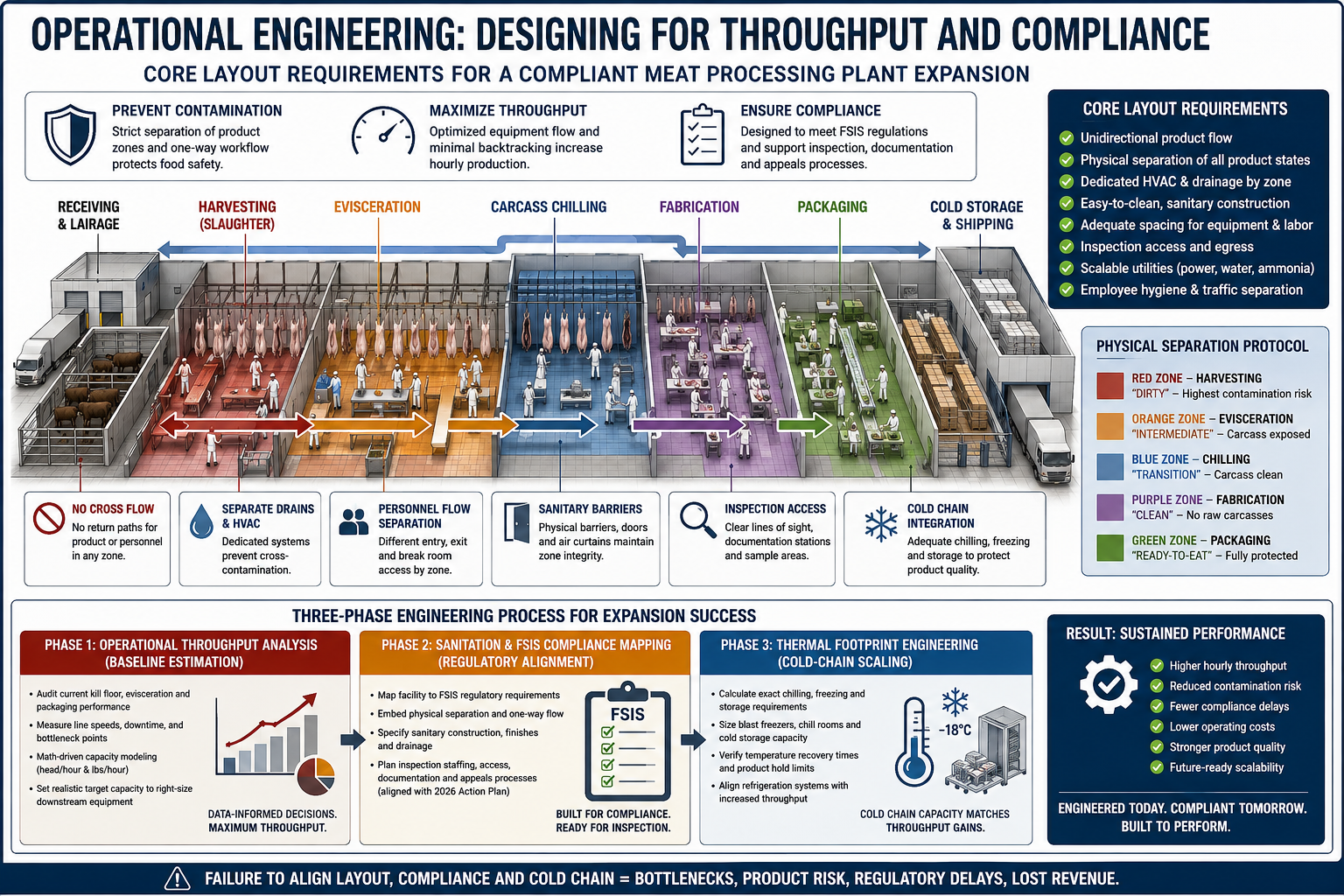
A compliant meat processing plant expansion requires an integrated architectural plan that synthesizes strict structural product separation with optimized mechanical workflow paths. The underlying spatial engineering must prevent cross-contamination while maximizing the hourly velocity of carcasses and packaged inventory through the facility footprint. Failure to align physical layout changes with food safety mechanics will result in immediate operational bottlenecks and severe regulatory delays.
To achieve continuous slaughterhouse capacity optimization without risking sudden compliance stops, projects must advance through three highly scannable, linear engineering phases:
- Operational Throughput Analysis (Phase 1: Baseline Estimation): Conduct a comprehensive math-driven audit of current bottleneck areas across the kill floor, evisceration line, and primary packaging zones. This baseline math establishes realistic target capacity parameters and prevents over-specifying downstream packaging machinery.
- Sanitation & FSIS Compliance Mapping (Phase 2: Regulatory Alignment): Embed strict physical separation protocols between harvesting, un-eviscerated carcasses, and ready-to-eat processing areas directly inside the revised meat processing facility design and layout. This step establishes proactive infrastructure risk mitigation against airborne pathogens and cross-contamination, ensuring the floor plan satisfies rigid FSIS regulatory compliance parameters while proactively factoring in streamlined inspection staffing and appeals processes formalized under the 2026 Action Plan.
- Thermal Footprint Engineering (Phase 3: Cold-Chain Scaling): Calculate exact blast-freezing, carcass chilling, and cold storage facility scaling costs required to sustain newly achieved slaughter speeds. Inadequate refrigeration scaling creates severe operational drag, rendering upstream throughput gains useless if product holds break temperature requirements.
Technology Integration: Unlocking Modern Efficiency and IP Value
How does automation affect the corporate valuation of a food processing plant?
Integrating automation directly into a food processing plant’s footprint shifts its corporate identity from a basic real estate asset to a high-value technology platform. Modernizing lines with automated processing equipment, sensor networks, and customized control software drives up industrial asset valuation by expanding processing margins and de-risking manual labor dependencies. These systemic optimizations insulate the processing facility from operational volatility while creating predictable, repeatable production yields.
Furthermore, integrating advanced manufacturing technologies into an expanded plant footprint creates deep, intangible value on the balance sheet. When an independent operator designs and implements proprietary operational workflows—such as unique tracking software integrations, custom automated sorting scripts, or specialized processing line configurations—they are building protected corporate intellectual property.
Firms that systematically execute meat plant automation and technology integration can undergo a comprehensive Intellectual Property (IP) portfolio valuation. Quantifying these custom processing automation mechanisms and proprietary software layers allows processors to leverage their intangible assets to secure non-dilutive capital, satisfy institutional underwriting requirements, and significantly maximize enterprise value during subsequent joint ventures or private equity exits.
Conclusion: Protecting Your Infrastructure Investment
Capitalizing on the USDA’s current policy shift demands a precise blending of industrial engineering, regulatory expertise, and strict financial valuation. Whether your facility is actively pursuing an MPPEP phase 4 allocation or utilizing commercial debt vectors, deploying capital into a meat processing plant expansion requires independent, third-party validation to eliminate structural risks and prevent costly overruns.
Do not leave your facility layout, funding compliance, or balance sheet valuation to chance. To ensure your engineering blueprints protect your capital, verify regulatory alignment, and maximize corporate asset value, speak with the advisory team at August Brown to schedule a formal technical feasibility evaluation.
Frequently Asked Questions
1. Who is eligible for the fourth phase of the Meat and Poultry Processing Expansion Program (MPPEP)?
To be eligible for the $60 million MPPEP Phase 4 allocation, applicant businesses must be independently, domestically owned entities with processing facilities physically located and operating within the United States or its territories. Eligible corporate entities include:
- For-profit organizations
- Nonprofit organizations
- Producer-owned cooperatives
- Tribes and tribal entities
Note: The programmatic funding is divided equally between Small/Very Small Processors and Intermediate Processors.
2. What are the operational goals of the USDA’s Small Processors Action Plan?
The primary operational goals of the Small Processors Action Plan are to modernize the agency’s support for small facilities, eliminate unnecessary regulatory red tape, and optimize agency customer service without weakening food safety standards. Administered under Secretary Brooke L. Rollins, the plan establishes specific action points:
- Appeals Optimization: Creating clearer, streamlined pathways for small plants to submit and track requests and appeals.
- Dedicated Support Channels: Establishing focused agency assistance to help small businesses resolve operational issues and secure timely responses.
- Technology Access Expansion: Expanding specialized technical and connectivity assistance for processing facilities operating in remote areas.
- Inspection Streamlining: Standardizing field consistency by addressing FSIS inspection staffing concerns and updating plain-language compliance guidance.
3. What types of projects can be funded under the $60 million MPPEP Phase 4 allocation?
The USDA Phase 4 MPPEP allocation funds capital projects focused on expanding meat and poultry processing capacity, encouraging market competition, and driving sustainable growth in the domestic beef supply chain. Funding is deployed across two competitive operational tracks:
- Processing Expansion Grants: Financial awards ranging from $50,000 to $2 million to support physical facility construction, brick-and-mortar modifications, equipment purchases, and production line build-outs. This track requires a mandatory 50 percent cost-share match.
- Simplified Equipment-Only Grants: Smaller financial awards ranging from $10,000 to $250,000 tailored strictly for advanced manufacturing technology acquisition and installation, minimizing the administrative burdens of broader infrastructure remodeling.
4. Which businesses are eligible to apply for Phase 4 MPPEP grants?
To qualify for Phase 4 MPPEP grant funding, the applicant’s processing facility must operating under a valid federal or state inspection program framework. Specifically, your facility must hold an active certification under one of the following compliance bodies:
- An active FSIS Grant of Inspection
- A state meat and poultry inspection program approved by the USDA
- An approved Cooperative Interstate Shipment (CIS) program framework
5. Does my facility have to process a specific type of livestock to qualify for MPPEP Phase 4?
Yes, a core eligibility requirement for the MPPEP Phase 4 program dictates that the applicant’s facility must primarily process cattle. This policy is designed to fortify the domestic American beef industry and expand regional harvesting capabilities. However, while cattle must remain the primary processing focus, awarded grant capital and machinery may be legally utilized to process other multi-species meat and poultry varieties alongside beef operations.