Quick Answer
USDA funding programs provide businesses with two primary financing options: USDA grants and USDA loans. While grants offer non-repayable grant funding for eligible projects, loans provide affordable USDA financing for businesses to support expansion, equipment purchases, infrastructure, and working capital. Choosing the right funding option depends on your business goals, eligibility, repayment capacity, and project scope. Understanding how these USDA funding programs differ can help businesses secure the right government funding, improve approval chances, and accelerate long-term growth.
Access to affordable capital is one of the biggest challenges businesses face when planning expansion. While traditional lenders remain a common funding source, many companies overlook the opportunities available through USDA funding programs.
Administered by the U.S. Department of Agriculture, these federal funding programs provide grants, low-interest loans, loan guarantees, and business assistance that encourage rural economic development, business expansion, and infrastructure investment. Today, USDA financing for businesses supports far more than agriculture, benefiting manufacturers, food processors, renewable energy companies, infrastructure developers, and other rural enterprises seeking sustainable growth.
The challenge isn’t finding funding—it’s choosing the right funding option.
Although USDA grants and loans are both valuable forms of government funding, they differ in eligibility, repayment obligations, and intended use. Before applying, businesses should assess whether their project is financially viable, aligns with program objectives, and meets funding requirements. Conducting government funding feasibility studies can help identify the most suitable funding option, strengthen applications, and improve the likelihood of securing USDA support.
This guide explains the differences between USDA grants and loans, outlines eligibility requirements, and helps you identify the USDA funding program best suited to your business.
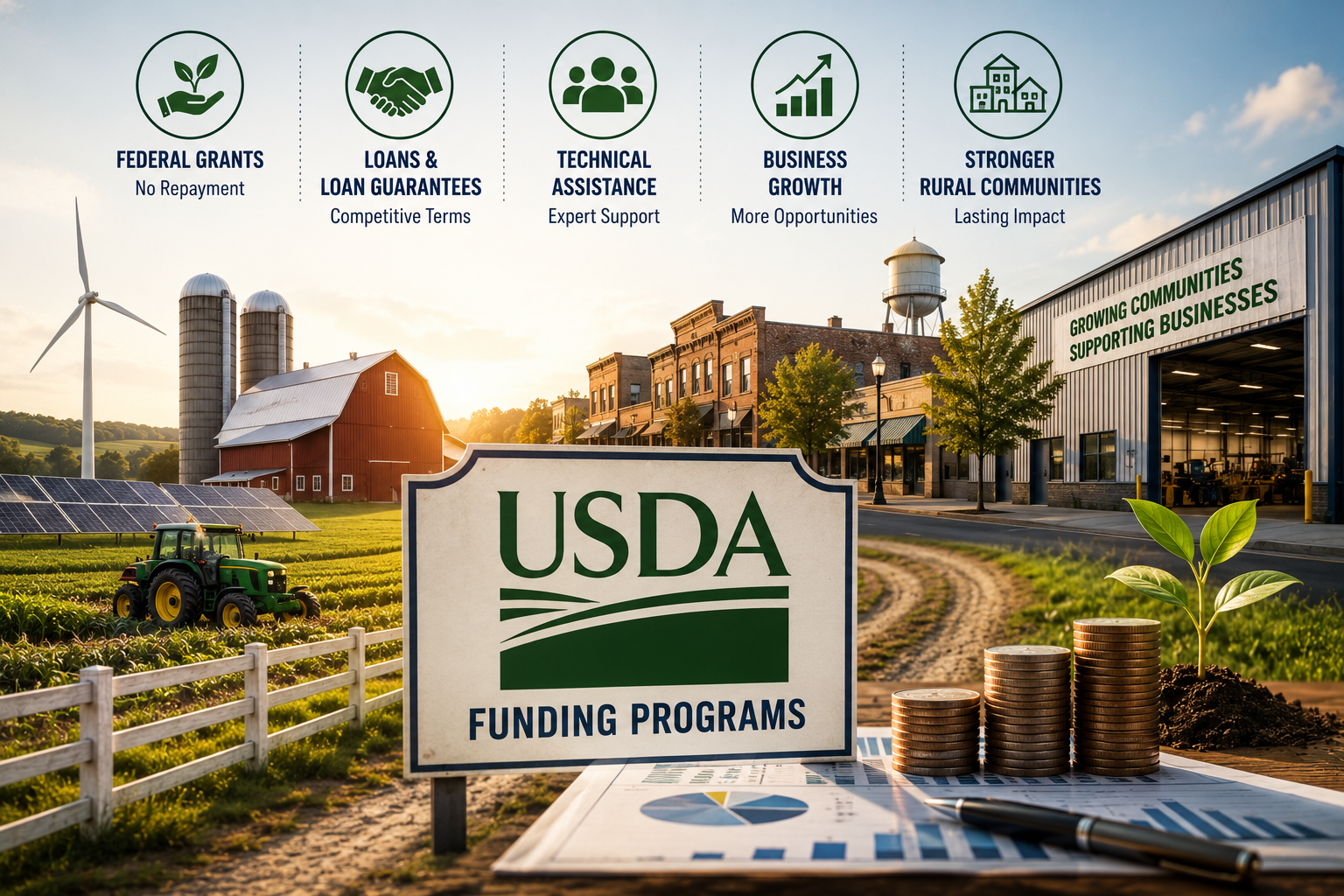
Understanding USDA Funding Programs
The U.S. Department of Agriculture offers a wide range of USDA funding programs that promote business expansion funding, job creation, and long-term economic growth. Many of these opportunities are administered through USDA Rural Development, which delivers USDA RD financing and business assistance for eligible rural communities.
Depending on the program, businesses may receive:
- Federal grants that do not require repayment.
- Direct or guaranteed loans with competitive terms.
- Technical assistance and USDA business assistance.
Current USDA funding opportunities 2026 continue to support:
- Manufacturing and business expansion
- Food processing and agricultural funding
- Renewable energy projects
- Rural infrastructure investment
- Community and economic development
Whether your goal is facility expansion, equipment upgrades, or infrastructure improvements, understanding these USDA funding programs is the first step toward choosing the right financing strategy.
USDA Grants vs USDA Loans: What’s the Difference?
Both grants and loans are key components of USDA funding programs, but they’re designed to meet different business needs.
USDA Grants
USDA grants provide grant funding that doesn’t require repayment, making them one of the most attractive forms of government funding available. Since funding is limited, these programs are highly competitive and typically support projects that deliver measurable economic or community benefits.
Many USDA Rural Development grants support:
- Renewable energy projects
- Rural infrastructure investment
- Manufacturing modernization
- Food processing
- Business innovation
USDA Loans
A USDA loan program offers affordable USDA financing for businesses that must be repaid over time. These loans typically feature competitive interest rates and flexible repayment terms, making them ideal for businesses pursuing long-term expansion.
Many USDA loans for small businesses are used for:
- Equipment purchases
- Business expansion
- Working capital
- Commercial real estate
- Construction and facility improvements
For businesses seeking larger capital investments, USDA loans often provide greater flexibility than grants.
USDA Grants vs USDA Loans: Comparison
| USDA Grants | USDA Loans |
|---|---|
| No repayment required | Must be repaid |
| Highly competitive | Generally easier to access |
| Limited funding availability | Higher funding amounts available |
| Best for innovation and public-benefit projects | Best for business expansion and capital investment |
| May require matching funds | Requires creditworthiness and repayment ability |
The right choice depends on your project goals, eligibility, and financial capacity. Businesses pursuing innovation or community-focused initiatives may benefit more from grants, while those planning expansion or infrastructure projects often find a USDA loan program to be the better fit.
Who Qualifies for USDA Funding?
Eligibility varies across USDA funding programs, but most USDA loan requirements and grant programs evaluate three key factors: your business, your project, and its potential economic impact. While many opportunities prioritize rural businesses, manufacturers, food processors, renewable energy companies, cooperatives, and infrastructure developers may also qualify.
Businesses are generally expected to demonstrate:
- Eligibility under the selected USDA funding program
- Financial stability and repayment capacity (for loans)
- A viable business or project plan
- Compliance with program-specific requirements
- A positive contribution to rural economic development
Understanding these requirements before applying can improve your chances of securing USDA financing for businesses and reduce delays during the application process.
USDA Rural Development Grants Explained
Among the most impactful USDA funding programs are USDA Rural Development grants, which support rural businesses, strengthen local economies, and encourage sustainable development.
Popular programs include:
1. Rural Energy for America Program (REAP)
Provides grant funding and loan guarantees for renewable energy systems and energy-efficiency improvements, helping businesses lower operating costs while improving sustainability.
2. Value-Added Producer Grants (VAPG)
Supports agricultural producers developing value-added products, expanding into new markets, and increasing profitability.
3. Rural Business Development Grants (RBDG)
Helps eligible businesses with equipment purchases, workforce development, technical assistance, and business expansion projects that stimulate local economies.
Explore more official USDA funding programs to identify opportunities that best match your business goals.
These initiatives continue to play a significant role in providing infrastructure funding, government funding, and long-term business growth opportunities.
How to Choose the Right USDA Funding Program
Choosing between a grant and a loan starts with understanding your business objectives.
Ask yourself:
- What is the funding intended for?
- How much capital is required?
- Can the business comfortably repay financing?
- Does the project align with USDA grant objectives?
- Will the investment support long-term growth?
If your project focuses on innovation, sustainability, or community impact, grant funding may be the best choice. If you’re planning facility expansion, equipment purchases, or large capital investments, USDA financing for businesses through a loan program may offer greater flexibility.
Evaluating these factors before applying can save time and improve your chances of approval.
Conclusion
USDA funding programs provide businesses with valuable opportunities to secure affordable capital, but the right funding option depends on your specific goals.
USDA grants offer non-repayable grant funding for projects that promote innovation and rural development, while USDA loans provide accessible financing for expansion, infrastructure improvements, and long-term investment. By understanding the differences between these funding options and reviewing your eligibility, you can make informed decisions that support sustainable business growth.
Need Expert Guidance Navigating USDA Funding?
Finding the right funding opportunity is only the first step. Preparing a competitive application, understanding eligibility requirements, and aligning your project with USDA priorities can significantly improve your chances of success.
At August Brown, we help businesses evaluate USDA financing for businesses, identify suitable USDA Rural Development grants, and develop tailored funding strategies that align with their growth objectives. Whether you’re exploring a USDA loan program, seeking grant funding, or looking for broader government funding opportunities, our team provides the expertise needed to simplify the process and maximize your funding potential.
If you’re ready to move forward, connect with our funding strategy experts to identify the USDA funding program that’s right for your business.
Frequently Asked Questions
1. Who qualifies for USDA loans?
Eligibility depends on the specific program, but most USDA loan requirements consider business location, financial stability, creditworthiness, repayment ability, and project feasibility. Many USDA loans for small businesses are available to rural manufacturers, food processors, cooperatives, and other eligible enterprises.
2. Which USDA funding option is easier to get?
Loans are generally easier to obtain because they are repaid over time and often involve approved lenders. Grants are more competitive due to limited funding and stricter evaluation criteria. The right option depends on your business goals and eligibility.
3. Can businesses receive both USDA grants and loans?
Yes. In certain situations, businesses can combine grant funding with a USDA loan program to finance different components of the same project, provided they meet each program’s eligibility and compliance requirements.
4. Are USDA grants taxable?
Some federal grants may be taxable depending on the funding program and how the funds are used. Businesses should consult a qualified tax professional to understand the applicable tax implications before accepting grant funding.