Farming is perhaps the only business where your entire year’s work can be upended by a single afternoon of bad weather. Whether it’s a flash flood, a lingering drought, or a sudden frost, the financial stakes are incredibly high.
Fortunately, the U.S. Department of Agriculture provides a robust safety net through various usda disaster relief programs. Understanding how to navigate these payments—and more importantly, how to turn that relief into long-term stability—is essential for any modern agricultural operation.
What is a USDA Disaster Payment?
At its core, a usda disaster payment is a form of financial assistance designed to help producers recover from “Acts of God” that result in significant crop or livestock losses. While many farmers are familiar with the Emergency Relief Program (ERP), the USDA has recently transitioned much of this support into the Supplemental Disaster Relief Program (SDRP).
These payments are not just handouts; they are strategic injections of capital intended to keep the American food supply chain secure.
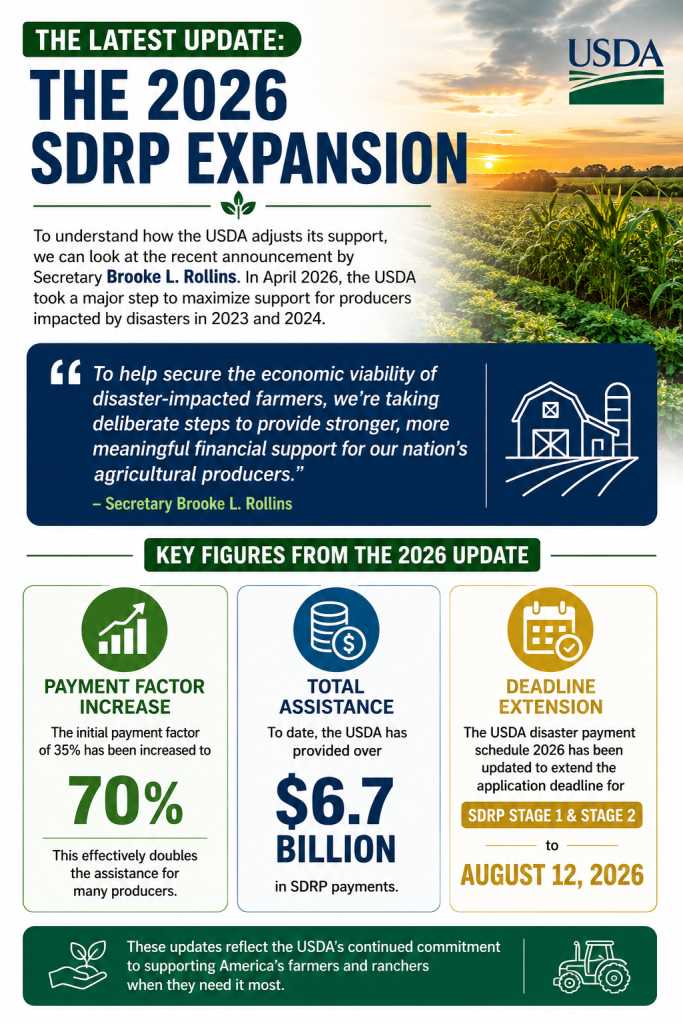
The Latest Update: The 2026 SDRP Expansion
To understand how the USDA adjusts its support, we can look at the recent announcement by Secretary Brooke L. Rollins. In April 2026, the USDA took a major step to maximize support for producers impacted by disasters in 2023 and 2024.
As Secretary Rollins stated:
“To help secure the economic viability of disaster-impacted farmers, we’re taking deliberate steps to provide stronger, more meaningful financial support for our nation’s agricultural producers.”
Key Figures from the 2026 Update:
- Payment Factor Increase: The initial payment factor of 35% has been increased to 70%. This effectively doubles the assistance for many producers.
- Total Assistance: To date, the USDA has provided over $6.7 billion in SDRP payments.
- Deadline Extension: The USDA disaster payment schedule 2026 has been updated to extend the application deadline for SDRP Stage 1 and Stage 2 to August 12, 2026.
USDA Disaster Payment Eligibility Requirements
Not every weather event triggers a payment. To maintain an evergreen operation, you should know the specific triggers for usda disaster assistance:
- Qualifying Events: Includes wildfires, hurricanes, floods, excessive heat, tornadoes, winter storms, and smoke exposure.
- Drought Specifics: For usda drought payments, the loss must occur in a county rated by the U.S. Drought Monitor as D2 (severe drought) for eight consecutive weeks, or D3 (extreme drought) or higher.
- Small vs. Large Operations: There is specific usda disaster payment for small farms support, ensuring that smaller acreage operations aren’t overshadowed by industrial giants.
Comparing Your Options: USDA Disaster Payment vs. Crop Insurance
One common question we hear is: “If I have insurance, do I still need disaster payments?“ The answer is almost always yes.
| Feature | Crop Insurance | USDA Disaster Payment (SDRP) |
| Source | Private policies (often subsidized) | Direct Federal Government funding |
| Purpose | Immediate indemnity for specific yield loss | Supplemental relief for “shallow” or quality losses |
| Timing | Paid shortly after loss adjustment | Dependent on Congressional funding/cycles |
| Coverage | Based on your specific policy level | Covers gaps left by insurance or Noninsured Crop Disaster Assistance Program (NAP) |
For those with livestock, the livestock indemnity program acts as a parallel safety net, specifically covering deaths in excess of normal mortality caused by adverse weather.
How to Apply: The USDA Disaster Payment Application
Applying for federal aid can feel like a mountain of paperwork, but it’s manageable if you are organized. The process usually begins at your local Farm Service Agency (FSA) office. A great place to start is the FSA disaster assistance discovery tool, which helps you identify which programs fit your specific loss.
To ensure your usda disaster payment application is processed quickly, have the following ready:
- AD-3117 Form: The primary application for disaster relief.
- Acreage Reports: Documentation of what was planted and where.
- Evidence of Loss: Photos, vet records (for livestock), or insurance adjuster reports.
- FSA Record-keeping: Ensure your farm records are updated in the Federal Register system through your local office.
Turning Relief into a Roadmap: The Specialist Perspective
As a USDA feasibility study specialist, I see disaster payments as more than just “emergency money.” They are a bridge.
Often, a disaster reveals a weakness in a farm’s infrastructure—perhaps a lack of efficient irrigation or the need for more resilient storage facilities. When you receive a usda erp payment or SDRP funds, it’s the perfect time to look at Rural Development loans.
Many of these long-term, low-interest loans require a professional feasibility study to prove the project’s viability. This is where agricultural management consulting becomes invaluable. We help you take the capital from a disaster payment and leverage it into a loan for a project that ensures you won’t be as vulnerable the next time the weather turns.
Closing Thoughts
While the August 12, 2026 deadline is the current priority, the mechanics of usda disaster relief remain a constant in the industry. By staying organized, keeping meticulous records for the FSA, and looking toward long-term development, you turn a season of loss into a foundation for growth.
Are you planning to use your disaster relief funds to expand or modernize? Get in touch with August Brown USDA feasibility study experts today to discuss how a professional feasibility study can help you secure the next stage of your farm’s journey.
Frequently Asked Questions (FAQs)
1. What is the current USDA disaster payment status?
As of May 2026, USDA disaster payments for the Supplemental Disaster Relief Program (SDRP) are actively being processed. Producers with approved applications for 2023 and 2024 losses are currently receiving their funds. You can check your individual status by contacting your local Farm Service Agency (FSA) office or logging into the Farmers.gov portal.
2. When will SDRP payments be made?
SDRP payments are being issued on a rolling basis. According to the USDA announcement on April 24, 2026, the second round of payments (the “top-up”) began immediately following the analysis that increased the payment factor. Most producers with approved Stage 1 and Stage 2 applications should see funds in their accounts throughout May and June 2026.
3. How is the USDA disaster payment amount calculated?
The payment amount is determined by your total calculated loss minus any prior insurance indemnities. The most critical figure for 2026 is the 70% payment factor.
- Previous Factor: 35%
- New 2026 Factor: 70%
- Formula: (Total Calculated Loss x 70%) – Previous Payments = Remaining Amount Due.
4. What is the USDA drought relief 2026 payment schedule?
The deadline to apply for drought-related relief under the SDRP is August 12, 2026. Payments are typically disbursed within weeks of application approval. For losses occurring in 2023 and 2024, the USDA has prioritized these payments to help farmers recover from “D2 Severe” or “D3 Extreme” drought conditions.
5. Is there an SDRP payment limit?
Yes, SDRP payments are subject to per-person or legal entity limitations as mandated by the American Relief Act of 2025. While limits vary based on the specific type of farming operation and Adjusted Gross Income (AGI), the standard cap for most supplemental disaster programs typically ranges between $125,000 and $250,000. Contact a consultant or your FSA representative for specific entity-based caps.
6. What is the SDRP Stage 1 second payment?
The “Stage 1 second payment” refers to the additional 35% being sent to producers who previously received an initial payment at the 35% factor. Because the USDA increased the factor to 70%, this second payment acts as a “catch-up” to ensure all eligible farmers receive the full 70% of their calculated disaster relief.
7. How do I get the SDRP top-up payment?
The SDRP top-up payment is issued automatically to producers who have already submitted an approved application. You do not need to file a new application to receive the increase from 35% to 70%. However, if your application requires modifications, you have until the August 12, 2026 extension deadline to make changes.
8. Is there an SDRP payment calculator?
While the USDA does not provide a public-facing automated calculator, farmers can use the FSA-639 or AD-3117 worksheets provided by their local office. To estimate your payment:
- Take your total crop/livestock loss value.
- Multiply by 0.70.
- Subtract any insurance or NAP payments received.
- The remainder is your estimated SDRP payout.